Look a little closer
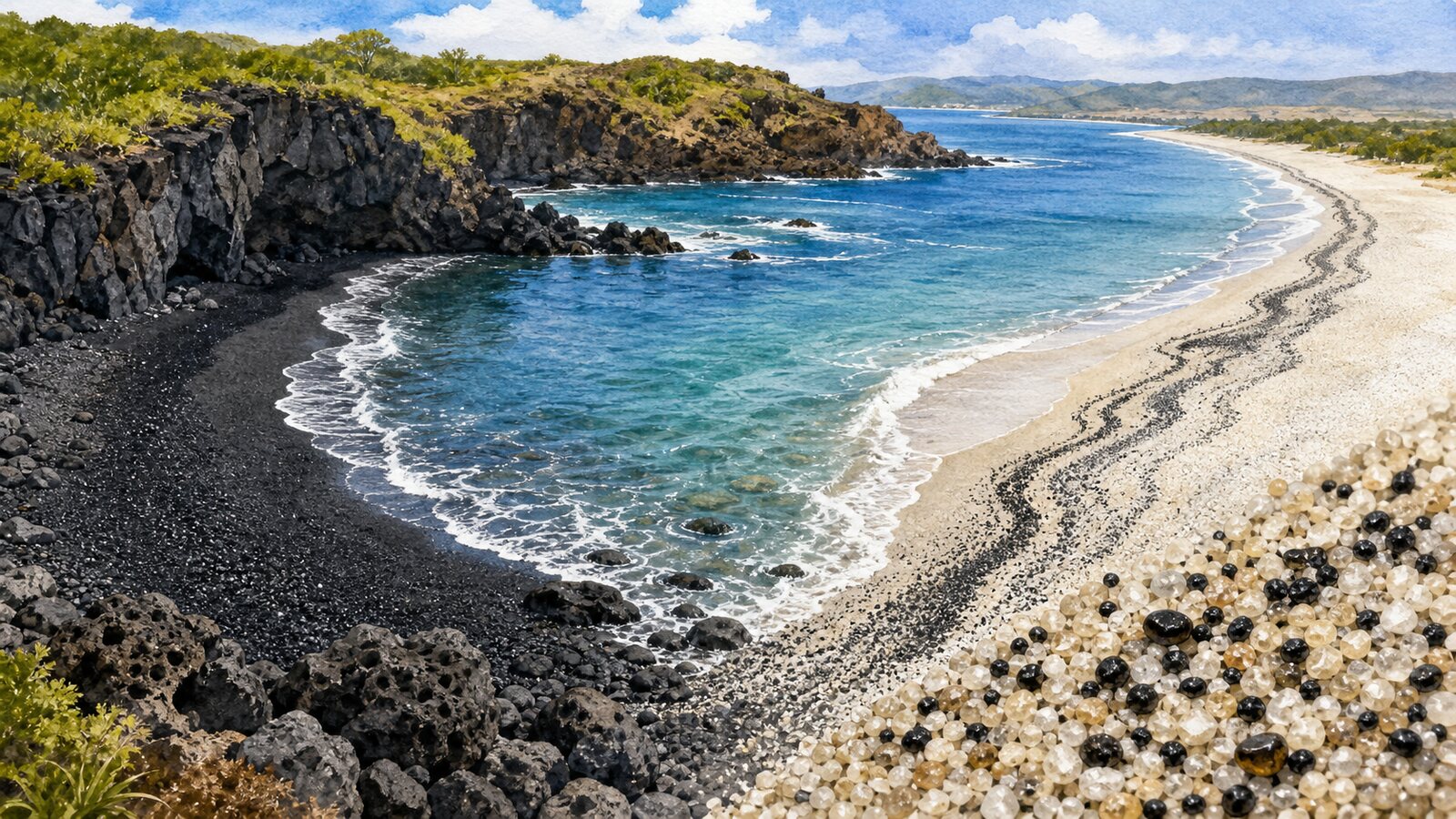
A beach becomes black when its sediment supply is dominated by dark volcanic rock, or when waves and wind concentrate dense dark minerals from a mixed deposit. Some black beaches are built largely from fragments of basaltic lava. Elsewhere, magnetite, ilmenite, and other heavy grains form dark ribbons within otherwise pale sand. The color records the sediment's source and sorting history, not a coating of soot or a beach that has burned.
Sand is a grain-size category, not the name of one substance. A pale beach may contain abundant quartz or calcium-carbonate shell and coral fragments. A dark one may contain basalt pieces and iron- and magnesium-rich minerals. The raw material available from nearby cliffs, river catchments, reefs, and eruptions determines what can reach the shore. Waves can reshape that material, but they cannot supply a mineral that is absent from the surrounding geology.
On an active volcanic island, a black beach can appear surprisingly quickly. When lava enters the sea, rapid cooling and interactions with water and steam fracture its edge into glassy and rocky debris. Surf repeatedly pounds loose fragments and the newly solidified lava, grinding them from blocks to pebbles and sand. Longshore currents can then move the debris into a cove or against a lava headland, where it accumulates as a new beach.
Direct lava entry is not the only volcanic route. Rain, streams, and surf also erode older basalt cliffs, ash layers, and volcanic slopes. Their sediment can contain rock fragments, separate mineral crystals, and volcanic glass with different shapes and degrees of rounding. Describing every black beach as powdered obsidian is therefore misleading. Obsidian may occur in some settings, but ordinary basaltic fragments and several dark minerals often make up much of the deposit.
A second route depends on density sorting. Weathering of continental or island rocks releases heavy minerals such as magnetite, ilmenite, and garnet alongside lighter quartz. Rivers and coastal erosion deliver the mixture to a beach. As a wave runs up and drains back, moving water tends to lift and carry a lighter grain more readily than a similarly sized denser grain. Repeated winnowing can leave a thin dark layer, streak, or fan enriched in heavy minerals.
The process is more complicated than a sieve that keeps every large grain. Whether a particle moves depends on size, density, shape, packing, and the speed and direction of the water. A storm can excavate deeper sediment and expose a heavy-mineral layer; gentler swash can gradually remove a veneer of lighter grains. Dark streaks may therefore appear on a mostly pale beach after energetic waves and fade as a different wave regime redistributes the sediment.
Not every black grain is magnetic. Magnetite responds strongly to a magnet, but ilmenite behaves differently, and dark basalt fragments or pyroxene grains do not all respond as one substance. A magnet collecting part of a sample can demonstrate that magnetic minerals are present. It cannot identify every remaining grain or prove that an entire beach formed by a single mechanism. Color alone is an incomplete mineral test.
A black beach is also temporary in shape and sometimes in existence. Waves deliver sediment while also carrying it offshore, and longshore currents shift it along the coast. Fresh lava may provide abundant loose debris at first, then contribute less after its surface stabilizes. Storms, river discharge, coastal structures, and changing currents alter that balance. This is why a geologically young beach can broaden, retreat, or migrate noticeably within years.
A handful of black sand consequently poses two separate questions: which rocks supplied the dark grains, and which transport process left them here? At one volcanic coast, overwhelming input of basaltic debris may provide both color and volume. At a mixed coast, wave sorting may raise the proportion of dense minerals enough to draw black bands. The visible beach is a changing sediment map produced jointly by source rock, breakage, transport, and selective removal—not simply by how dark the original coast looked.
EDITORIAL RESPONSIBILITY
FactosBrain Editorial Desk
The FactosBrain Editorial Desk researched and reviewed this article under our editorial policy. We assess error reports under our corrections policy.