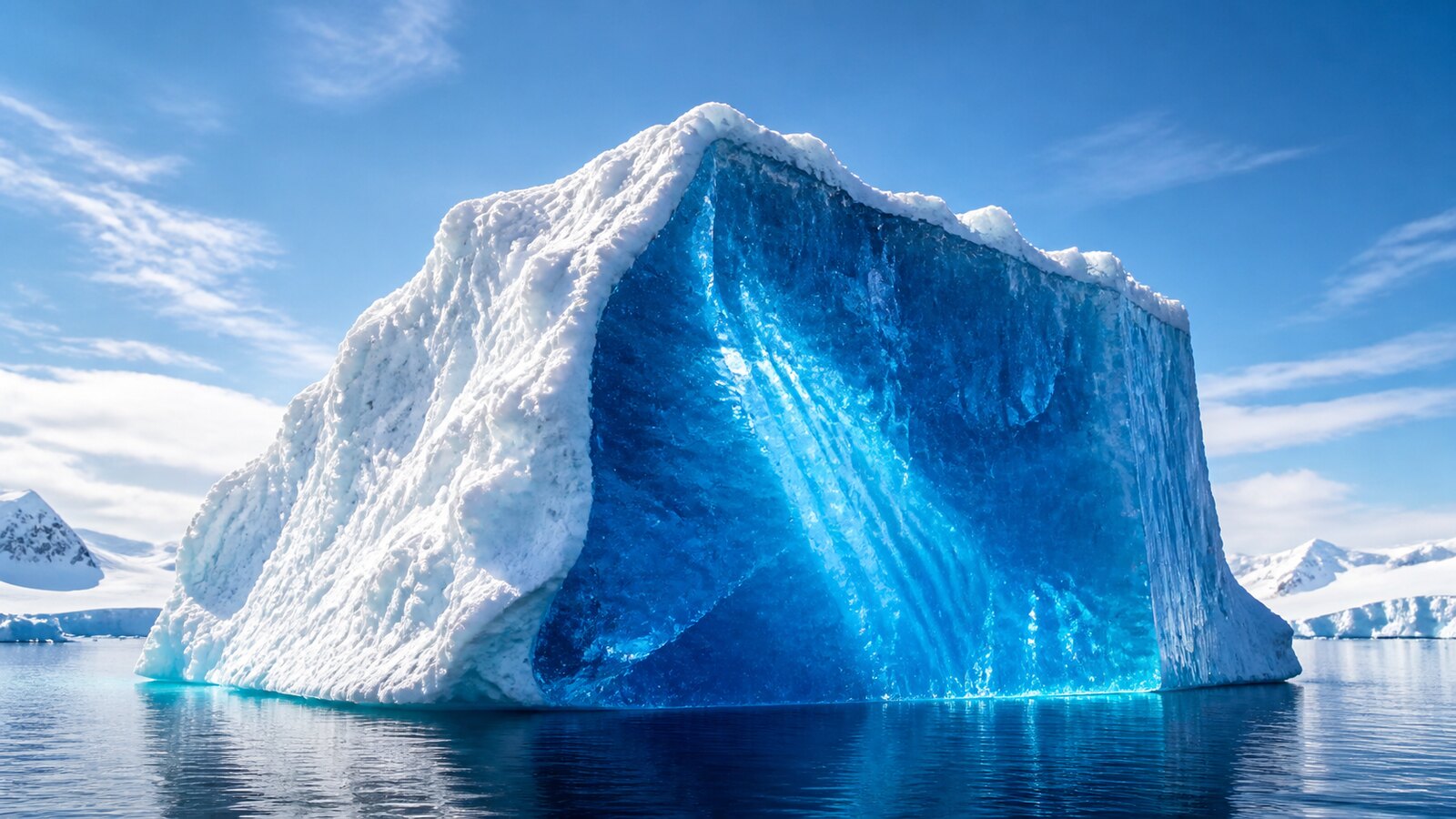
Some icebergs and freshly exposed glacier faces look blue because thick ice absorbs the red end of visible light more strongly than the blue end. When light travels far enough through dense ice, red and orange components are progressively removed. The relatively blue light that remains can be transmitted or scattered back to an observer. No blue pigment needs to be dissolved in the ice.
Sunlight contains many visible wavelengths and normally appears white. The molecular vibrations and electromagnetic properties of water make absorption slightly wavelength-dependent. Over a very short distance, the difference is hard to notice. After light has traveled tens of centimeters or meters within ice, small losses accumulate. The U.S. Geological Survey summarizes the result directly: the longer the path through ice, the bluer it appears.
Fresh snow and many iceberg surfaces are nevertheless white because they contain countless boundaries between ice and air. Light is repeatedly redirected at those interfaces and returns after a comparatively short journey. Most visible wavelengths escape together before selective absorption becomes obvious, so the mixture looks white. Whiteness does not mean ice absorbs no light; it often means scattering has shortened the distance light spends inside solid ice.
Glacier snow is buried and compressed year after year. Its grains merge, pass through the intermediate material called firn, and become denser glacial ice. Air spaces shrink and become isolated bubbles as compression continues. With fewer large air interfaces, light can penetrate farther instead of immediately scattering out near the surface. Long paths that remove more red light become possible, especially inside clear ice, deep crevasses, or newly fractured faces.
The ice does not have to be perfectly bubble-free to look blue. What matters is how quickly air interfaces return light and how long the effective path through ice becomes. Small bubbles can remain in dense glacial ice, while bubbles and crystal boundaries can help redirect surviving blue light toward the viewer. Both extreme slogans—bubbles alone make the blue, or absolutely no bubbles may remain—miss the combined roles of absorption and scattering.
Surface condition also controls the display. A rough, cracked face covered with frost or new snow scatters all colors readily and tends to look white. A smooth wet surface, a fresh break that exposes compact interior ice, or a deep crevasse can let light take longer routes and reveal stronger blue. The same iceberg may alternate between white and blue as weather, meltwater, fracture, and viewing angle change.
Thickness does not guarantee that every observed ray will be blue. The spectrum of the illumination, blue light arriving from sky and sea, the orientation of internal cracks, and the path from ice to observer all modify the color. Submerged ice adds the optical effects of surrounding water. Camera white balance and exposure can also exaggerate or suppress a hue that appeared different to a person at the scene.
Other iceberg colors may involve additional materials. Rock flour and sediment incorporated during glacier flow can make gray, brown, or black bands. Organic material and algae associated with marine ice or water-filled cracks can contribute green or brown tones. Meltwater that refreezes may form unusually clear, bubble-poor layers. Selective absorption by pure ice is the foundation of blue ice, but it is not a complete explanation for every colored stripe.
Blue should not be read as an exact age stamp. Long compression commonly helps create dense, low-bubble ice, so older glacial material often provides favorable conditions. Yet visible color also depends on thickness, snow cover, refreezing, cracks, surface roughness, and illumination. A thin old fragment can look white, while a newly exposed thick face can look intensely blue. Color indicates an optical path, not a calendar date.
A blue iceberg is a large natural demonstration of wavelength-dependent optics. Air-rich snow returns mixed light quickly and looks white. Dense, thick ice lets light travel farther, preferentially removes more red wavelengths, and allows remaining blue light to scatter or transmit out. Bubbles, crystal structure, surface texture, thickness, and lighting then tune the strength and pattern. What looks like blue dye is white sunlight filtered by a long journey through ice.
EDITORIAL RESPONSIBILITY
FactosBrain Editorial Desk
The FactosBrain Editorial Desk researched and reviewed this article under our editorial policy. We assess error reports under our corrections policy.