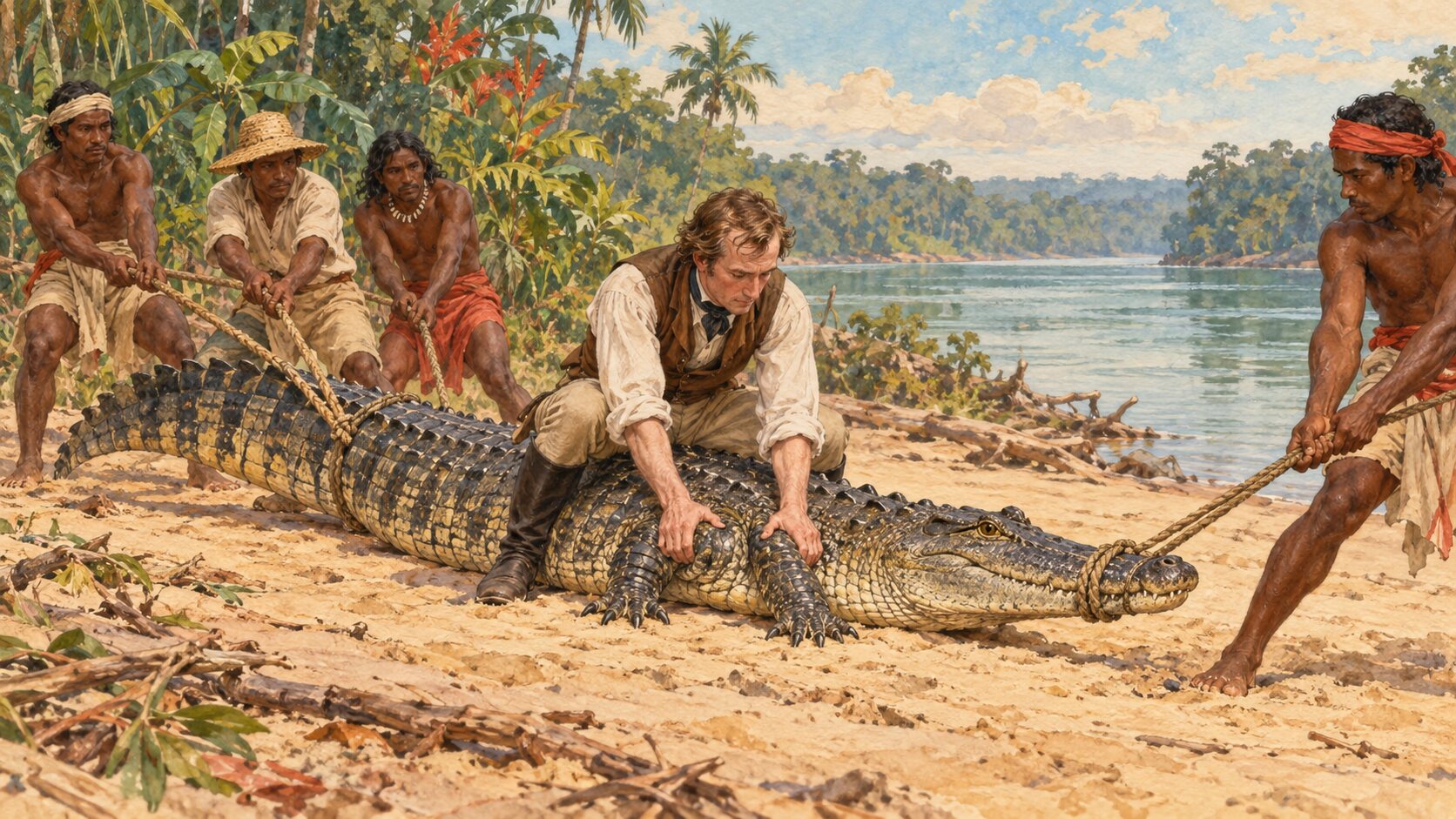
Charles Waterton appears in an old print perched on the back of a caiman, gripping its front legs while other men pull a rope. The animal is on a sandbank. The scene depicts the restraint of a crocodilian hauled from a river.
Waterton was a British naturalist and specimen collector. On the South American journey he began in 1820, he went to the Essequibo River in what is now Guyana to obtain a large caiman. He brought shark hooks, chain and a new rope. He wanted the animal's skin to remain intact for preservation.
In his book Wanderings in South America, the equipment repeatedly disappoints him. A caiman approaches the fish bait and takes it into its mouth. When the men pull, it drops the bait. The animal returns, but another pull produces the same result. Watching it take the bait is not the same as hooking it.
After unsuccessful attempts, the party visits another creek and meets three Indigenous men preparing to go fishing. They agree to help in exchange for supplies. One looks at the shark hook and laughs. He has watched his father catch caimans, he says, and will make a more suitable device.
He binds four pieces of tough, barbed wood to the rope, arranging them like an arrowhead with spreading ends. Bait is attached to this wooden hook, which is suspended above the water; the other end of the line is secured on shore. Pulling against a swallowed hook is intended to drive its barbs into the animal.
The maker then strikes an empty tortoise shell with an axe. Asked why, he explains that the sound will tell the caiman something is happening there. Waterton compares it to a dinner bell. They leave the trap until morning.
A caiman is then found attached to the rope. Waterton gives its length as ten and a half feet, about 3.2 metres. Securing it on land is a new problem. When he announces that he wants it brought out alive, the men object to the danger. They propose using guns or arrows first.
That would damage the specimen Waterton has come to collect. He refuses. His own account also records threatening to knock down Daddy Quashi when that companion advocates a gun, then chasing him on the sand when he objects again. The party's participation cannot be read as entirely willing cooperation.
Waterton takes the canoe's mast and wraps the sail around its end. He plans to thrust it into the animal's mouth if it rushes at him. The other men agree to pull once he proposes placing himself between them and the caiman. Their first attempt brings it to the surface, where it struggles and dives again; they slacken the line. On the next pull, it comes ashore.
As the caiman approaches, Waterton drops the mast and jumps onto its back. He describes holding its front legs bent behind it while it plunges and lashes the sand with its tail. Sitting near the head keeps him beyond the tail's reach, according to his account, but the animal's movements make his seat uncomfortable.
The men shout in triumph. Waterton asks them to pull both him and the caiman farther inland, fearing that a broken rope could take him back into the river with it. When the animal becomes exhausted, he binds its jaws and forelegs. Others press down its head and shoulders while he restrains its tail.
The caiman is carried by canoe to camp, where Waterton kills and dissects it. He records spending a day and a half on the dissection. The preserved animal becomes one of his best-known exhibits: the demand for an uninjured skin has led him onto a living caiman's back.
The ride also becomes a coloured engraving in 1827. Beneath it appears Waterton's own statement from the book: this was the first and last time he was ever on a caiman's back.
EDITORIAL RESPONSIBILITY
FactosBrain Editorial Desk
The FactosBrain Editorial Desk researched and reviewed this article under our editorial policy. We assess error reports under our corrections policy.