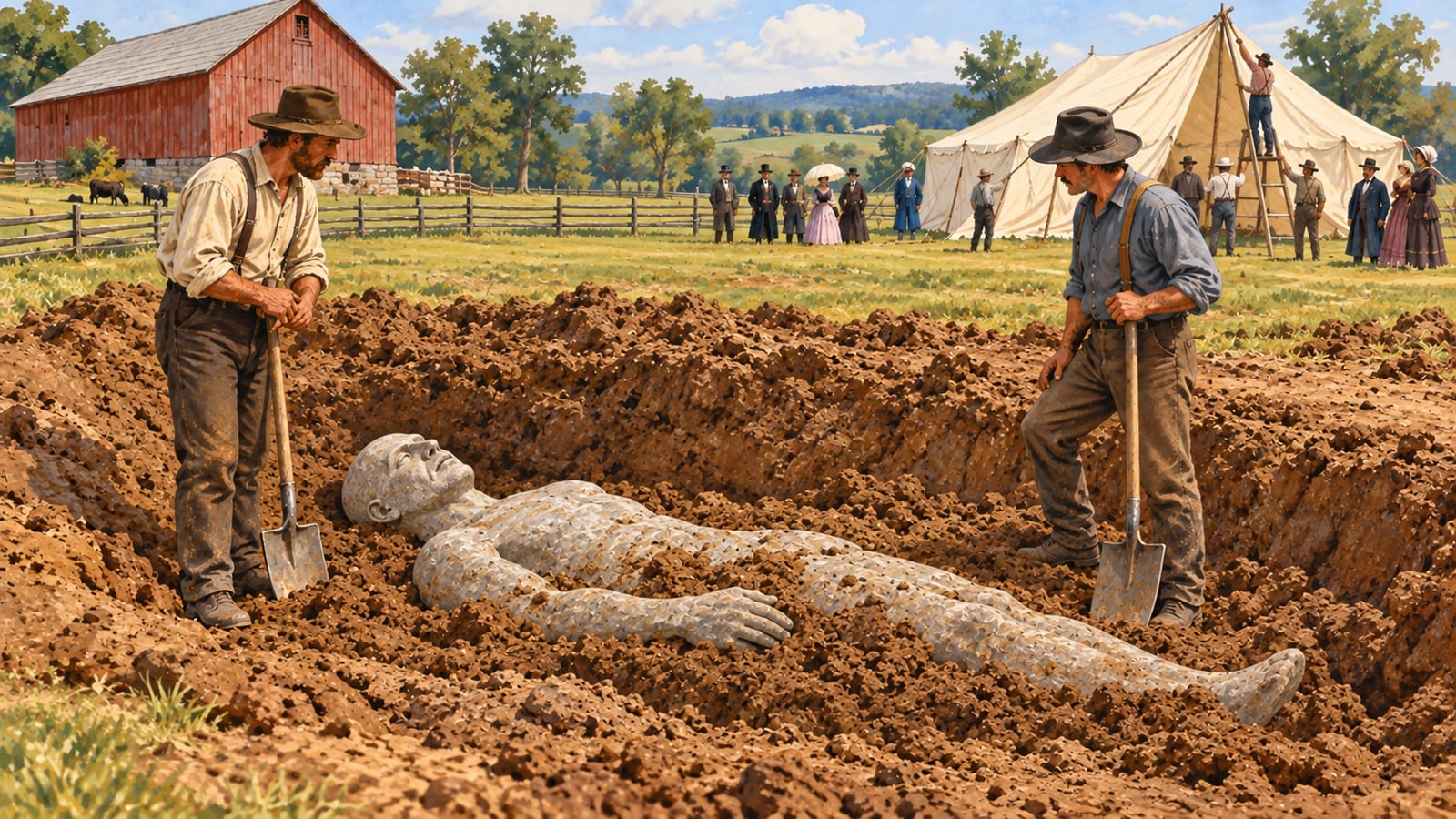
In October 1869, men digging a well on a New York farm uncovered an enormous human figure. About ten feet long, it lay in the earth as though a giant had turned to stone. Visitors arrived to see it, and farmer William Newell put up a tent and began charging admission.
Inside, spectators could study the figure and debate its nature. Was it a petrified person or an ancient statue? The subdued light and tiny marks resembling pores encouraged a sense of mystery. Andrew Dickson White, who visited the site, later remembered an atmosphere so solemn that people spoke almost in whispers.
The figure was the creation of George Hull, a tobacco businessman. Accounts of the scheme trace its inspiration to an argument about biblical giants. Rather than persuade an opponent with words, Hull arranged to produce something that could be presented as evidence. He also intended to profit from people coming to inspect it.
The work began with a large block of gypsum acquired in Iowa and taken to Chicago for carving. A newly finished sculpture looked inconveniently new, so its surface needed further attention. Rubbing gave it a worn appearance. A tool fitted with needles produced marks resembling pores, and treatment of its color helped suggest age.
Next came the ground from which it would emerge. Hull had the figure buried on Newell's farm, where it remained for nearly a year. When workers were hired to dig at that spot in the autumn of 1869, the discovery was built into the assignment. The men uncovering it could be surprised even though those arranging the excavation knew what lay below.
Not everyone accepted the spectacle. White questioned why anyone would choose that inconvenient place for a well when water was already available nearby. Yale paleontologist Othniel Marsh examined the material and surface. Gypsum exposed to wet earth over a long period should not have remained in that condition, and marks of recent tools offered a less ancient explanation.
Doubt did not immediately empty the exhibition. Controversy also attracted visitors. Businessmen acquired an interest in the giant and took it on tour. When P. T. Barnum failed to obtain the original attraction, he arranged a competing copy and exhibited that instead.
The first fake now had a rival claiming to be the genuine Cardiff Giant. Its owners attempted legal action against Barnum. Having promoted their sculpture as a petrified body, they were in the peculiar position of defending its standing as the original object against another manufactured giant.
Meanwhile, witnesses connected a large box and wagon with the farm, and accounts emerged from people involved in obtaining and carving the stone. The object's history led back to the previous year, not antiquity. Hull eventually acknowledged the deception. No mysterious natural process was needed to explain a sculpture that had been transported and buried.
Exposure did not destroy its value as an attraction. The fraud itself became worth seeing. Much later, the Farmers' Museum marked the 150th anniversary of the discovery in 2019 with cake and a party hat. The figure had failed as an ancient human being, but it had enjoyed a remarkably long life as a hoax.
EDITORIAL RESPONSIBILITY
FactosBrain Editorial Desk
The FactosBrain Editorial Desk researched and reviewed this article under our editorial policy. We assess error reports under our corrections policy.