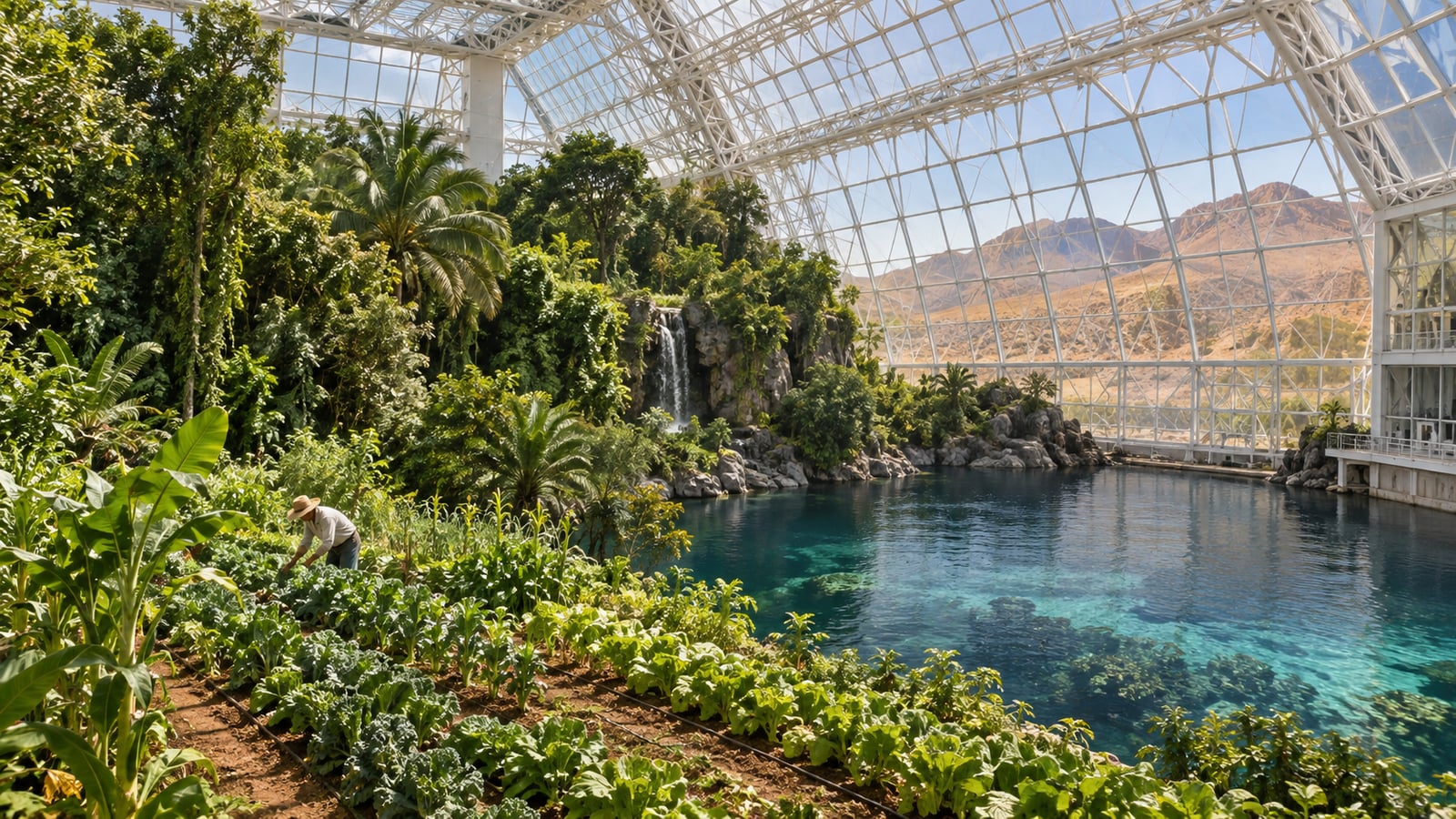
The glass enclosure contained a forest, an ocean, a desert and a farm. In September 1991, eight people moved in, intending to live there for two years. But as their stay continued, the proportion of oxygen in the air kept falling. A world designed to support life was losing something its residents needed with every breath.
The Arizona facility was called Biosphere 2. Biosphere 1 was Earth itself. The project sought to reproduce the circulation of water, air and nutrients on a scale that could be studied inside a building. It could also help develop habitats for people living beyond Earth. This was a considerably bigger undertaking than keeping plants alive in a greenhouse.
Beneath the ecosystems lay extensive machinery. Equipment circulated air and water and regulated temperature and humidity; power came from outside. The enclosure was not an independent planet. Even with that support, however, its residents had to grow food, recycle resources and deal with the changes that living things produced inside their shared surroundings.
Food became an immediate concern. Harvests fell short of expectations, and the crew also ate stored provisions. From outside, the building represented a possible future in space. Inside, it mattered what the farm could supply that day. Crew member Mark Nelson later recalled persistent hunger. Maintaining this experiment meant being a farmer as well as an observer.
Meanwhile, oxygen fell from roughly 21 percent of the atmosphere to about 14 percent. Headaches and fatigue accompanied the decline, and managers eventually supplied additional oxygen. Nelson remembered a rapid improvement after entering an oxygen-enriched chamber, including the unfamiliar sound of people running. Adding oxygen changed the conditions of the experiment, but the people conducting it still had to breathe.
The investigation led researchers into the soil. It contained abundant organic matter, which microbes broke down while consuming oxygen and releasing carbon dioxide. The people and animals were not the only organisms changing the atmosphere. An enormous amount of activity was occurring out of sight, beneath the plants they were tending.
That still left a puzzle: the measured rise in carbon dioxide did not account for all the oxygen loss. The building helped explain the difference. Carbon dioxide reacted with exposed concrete, forming calcium carbonate and leaving the air. The soil and the walls had to be considered together. The structure containing the ecosystem was participating in it, too.
Supplying oxygen drew criticism, but it did not end the facility's usefulness. After the habitation experiments, researchers continued studying how plants, air and water interacted inside it. Today the University of Arizona operates Biosphere 2 as a research facility. The enclosure that had been home to eight people became a place to examine parts of the much larger world outside its glass.
EDITORIAL RESPONSIBILITY
FactosBrain Editorial Desk
The FactosBrain Editorial Desk researched and reviewed this article under our editorial policy. We assess error reports under our corrections policy.