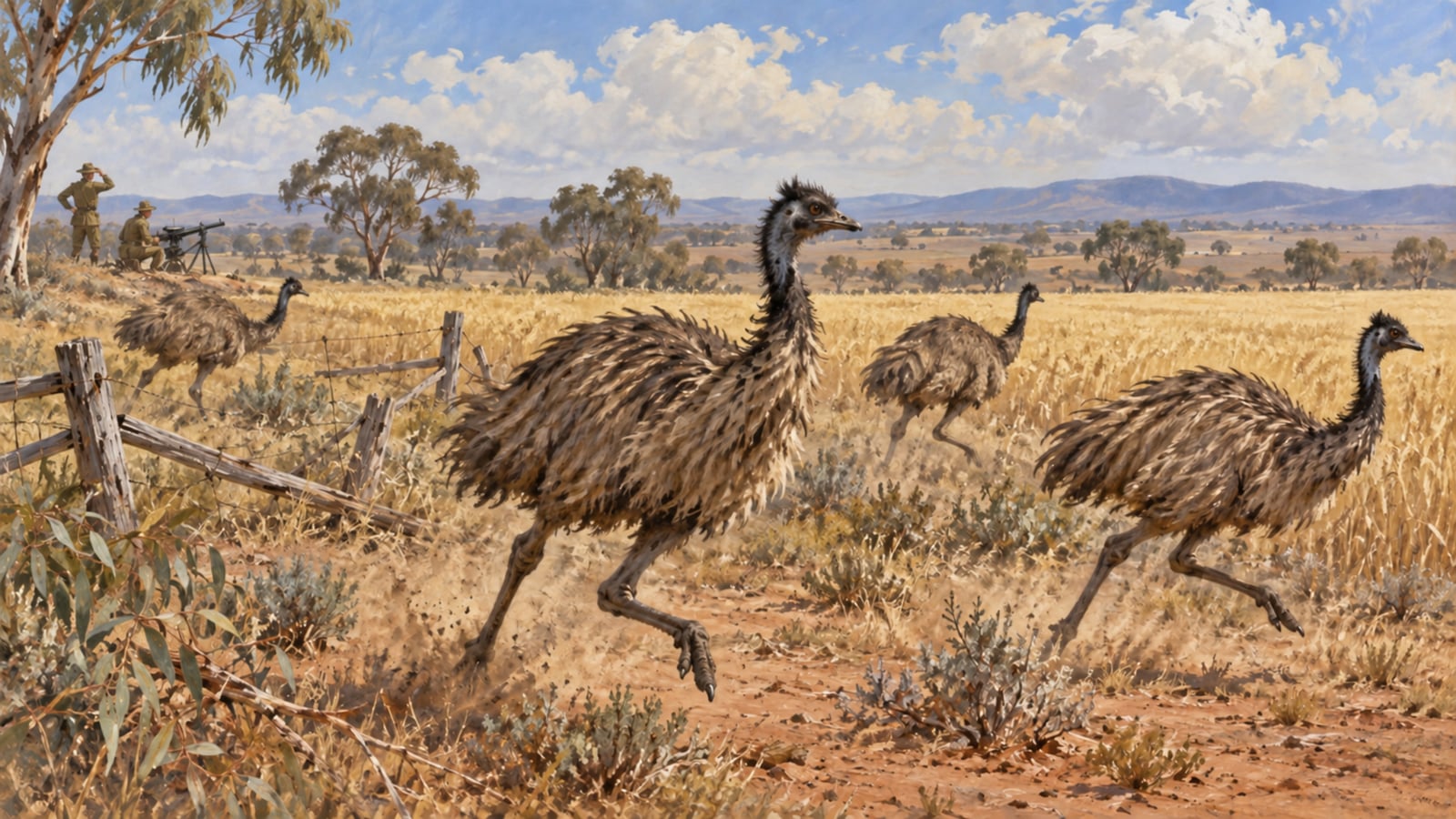
About a thousand emus were approaching water where soldiers lay in wait. It was November 1932 in Western Australia. Instead of pursuing birds scattered across open country, the men would catch a flock gathering to drink. Then the gun jammed. Roughly a dozen birds fell; the rest escaped.
The episode became part of the “Emu War.” The soldiers and machine guns were real, but this was military assistance with a wildlife cull, rather than a formally declared war against birds. To the farmers who requested help, the problem was considerably less entertaining than the name suggests.
Some had returned from the First World War to begin farming. Depression-era wheat prices were already making life difficult when migrating emus entered the fields. The birds did more than eat grain: they trampled crops and damaged fences. Rabbits followed through the gaps. What farmers were trying to save was a harvest, not merely a few mouthfuls of wheat.
Defence Minister George Pearce authorized help. A small party under Major Meredith brought two Lewis guns and ammunition. These were weapons capable of firing repeatedly into a massed target. The missing element was a target willing to remain massed.
Threatened emus broke into smaller groups and scattered. What had looked like one large flock became birds moving in different directions across fields and scrub. Attempts to drive them together did not produce the orderly target the gunners needed. Waiting beside water offered another chance to catch a group in one place. On that occasion, it was the equipment that failed.
The soldiers were withdrawn early in November. Farmers objected: recalling the men did not remove the birds from their crops. They asked for renewed assistance, and the military operation resumed later that month. The familiar story of an immediate defeat and retreat leaves out this return.
The second effort produced reports of more birds killed, though the accuracy of totals—including wounded birds that escaped—remained questionable. The party withdrew again in December. In Parliament, questions concerned not only the results but who would pay for the ammunition. A crop-protection problem had become something the defence authorities needed to explain.
Fencing and bounties for killing emus remained part of the response afterward. The joke that the birds had defeated the army did not mean farmers surrendered their wheat fields. Once the soldiers had gone, the crops still needed protection, and the birds still had to be kept out.
EDITORIAL RESPONSIBILITY
FactosBrain Editorial Desk
The FactosBrain Editorial Desk researched and reviewed this article under our editorial policy. We assess error reports under our corrections policy.