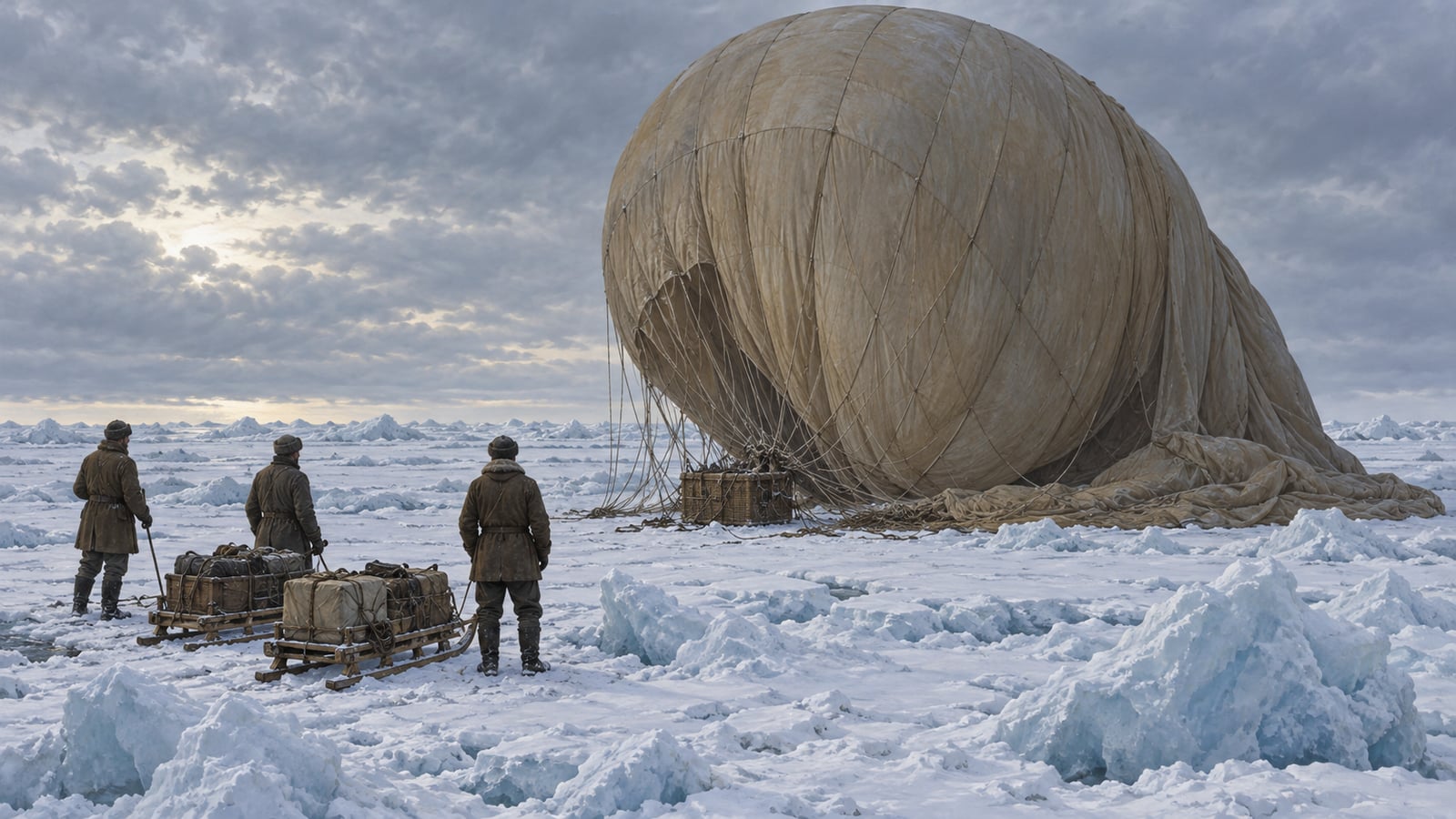
In the photograph, the balloon is no longer flying. It rests on the ice, with members of the expedition beside it. This was a picture taken by the people who had set out to reach the North Pole. The public would not see it for another 33 years. None of the three explorers came back to explain what had happened.
They had left Svalbard in July 1897. Swedish engineer Salomon August Andrée was accompanied by Nils Strindberg and Knut Frænkel in a balloon named Örnen, the Eagle. It used hydrogen, not heated air. Their idea was to pass over the pole while surveying the region below. Where other travelers struggled across the surface, they proposed to take their observations from the sky.
Getting airborne was only part of the problem. Andrée hoped that long ropes dragging below the balloon would help him control its movement. Those ropes were lost soon after departure. The expedition was left without the arrangement on which he had placed so much confidence. Fog and cloud added to their difficulties, and on July 14 the flight ended on the ice.
The surface they had intended to fly over now became their route home. They loaded supplies onto sledges and tried to reach a food depot in Franz Josef Land. They never got there. A flight of roughly three days was followed by months of slow travel. Equipment taken on a journey through the air had become a load they had to pull for themselves.
Meanwhile, news stopped reaching the outside world. Carrier pigeons had brought early messages from the expedition. Later came reports of possible sightings, but no confirmed return. Without the men or their records, even the basic sequence remained missing: how long they had flown, where they had landed, and what they had done afterward.
In 1930, another expedition found their remains on Kvitøya, a small island about 250 miles east of the departure point. Among the surviving possessions were notebooks, diaries and photographic negatives. Parts of the writing could still be read. The negatives could still be developed. Images from a journey that had vanished decades earlier became visible at last.
Together, these objects established that landing had not been the end. The three men had continued across the ice, making photographs and keeping records along the way. Their final days were less clearly documented. The precise causes of their deaths remain uncertain; the surviving evidence brings the journey much closer without supplying a complete account of its ending.
Another remnant survives far from the discovery site. The Library of Congress holds fabric samples retained while the balloon was being planned. They were never wreckage: they belong to the period when the flight was still a project under construction. Those small pieces of cloth and the photographs recovered from the ice preserve opposite ends of a journey whose travelers never came home to tell it.
EDITORIAL RESPONSIBILITY
FactosBrain Editorial Desk
The FactosBrain Editorial Desk researched and reviewed this article under our editorial policy. We assess error reports under our corrections policy.