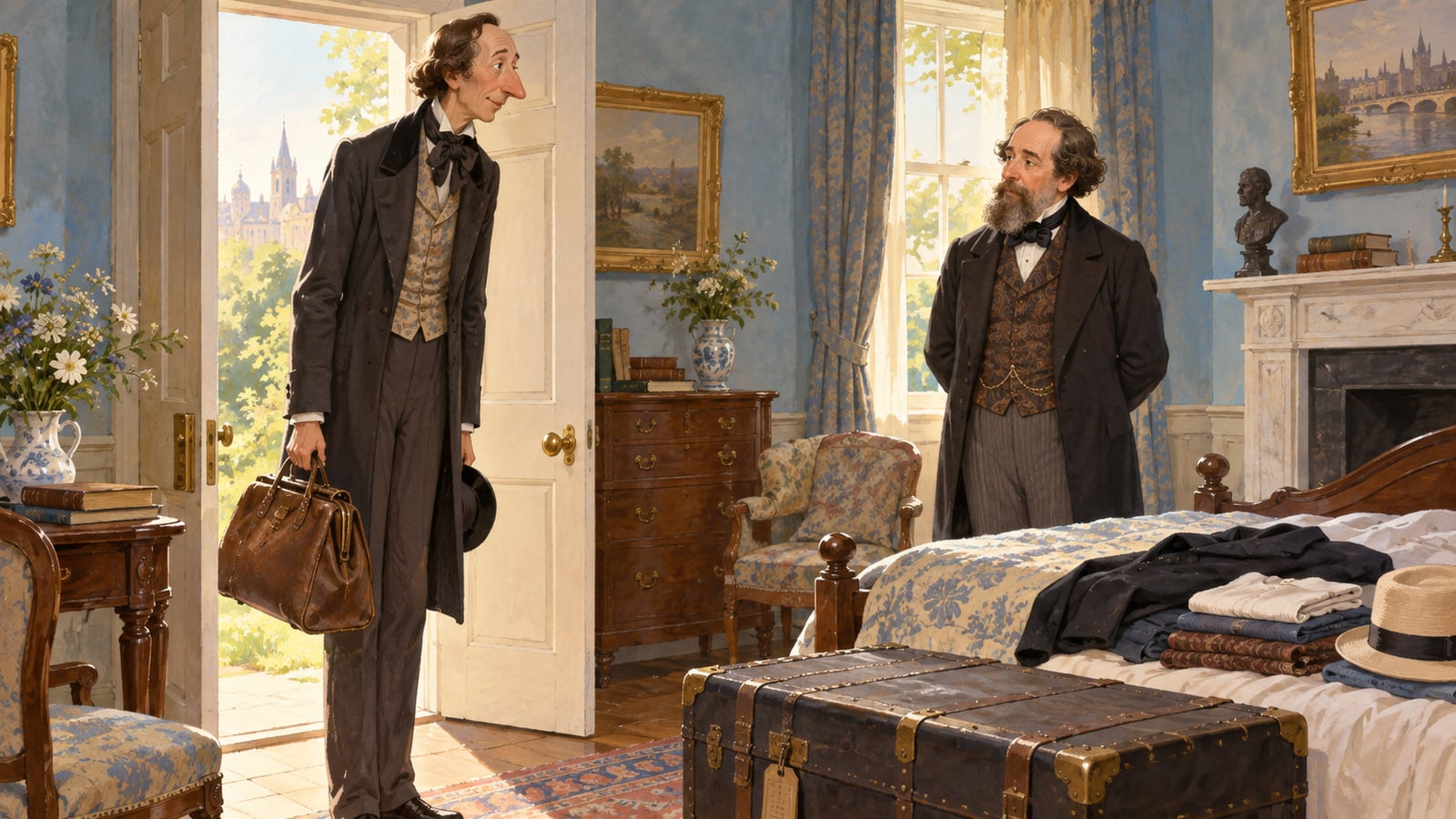
For Hans Christian Andersen, staying with a writer he admired was a pleasure. For Charles Dickens's household, the summer visit of 1857 became something else. According to family recollections, Dickens later left a note saying that Andersen had occupied the room for five weeks, which had felt vastly longer to the family.
Their friendship had begun warmly. Ten years earlier, Dickens had presented Andersen with a copy of The Chimes, inscribed as a friend and admirer. Andersen's regard for Dickens was deep. But enjoying another writer's books was a different undertaking from sharing a household for weeks.
Even a morning routine could create confusion. In the family's account, Andersen announced that Danish custom called for a son of the household to shave a male guest. Dickens arranged visits to a local barber instead. What the visitor presented as ordinary hospitality required a different solution from his host.
Communication itself looked different from either side. Andersen wrote that Dickens had praised the rapid improvement in his English. Dickens's private correspondence was less generous: after the visit, he mocked the guest's ability to make himself understood in several languages. Encouragement delivered face to face and complaints sent to somebody else leave sharply different impressions of the same stay.
A July letter also recounts Andersen returning from a London cab ride with an improbable collection of possessions in his boots. Dickens said that the driver's shortcut had made the visitor fear robbery, prompting him to hide his watch, money, penknife, writing equipment, newspapers, and other objects. In the host's telling, even getting home became an extraordinary undertaking.
Yet the prolonged stay cannot simply be blamed on a guest refusing to take a hint. In his diary for June 21, Andersen recorded Dickens warmly urging him to remain for a charitable performance. He understood that Dickens's wife and daughters were glad to have him there too. The invitation moved him. A guest taking an invitation seriously and a household tiring of his presence could exist at the same time.
Dickens was also unusually busy. Performances and readings to help a deceased friend's family left him little sustained rest, as he explained in the same July correspondence. Entertaining a long-term guest came on top of that work.
The friendship did not recover its earlier warmth. The Dickens Museum describes the final letter Andersen received after returning home as chilly. His diary, however, still preserves the request to stay longer. Two writers skilled at portraying people had not necessarily understood the same thing by the courtesies exchanged under one roof.
EDITORIAL RESPONSIBILITY
FactosBrain Editorial Desk
The FactosBrain Editorial Desk researched and reviewed this article under our editorial policy. We assess error reports under our corrections policy.