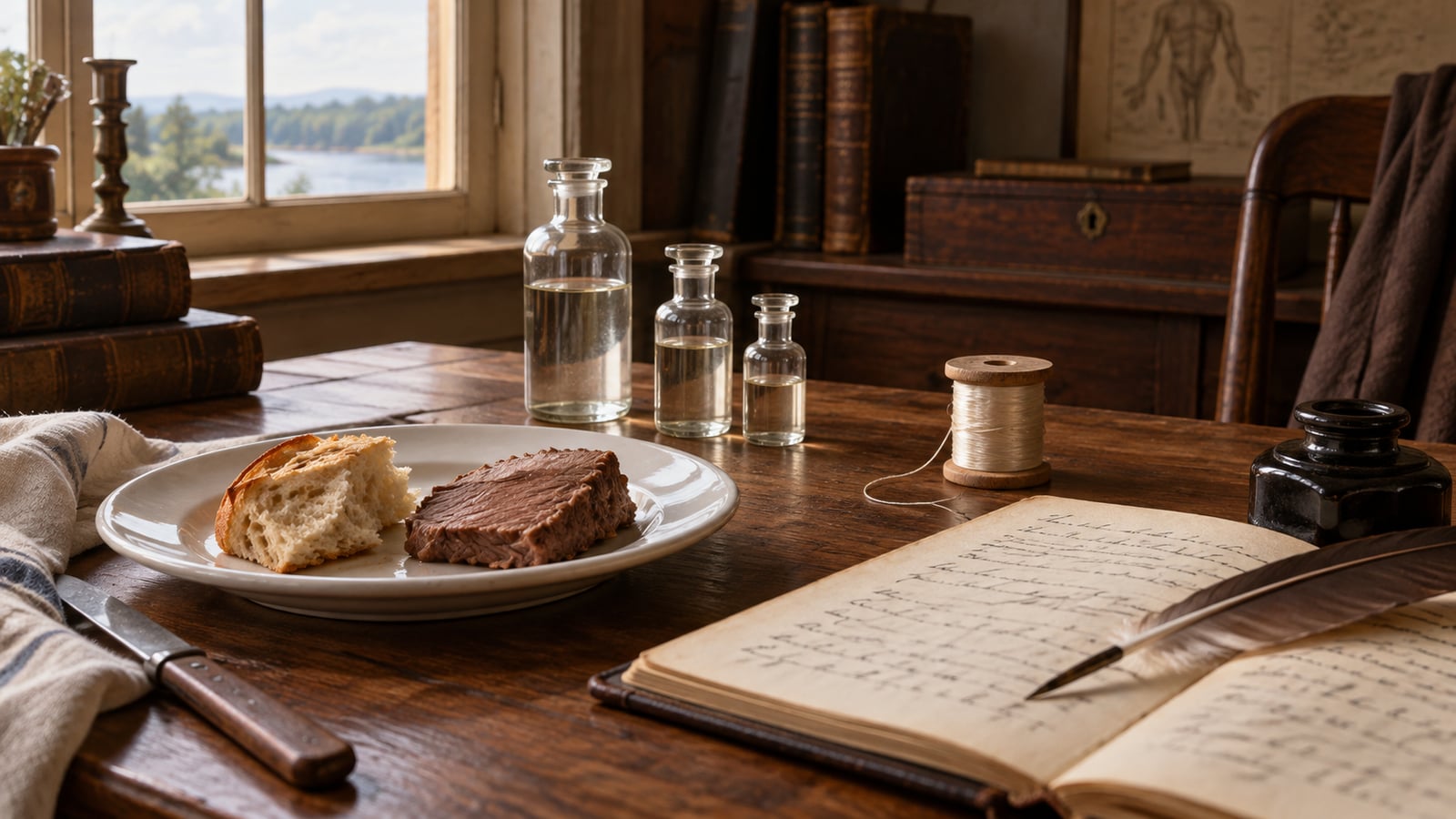
William Beaumont tied pieces of food to a string: meat, bread and sliced cabbage. He lowered them into a patient's stomach through an opening in the man's side. An hour later, he pulled them out to inspect them. This was an experiment recorded in 1825. The man supplying the living stomach was Alexis St. Martin.
Three years earlier, St. Martin had been accidentally shot on Mackinac Island. Beaumont, an army surgeon, treated him, and he survived. But the wound did not close normally. A passage remained between his stomach and the outside of his body. Even after his recovery, it allowed the doctor to examine a functioning stomach at a time long before miniature cameras could do that job.
In the August 1 experiment described in Beaumont's book, bread and cabbage changed sooner than the meat. He repeatedly withdrew the samples and returned them. Yet disappearing from a string was not necessarily the same as complete digestion. Beaumont later noted that softened bread might simply have fallen off, while thinly sliced cabbage exposed more surface to gastric fluid than solid meat. Direct access did not remove the need to interpret what he saw.
The experiment also brought complaints of pain and discomfort. Beaumont recorded removing the remaining food and not putting it back. Alongside his observations of the samples, the book preserves the patient's response. This unusual access to digestion came through the body of someone who had to endure the procedure.
Beaumont also removed gastric fluid and tested it outside the body. He placed meat in a warmed vial of the fluid and a similar piece inside St. Martin's stomach. Both changed, but in his observations the piece inside the stomach broke down faster. The comparison let him investigate the action of the stomach's fluid, rather than treating the organ simply as a pouch that moved food around.
The relationship extended beyond treatment. St. Martin worked in Beaumont's household in exchange for accommodation, food and pay. Employment contracts also permitted experiments. His physician was therefore his employer, too. The existence of signed agreements cannot by itself establish how freely he could refuse. Work, support and research were bound together in the same arrangement.
St. Martin did not remain constantly at the doctor's side. He returned to Canada, married, raised children and worked. Beaumont complained in his book that the departure had occurred without his permission, and described his efforts to bring St. Martin back. What interrupted the doctor's research was also part of another man's family life. Experiments resumed after his return.
Beaumont published his findings in 1833. The surviving pages carefully track food, time and changes in gastric fluid. They also contain a person who complained of pain and sometimes left. The doctor wanted to observe a stomach at work. Its owner had a life outside the experiment.
EDITORIAL RESPONSIBILITY
FactosBrain Editorial Desk
The FactosBrain Editorial Desk researched and reviewed this article under our editorial policy. We assess error reports under our corrections policy.