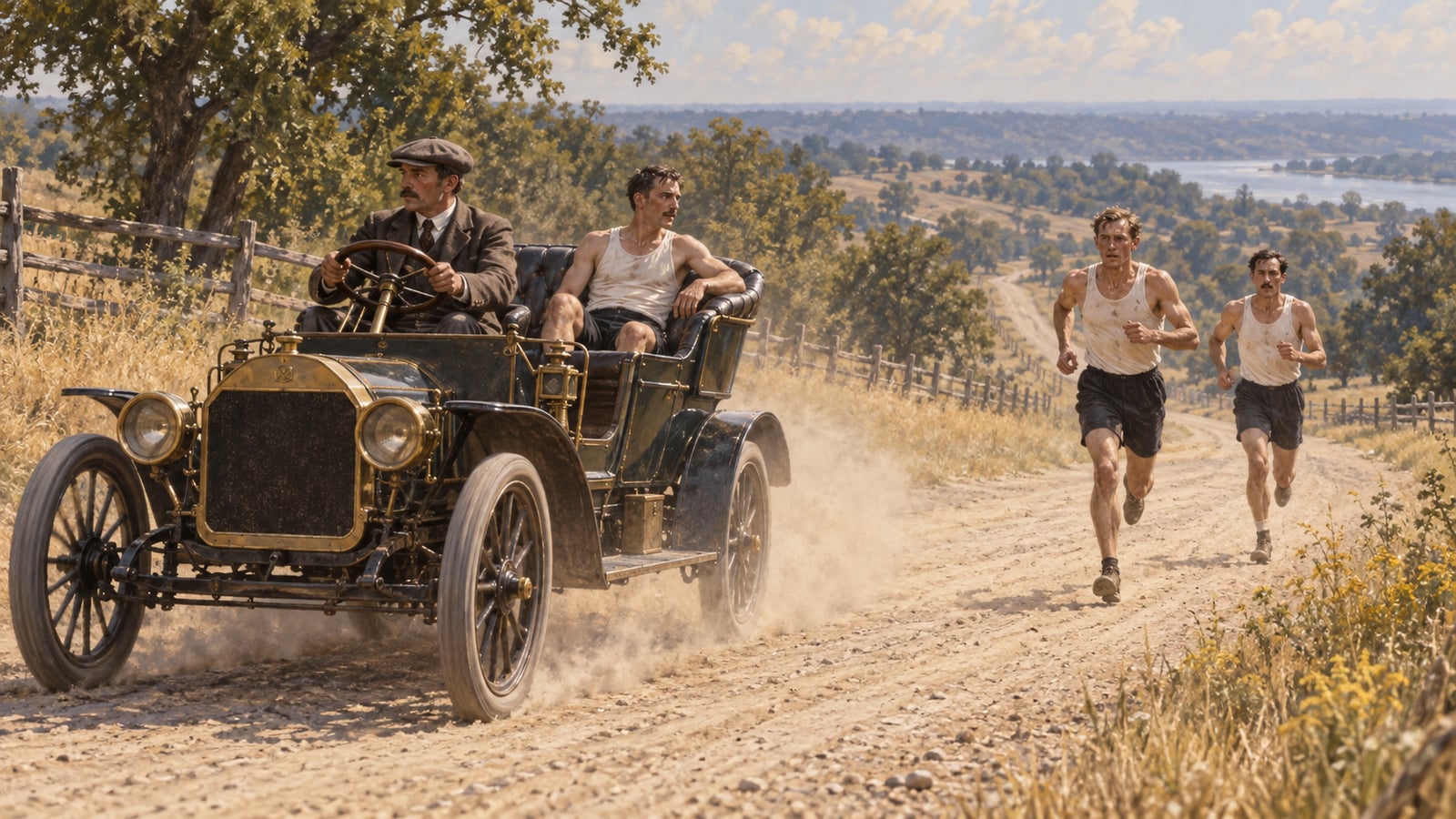
Fred Lorz was the first runner to return to the stadium in the 1904 Olympic marathon. The crowd welcomed him as the winner. He had certainly covered the final stretch on foot. The difficulty was what had happened outside the stadium: for a substantial part of the journey, he had been sitting in an automobile.
The course helps explain why anyone might have wanted a lift. On August 30, the runners faced hot weather, hills and dusty roads around St. Louis. Cars accompanying the race threw up clouds that obscured the competitors and made them cough. Charles Lucas, who followed the event, described only one place to obtain fresh water after leaving the stadium: a well about halfway along the route.
Lorz suffered cramps roughly nine miles into the race, abandoned his effort and got into a car. Had he remained there, his story would have been that of a runner who dropped out. Instead, after riding for miles, he got out and started running again. According to Lucas, people who had seen him in the automobile challenged him. Lorz explained that the car had broken down and he was simply trying to get back.
Back he went, all the way into the stadium. Spectators who had not followed his journey saw the first runner arriving and cheered accordingly. Once the ride was exposed, Lorz was disqualified. Removing the wrong man from first place, however, did not turn the rest of the marathon into an uncomplicated sporting triumph. The legitimate leader, Thomas Hicks, was in serious difficulty.
Hicks had begun to weaken long before the finish. Lucas was one of the men looking after him, and his account describes a runner asking for water but being allowed only to have his mouth sponged. Later, Hicks wanted to lie down. His attendants would not let him. They kept him moving, even when that meant slowing to a walk.
Their assistance included egg white and strychnine, followed later by more strychnine and brandy. The Olympic Museum now describes the treatment as grounds for a doping disqualification today. Lucas, by contrast, openly recorded giving the drug. He regarded the race as evidence that drugs could help athletes on the road. What looks alarming in the account was presented by its author as a means of getting his runner through the contest.
Then Lorz came past. He was back on foot by this point, so the exhausted Hicks saw what appeared to be a competitor overtaking him. Lucas reported that Hicks resumed running after being told Lorz was no longer in the race. Two men were travelling towards the same finish: one struggling to win, the other explaining that he was returning after his car had failed.
Near the end, Hicks could barely lift his legs. Lucas described him believing the finish was still far away when it was actually close. He walked up the final hills and jogged down them, eventually recording 3 hours, 28 minutes and 53 seconds. He was the recognized winner, but he was in no condition to receive the trophy on the field. Medical attention came first.
Lorz received a lifetime suspension. That lifetime proved brief: after an apology, he was allowed to race again. The following year he won the Boston Marathon, this time as its official champion. The man who had reached an Olympic finish first without running the entire course returned to demonstrate that he could, after all, win a marathon on his feet.
EDITORIAL RESPONSIBILITY
FactosBrain Editorial Desk
The FactosBrain Editorial Desk researched and reviewed this article under our editorial policy. We assess error reports under our corrections policy.