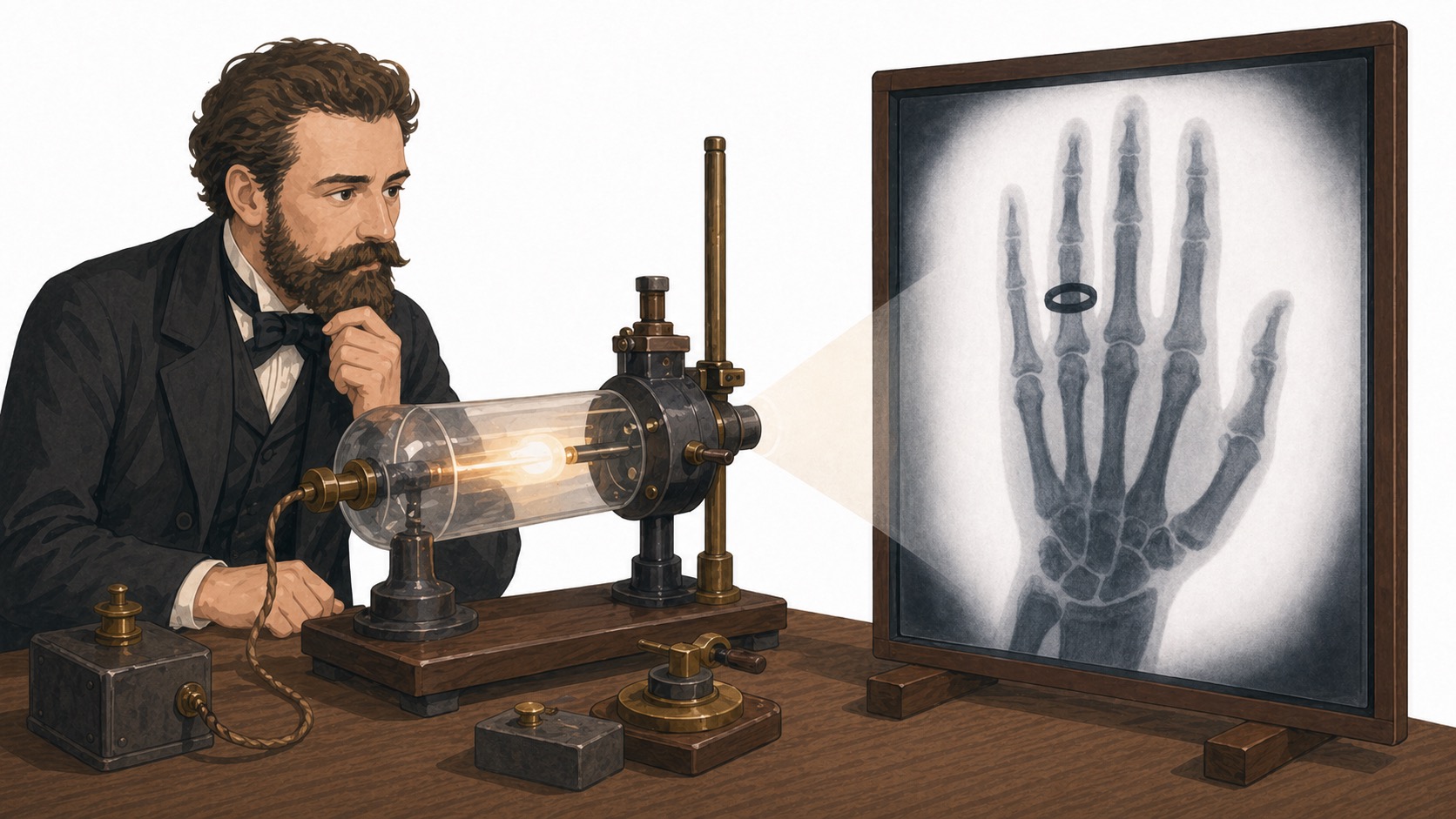
In 1895, Wilhelm Conrad Röntgen discovered that an unknown kind of radiation could pass through materials that blocked visible light. While experimenting with a covered discharge tube, he noticed a fluorescent screen glowing at a distance. He called the radiation X-rays, using “X” for something whose nature was not yet known.
Röntgen tested how different objects changed the rays and found that flesh was more transparent to them than bone or metal. In a famous early radiograph, the bones of his wife Anna Bertha's hand appeared along with the dark outline of her ring. The image made the discovery immediately understandable: a body could be examined internally without being cut open.
X-rays are now understood as high-energy electromagnetic radiation, part of the same broad family as visible light but with much shorter wavelengths. When a beam passes through the body, tissues absorb or scatter different amounts. Dense, calcium-rich bone usually removes more of the beam than soft tissue, producing contrast at the detector.
The discovery changed medicine quickly because it offered information that touch and external observation could not provide. Physicians could locate fractures and foreign objects, and later technologies improved image quality, reduced exposure and extended the principle into fluoroscopy and computed tomography. Röntgen received the first Nobel Prize in Physics in 1901.
The ability to penetrate tissue also creates risk. X-rays are ionizing radiation, energetic enough to damage molecules and cells, so medical imaging balances the expected diagnostic benefit against exposure. Modern equipment, shielding and carefully selected settings are designed to obtain the needed image with an appropriate dose rather than treating the rays as harmless light.
Röntgen's hand image was not merely a dramatic photograph. It demonstrated a new relationship between physics and diagnosis: invisible radiation could be converted into visible evidence about hidden structures. Today's radiographs look routine only because more than a century of engineering and safety practice has grown around that first unfamiliar glow.
EDITORIAL RESPONSIBILITY
FactosBrain Editorial Desk
The FactosBrain Editorial Desk researched and reviewed this article under our editorial policy. We assess error reports under our corrections policy.