Look a little closer
A wool sweater usually shrinks in washing not because heat melts each fiber into a shorter strand, but because wet fibers migrate and entangle through direction-dependent friction at their scaly surfaces. Moisture and warmth swell and mobilize the fibers, while tumbling, rubbing, and compression repeat the motion. The knitted network becomes denser and more felt-like, reducing its width and length.
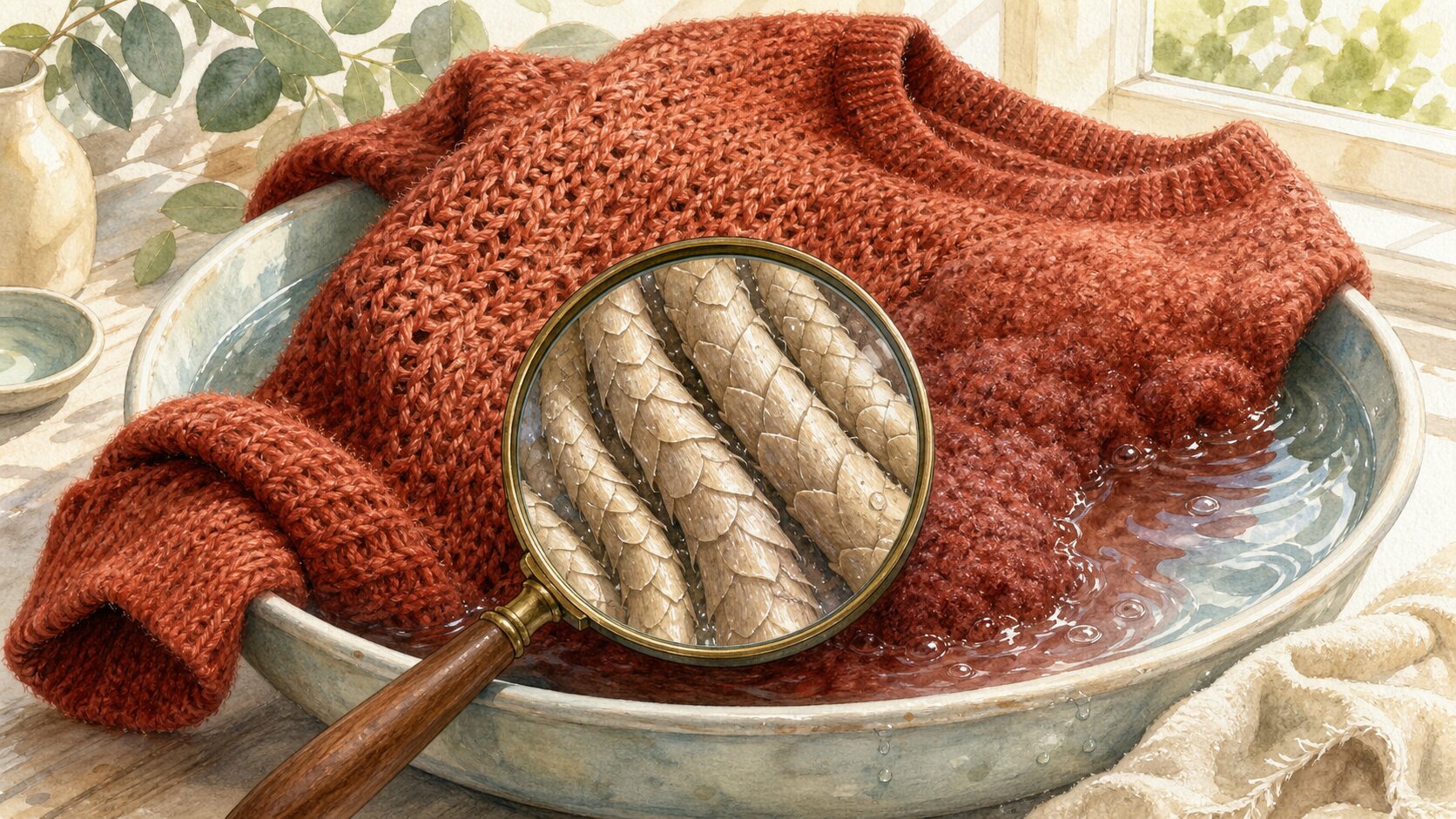
Wool is a keratin protein fiber whose outer cuticle consists of flattened cells overlapping rather like roof tiles. The free edges of those scales generally point toward the fiber tip. This microscopic surface does not slide through neighboring fibers like smooth synthetic filament. Wool also has natural waviness, called crimp, which creates more opportunities for neighboring fibers to touch, cross, and become entangled.
The force needed to move one wool fiber with the scale direction differs from the force needed to move it against the scales. Textile scientists call this the directional friction effect. When wet fabric is repeatedly compressed, released, stretched, and relaxed, a fiber does not necessarily retrace exactly the same path on every cycle. It can make a small net migration in the easier direction. Scale edges, bends, and contacts with adjacent fibers resist the return journey, so countless microscopic slips and catches accumulate into macroscopic shrinkage.
Water, heat, detergent, and agitation play related but distinct roles. Water penetrates and swells wool, altering its mechanical response and the friction between fibers. Higher temperature can increase molecular mobility and intensify washing action, but quietly soaking wool in warm water is not mechanically equivalent to repeatedly turning it in a hot wash. Detergents and pH can modify surface wetting and lubrication. For felting shrinkage, moisture combined with repeated mechanical movement is especially important; heat alone is not a complete explanation.
A garment becoming smaller does not mean every fiber shortened by the same percentage. Fibers and yarns shift within knitted loops, void space decreases, stitch definition blurs, and the fabric becomes thicker and firmer. Roughly the same amount of wool is packed into less area. That network-level densification is felting. Used deliberately, it produces a cohesive material for hats and craft felt that resists unraveling when cut. In a sweater, the same mechanism appears as unwanted loss of dimensions and flexibility.
Not every dimensional change in wool is felting. Fabric stretched or compressed during spinning, knitting, and finishing can change size when water releases stored manufacturing stresses; this is called relaxation shrinkage. Felting shrinkage instead grows through the continuing migration and entanglement enabled by directional friction. A garment that changes slightly after a gentle first wash is therefore not necessarily in the same state as one with a matted surface and vanished stitch pattern after vigorous washing and tumbling.
Claims that a severely felted sweater can always be fully 'unshrunk' with water or hair conditioner are unreliable. A mildly relaxed or distorted knit may sometimes be reshaped to measured dimensions by careful wet blocking and flat drying. Once fibers have migrated and locked at many contacts, however, there is no simple damage-free path that runs the original knitting geometry backward. Forceful stretching may elongate yarns or seams rather than restore the original loop and fiber positions.
Machine-washable or 'superwash' wool is engineered to reduce the frictional imbalance. Established processes modify the cuticle and apply a thin polymer treatment; other research explores enzymes, plasma, chlorine-free chemistry, and alternative coatings that reduce catching and migration. The term does not describe one identical surface for every product. Treatments differ in durability, hand, dye response, and environmental tradeoffs, while fiber blend and knit construction also affect how a garment responds. Its own care label remains more useful than a rule based on the word wool alone.
Researchers can image cuticle scales with scanning electron microscopy and measure friction while drawing fibers toward the root and tip separately. Standardized laundering tests mark a known area, then compare its shrinkage, thickness, permeability, and surface matting before and after repeated cycles. Testing treated and untreated samples under the same conditions helps isolate the role of altered scale friction. Recommendations for cool water, low agitation, and flat drying are therefore not rituals aimed at one dangerous temperature; they interrupt several links in the migration sequence. Washing shrinkage in wool is a structural rearrangement in which a directional microscopic surface converts repeated back-and-forth motion into one-way collective densification.
EDITORIAL RESPONSIBILITY
FactosBrain Editorial Desk
The FactosBrain Editorial Desk researched and reviewed this article under our editorial policy. We assess error reports under our corrections policy.