Look a little closer
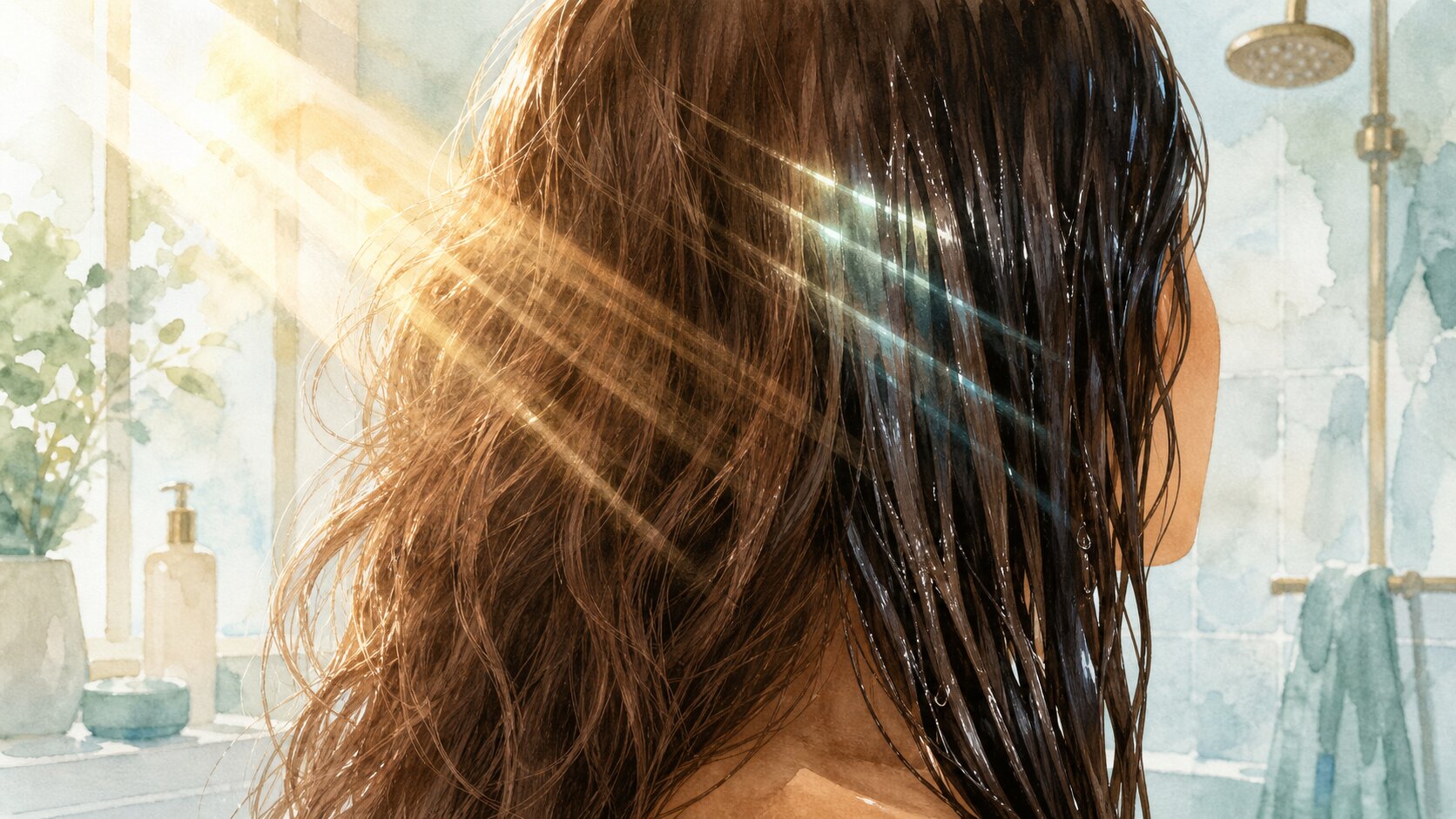
Wet hair usually looks darker because water changes the routes by which light returns to the eye, not because it suddenly creates more pigment. Water replaces some of the air at and between the fibers, reducing pale diffuse scattering and allowing light to travel farther into a strand or hair bundle. More of that light is then absorbed or redirected away, so less reaches the observer and the same hair color appears deeper.
Visible hair color is not produced by pigment alone. Most of a hair shaft is cortex containing melanin granules, while an outer cuticle of overlapping transparent cells protects it. Incoming light can reflect from the cuticle, refract into the shaft, scatter through internal structures, be absorbed by melanin, and emerge again. The balance among those events depends on surface condition, fiber alignment, illumination, and viewing angle as well as on the amount and kind of melanin.
Dry hair contains countless boundaries between air and keratin. Their substantially different refractive indices mean that light changes direction and partly reflects whenever it encounters a fiber or a tiny gap. Some of this multiply scattered light returns toward the viewer and adds a pale component over the underlying color. The effect resembles the brightness of other dry fibrous materials, although a hair is a curved optical fiber with distinctive surface reflections rather than simply a piece of cloth.
When water fills part of the air space, the optical contrast at many boundaries becomes smaller because water's refractive index is closer to that of hair than air's is. Less light is immediately scattered back from a wet interface, and more can enter the cuticle or pass among neighboring strands. A longer route creates more opportunities for melanin and other material to absorb light. It also gives rays more chances to leave in directions that do not meet the eye. The diffuse light returning from the bundle therefore decreases.
Water also gathers separate fibers into larger locks. Surface tension pulls damp strands together, reducing the airy volume and the number of isolated surfaces that can scatter light broadly. Bright background glimpsed through dry hair may disappear, and light emerging from one strand can encounter another instead of escaping. This geometric change works alongside the refractive-index effect. It explains why freshly washed hair can look both darker and flatter even though each shaft still contains essentially the same pigment.
A wet head is not uniformly dim, however. A smoother water-coated surface can produce stronger specular reflection—the concentrated shine seen when the light, surface, and eye line up. A narrow streak may flash brightly while the surrounding hair, which sends back less diffuse light, looks richer and darker. Models used to render wet materials likewise need both changes: reduced or redirected diffuse reflection and altered glossy highlights. Viewing the same lock from another angle can therefore change the impression substantially.
A classic 1988 optics analysis examined why rough, absorbing materials darken under a liquid film. Diffusely reflected rays can be trapped by internal reflection at the liquid surface and sent back toward the absorbing material, increasing the chance that they will be lost rather than escape. Replacing air with a liquid also changes reflection because the relative refractive index at the material boundary is smaller. A bundle of curved, structured hairs is more complicated than the simplified surface in that model, but the analysis captures key routes by which wetting reduces return light.
The water itself is not painting brown or black onto the hair, and melanin does not increase during a shower. A thin layer of water is largely transparent to visible light; its important role here is to reorganize interfaces and paths. The strength of the effect varies with natural color, fiber diameter, degree of wetness, and cuticle damage or porosity from weathering, bleaching, and dyeing. Very light or white hair under strong backlighting may show enough transmission and background influence that the rule 'wet always means darker' becomes unreliable.
As hair dries, liquid bridges break and fibers separate, restoring many air–hair boundaries. More light scatters from the surfaces and gaps back toward the viewer, and a larger fraction can return before traveling far enough to be absorbed. The original brighter appearance re-emerges without any reversal of pigment chemistry. The temporary darkening is therefore an optical state of the whole wet bundle: clear water changes scattering, refraction, absorption opportunities, and strand arrangement all at once.
EDITORIAL RESPONSIBILITY
FactosBrain Editorial Desk
The FactosBrain Editorial Desk researched and reviewed this article under our editorial policy. We assess error reports under our corrections policy.