Look a little closer
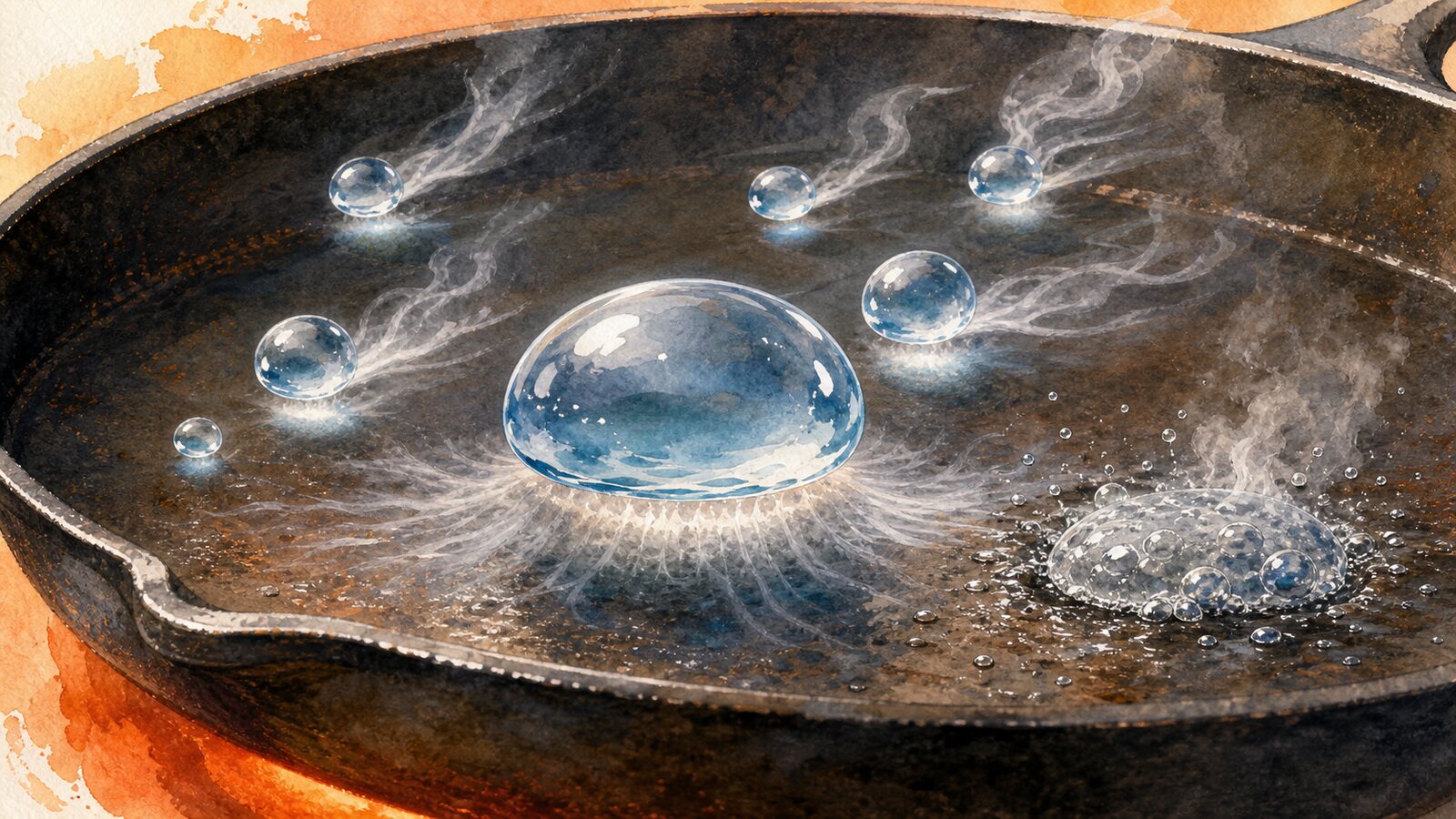
Water drops skitter across a very hot pan because rapid evaporation at their undersides creates a continuously renewed film of vapor between liquid and metal. Pressure in that thin layer supports the drop while greatly reducing direct contact, friction, and heat transfer. Instead of wetting the pan and boiling violently in place, the water rounds up and glides in the state known as the Leidenfrost effect.
On a merely warm surface, water wets the material and evaporates slowly. As temperature rises, bubbles begin forming at many contact points and departing in vigorous nucleate boiling, which transfers heat efficiently into the liquid. At sufficiently high superheat, however, vapor is produced fast enough to separate most of the drop from the solid. The transition toward film boiling marks the onset of a Leidenfrost state.
The supporting layer is not a trapped pocket of ordinary air. Energy from the pan keeps converting water at the bottom of the drop into vapor, and that vapor flows outward through the narrow gap. Its pressure rises enough to balance the drop's weight while the escaping gas is continually replaced. The result is a dynamic bearing, often only tens to hundreds of micrometers thick, rather than a permanent cushion sealed under the water.
Surface tension explains much of the rounded shape. In a small drop, the tendency to minimize surface area is strong compared with gravity, so the liquid approaches a sphere; a larger Leidenfrost puddle becomes flatter under its own weight. In either case, removal of solid contact makes lateral resistance extremely small. A slight pan slope or momentum from the initial impact can therefore carry a drop much farther than it would travel while wetting the surface.
There is no single rocket-like push that always determines the route of a wandering kitchen drop. Tilt, roughness, uneven vapor escape, deformation, and circulation within the liquid can all contribute. Experiments with asymmetric ratchet textures deliberately channel vapor and propel droplets in one direction through viscous forces. The erratic run on an ordinary pan is better understood as a sensitive response to small, changing asymmetries than as a programmed path.
The counterintuitive part is that a drop can survive longer on a hotter surface over part of the boiling curve. During nucleate boiling, direct liquid-metal contact transfers energy rapidly. Once a stable Leidenfrost film develops, vapor—much less effective at conducting heat than liquid—acts as insulation, and heat flux can fall. A drop may consequently outlast one on a somewhat cooler, directly wetted pan. Raising the temperature farther eventually increases transfer through the film and shortens the lifetime again.
A universal pan temperature cannot define the effect. The Leidenfrost point lies above a liquid's ordinary boiling temperature, but its value depends on the liquid, drop size and impact, contamination, and the surface itself. A material that replenishes surface heat readily behaves differently from one whose top layer cools under the drop. Roughness can destabilize the vapor gap by bringing solid peaks closer to the liquid. Experiments across several substrates therefore measure different thresholds rather than one kitchen constant.
Researchers map these regimes by timing drops over a range of temperatures and using high-speed video to distinguish contact boiling, rebound, breakup, and sustained levitation. Optical reflection and interference methods can resolve changes in a gap almost invisible to the eye. Such measurements reveal that the underside is not a perfectly flat hovercraft deck: the vapor pocket has shape, flow, and oscillations, and it evolves as the shrinking drop changes weight and curvature.
A vapor film also does not guarantee that liquid and metal never touch for even an instant. Impact, oscillation, or a rough peak crossing the gap can produce local contact. As a clean drop becomes very small, it may lift away; if contaminants accumulate and inhibit evaporation, the film can instead thin until contact triggers abrupt breakup. Levitation is a regime maintained by conditions, not an invulnerable shell around the liquid.
The effect matters wherever liquid must cool an overheated solid. During metal quenching, spray cooling, firefighting, or thermal-system operation, a stable vapor blanket can make apparent contact remove heat more slowly than expected. Engineers may alter texture or wetting so that the film collapses and liquid touches the surface more effectively, or exploit levitation when low drag is useful. The transition is thus an operating boundary, not merely a visual trick for testing cookware.
A racing bead on a pan has not somehow escaped evaporation. A small portion is evaporating continuously in order to lift and insulate the liquid that remains. Once that vapor film supplies both support and low friction, tiny slopes and imbalances become conspicuous motion. The Leidenfrost effect is the point where adding heat reorganizes the contact itself, breaking the simple expectation that a hotter surface must always make a visible drop vanish faster.
EDITORIAL RESPONSIBILITY
FactosBrain Editorial Desk
The FactosBrain Editorial Desk researched and reviewed this article under our editorial policy. We assess error reports under our corrections policy.