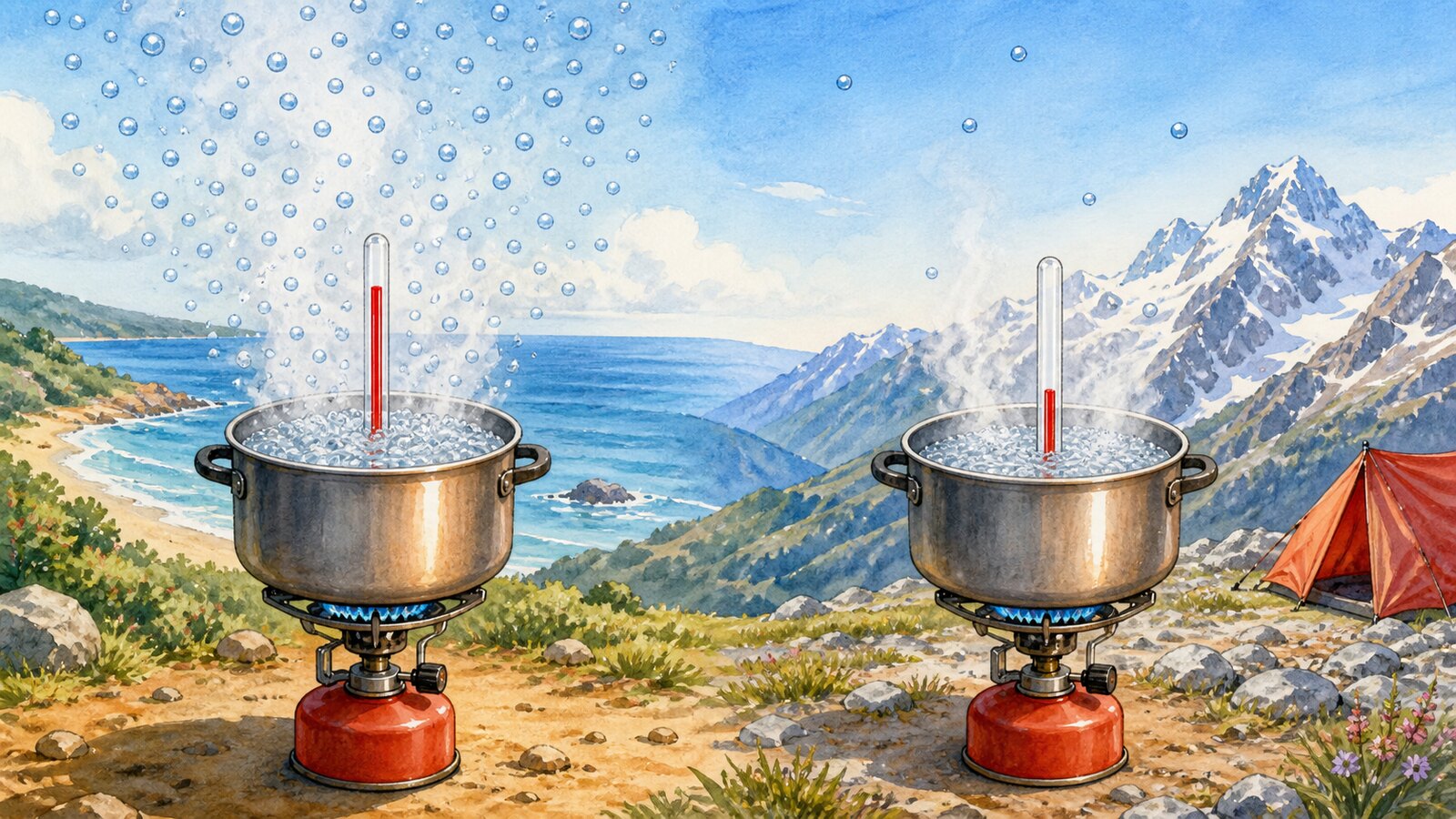
Water boils below 100°C at high altitude because the surrounding air pressure is lower, so water's vapor pressure can match it at a lower temperature. The familiar 100°C value is the normal boiling point of pure water at 101.325 kilopascals, approximately one atmosphere, rather than an immutable temperature built into water. A mountain pot may begin boiling after less warming even though its boiling water is cooler than boiling water near sea level.
Boiling is a particular kind of vaporization. Water molecules escape from the surface at temperatures far below the boiling point, producing evaporation and a vapor pressure above the liquid. Heating increases that vapor pressure because a larger share of molecules can enter the vapor phase. Boiling begins when vapor bubbles inside the liquid can resist the pressure squeezing them and grow instead of collapsing. In an open pot, that condition is reached when the liquid's vapor pressure is comparable to the external pressure.
Atmospheric pressure generally falls with elevation because there is a smaller column of air above a high location. It is sometimes said that water boils early because mountain air has less oxygen, but oxygen is not the direct control. The relevant change is the pressure exerted by all the surrounding gas. Weather and temperature also alter local pressure, so elevation does not assign every place one perfectly fixed boiling temperature. It does, however, set a strong average trend: climb higher and the external pressure usually becomes lower.
As a pot warms, the vapor pressure of its water rises. Near standard sea-level pressure it does not match the surroundings until the temperature is close to 100°C. On a mountain, the lower target pressure is reached sooner. The U.S. Department of Agriculture gives an illustrative boiling temperature of 208°F, or about 97.8°C, at 2,000 feet (about 610 meters), and about 198°F, or 92.2°C, at 7,500 feet (about 2,286 meters). The relationship is not a single linear rule across every altitude, but the direction is consistent.
Once an open pot is boiling steadily, turning up the burner does not keep raising the bulk water temperature by a comparable amount. Much of the added energy supplies the phase change from liquid to vapor. While pressure stays roughly constant and liquid water remains, its average temperature stays near the local boiling point. A stronger flame mainly creates vapor faster, makes the bubbling more vigorous, and empties the pot sooner. Small local differences can occur near the heated surface or because substances are dissolved in the water, but a rolling boil is not inherently much hotter than a gentle one at the same pressure.
This resolves a familiar high-altitude puzzle: the pot can reach boiling sooner while food takes longer to cook. Starting from room temperature, the water has fewer degrees to climb before bubbles persist. After that point, however, food immersed in the water or exposed to its steam is being heated at a lower temperature. Many temperature-dependent changes, including the softening of starch-rich foods and changes in proteins, then proceed more slowly. Increasing the flame cannot restore the missing boiling temperature; it may only accelerate water loss.
A pressure cooker uses the same relationship in reverse. Steam accumulates inside the sealed vessel and raises the pressure above the surrounding atmosphere. Water must then reach a higher temperature before its vapor pressure can balance that greater pressure and sustain boiling. The hotter water and steam can transfer heat to food at temperatures unavailable in an open pot. At altitude, a pressure cooker is useful not because it produces a special kind of heat, but because it replaces some of the pressure the mountain atmosphere no longer supplies.
Not every bubble seen during heating means that full boiling has begun. Small bubbles that first cling to the wall of a warming pot often contain dissolved gases leaving the water as their solubility decreases. During established boiling, the bubbles are primarily water vapor and commonly begin at microscopic scratches or other nucleation sites. Pressure is also slightly greater deeper in the pot because of the weight of the water above. Those details complicate the exact birth of an individual bubble without changing the central rule that external pressure helps set the boiling temperature.
The composition of the water adds another boundary to the 100°C shorthand. A dissolved, nonvolatile substance such as salt or sugar lowers the water's vapor pressure at a given temperature and can raise the boiling point. Ordinary weather changes the atmospheric pressure as well. It is therefore more accurate to say that pure water has a normal boiling point near 100°C at one atmosphere than to claim that every pot at sea level always boils at exactly 100°C. Pressure, composition, and measurement conditions all matter when precision matters.
There is no contradiction in a mountain pot bubbling at a lower temperature yet cooking more slowly. Visible boiling does not announce that a universal 100°C threshold has been crossed; it announces that water's vapor pressure has caught up with the pressure around it. Reduce that surrounding pressure by climbing, and the threshold moves downward. Raise it inside a pressure cooker, and the threshold moves upward. The boiling point is therefore a condition negotiated between a liquid and its environment, not a number belonging to the liquid alone.
EDITORIAL RESPONSIBILITY
FactosBrain Editorial Desk
The FactosBrain Editorial Desk researched and reviewed this article under our editorial policy. We assess error reports under our corrections policy.