Look a little closer
An opened soda loses its fizz faster when warm because warm liquid cannot hold as much carbon dioxide at the same gas pressure. Opening the container also removes the high pressure that kept extra CO2 dissolved. The warm drink is left more strongly supersaturated, so excess gas diffuses into bubbles and escapes until the liquid approaches a new, flatter equilibrium.
Carbonation begins with cold beverage and carbon dioxide under pressure. Henry's law describes the central equilibrium: at a fixed temperature, the concentration of a dissolved gas is proportional to that gas's partial pressure above the liquid. High CO2 pressure therefore drives more gas into a drink, and low temperature increases the amount that can be retained. After a bottle or can is sealed, compressed carbon dioxide in the headspace helps prevent the dissolved gas from leaving all at once.
The pressure balance changes as soon as the seal breaks. Compressed headspace gas rushes out, and the carbon dioxide partial pressure above the exposed drink falls toward its much lower value in ordinary air. The liquid briefly contains more CO2 than the new conditions can support, a state called supersaturation. Dissolved molecules then move toward the surface or join growing gas bubbles. As carbon dioxide leaves, its concentration and the sensory bite associated with carbonation decline.
Temperature shifts the equilibrium again. Dissolution is a dynamic exchange in which molecules continually enter and leave the liquid, not a permanent bond that locks every CO2 molecule in place. Over normal beverage temperatures, carbon dioxide is less soluble in warmer water. Given equal pressure and volume, a warm drink can retain less than a cold one. It consequently has a larger excess to release after opening. Faster molecular motion and diffusion at higher temperature can also help the drink approach its new equilibrium more quickly, although the exact rate depends on the container and how it is handled.
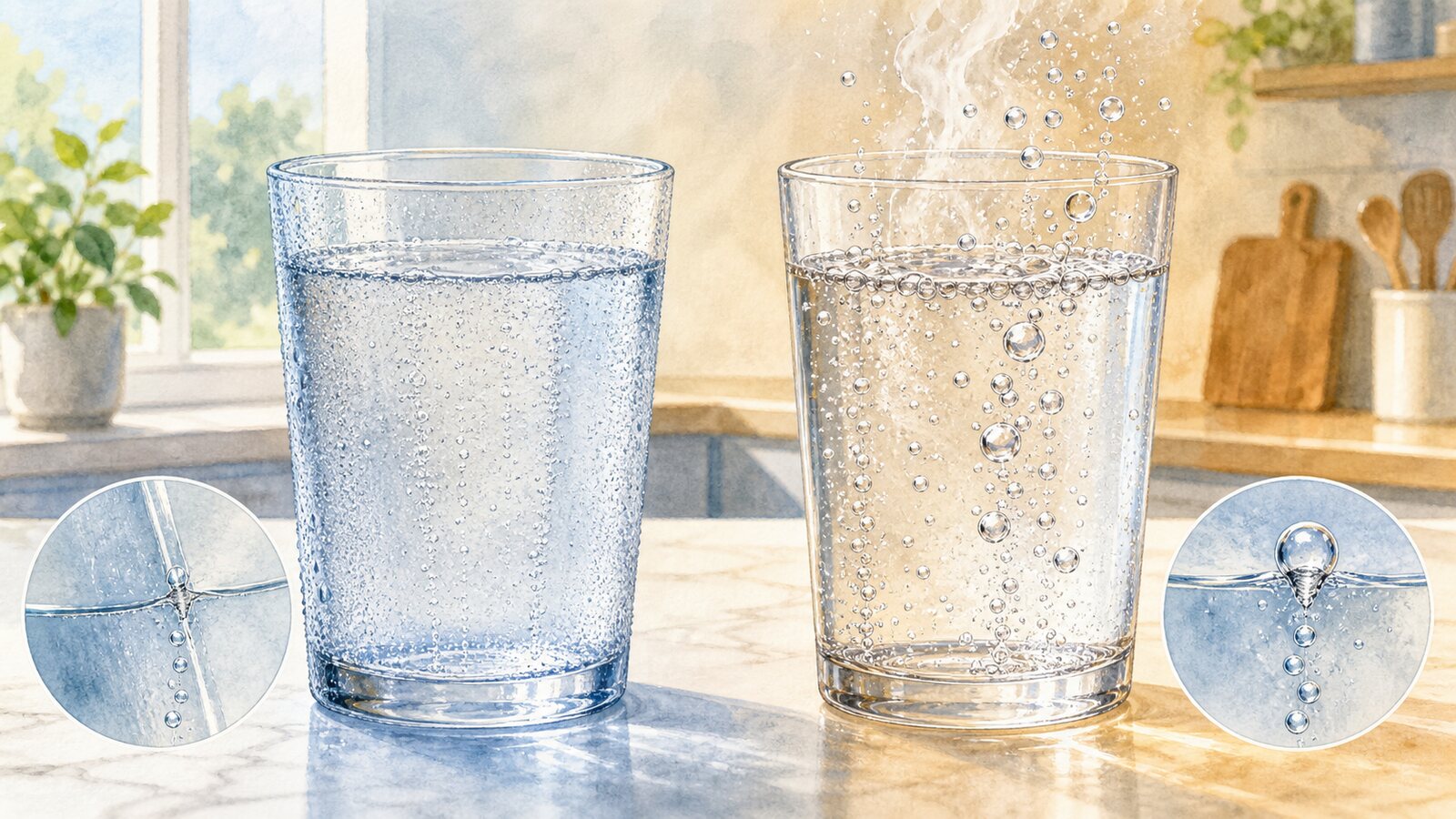
Excess dissolved gas does not necessarily turn into bubbles everywhere at once. Creating a brand-new bubble in a perfectly uniform liquid carries an energy cost because surface tension resists the new gas-liquid boundary. Microscopic scratches, dust, cellulose fibers, and small gas pockets already trapped on a surface provide nucleation sites that lower that barrier. Carbon dioxide diffuses into a pocket, the bubble grows and rises, and another can form at the same spot. Rough glass, ice, a straw, or vigorous pouring can therefore produce more visible fizz without creating new CO2.
The temperature effect is visible in controlled demonstrations. An American Chemical Society classroom experiment places comparable samples of carbonated water in warm and cold baths; more bubbles rise from the warmed sample. Research on bottled sparkling water also modeled bubble nucleation under serving conditions and found that, for a given dissolved CO2 concentration, the number of bubbles likely to form in a glass increases with temperature. Visible bubbling and total remaining gas are not the same measurement, however. Abundant bubbles show that gas is leaving actively, not that a warm drink stores more carbonation.
A sealed warm bottle needs a different description. If an intact container is truly closed, heating does not give its carbon dioxide a route to disappear from the system. Some gas leaves the liquid and enters the headspace instead, raising internal pressure until a new balance develops. Opening that warm container releases the higher headspace pressure and exposes a liquid with lower CO2 solubility, so foaming can be more forceful than from a chilled one. Shaking makes the response more dramatic by distributing small gas pockets and increasing liquid-gas contact, even though it does not manufacture carbon dioxide.
Keeping soda cold, avoiding agitation before opening, resealing promptly, and minimizing headspace can slow the loss. A cap cannot recover gas already released into the room; it only lets the remaining CO2 redistribute between liquid and the newly sealed space. If a large bottle contains only a small amount of drink, its large headspace can take up more gas before pressure rebuilds, leaving less dissolved in the liquid. Freezing is not a safe shortcut. Expanding ice and displaced gas can deform or rupture a container, so storage should remain within the manufacturer's guidance.
Fizz is not perceived only by counting bubbles. Dissolved carbon dioxide, the small fraction involved in acid-base chemistry, temperature, sweetness, and aroma all contribute to how lively a beverage tastes. The main physical chain is nevertheless straightforward: warming lowers the equilibrium amount of CO2 the liquid can hold, opening removes the retaining pressure, and nucleation sites give the excess gas practical escape routes. Cold soda stays fizzy longer because its thermodynamic balance favors carbon dioxide remaining in solution, not because low temperature somehow freezes bubbles in place.
EDITORIAL RESPONSIBILITY
FactosBrain Editorial Desk
The FactosBrain Editorial Desk researched and reviewed this article under our editorial policy. We assess error reports under our corrections policy.