Look a little closer
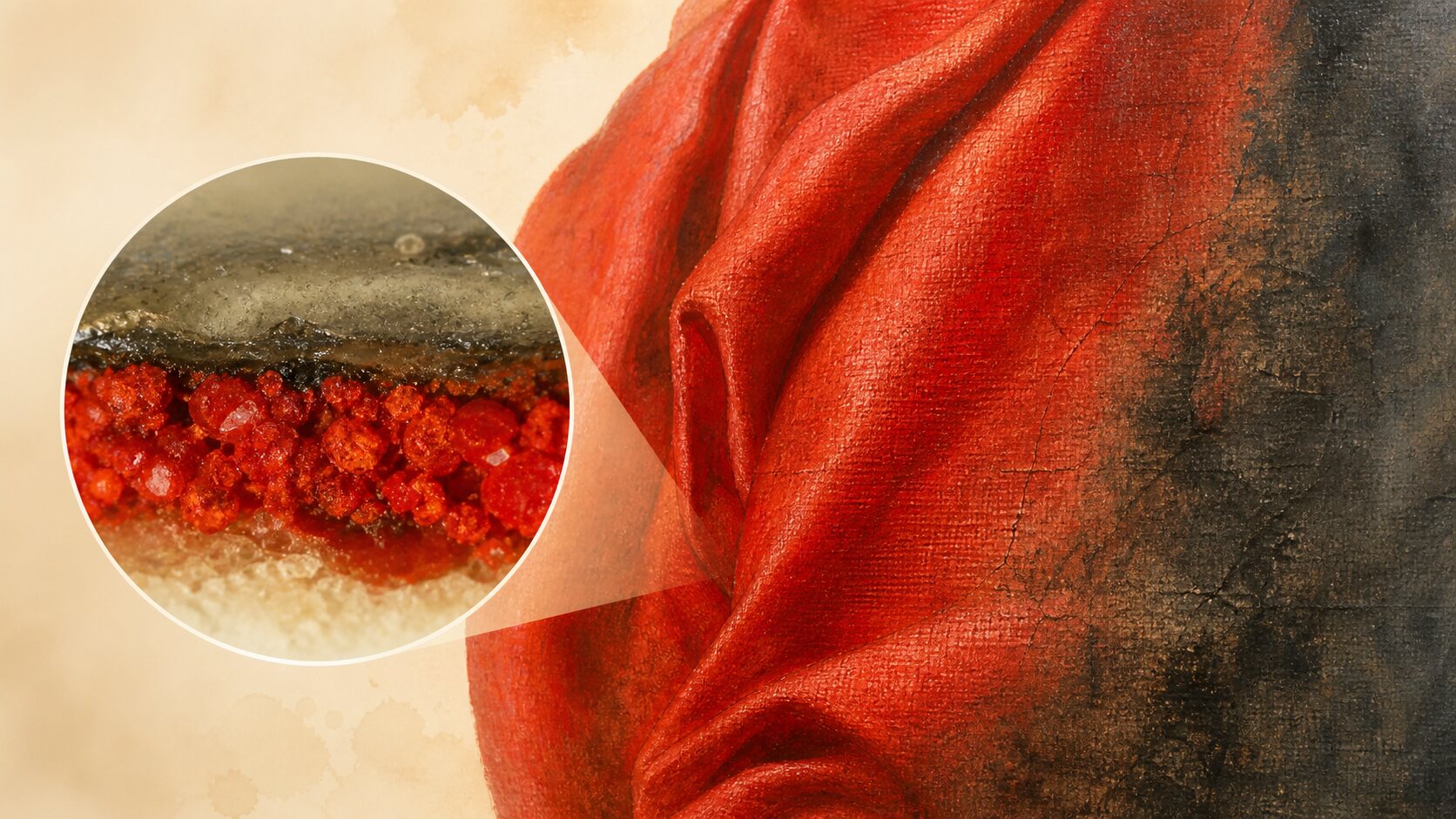
In an old mural or painting, clothing or ornament that was once a vivid orange-red can sometimes look brown, gray, or black. One reason is the alteration of vermilion, a historic red pigment based on mercury sulfide, HgS. Vermilion was prized for its brilliant color and used in many media for centuries. In some artworks, however, light and the surrounding chemical environment gradually change the paint surface. A dark red area in an old picture is therefore not always evidence that the artist originally chose a dark palette.
Color depends on which wavelengths a material absorbs and reflects. The red form of mercury sulfide reflects the longer wavelengths that our eyes interpret as intense red. A painting surface is not isolated from its environment, though. Light can initiate photochemical reactions in pigment and binder, while humidity, pollutants, varnishes, and past conservation materials can influence the route those reactions take. It is more accurate to say that particular materials and conditions raise the risk of alteration than to say that every red pigment simply turns black in light.
Researchers have found metallic mercury and chlorine-containing reaction products at the surfaces of darkened vermilion paints. Chloride can come from impurities associated with pigment manufacture or from external sources such as sea spray, cleaning materials, coatings, and other environmental exposures. Under illumination, these ingredients can participate in surface reactions that change how the thin outer layer absorbs and scatters light. The inside of a pigment grain may still be red even while the paint film appears dark from the viewing side.
That evidence makes the story more complicated than a single crystal conversion. An older explanation often invoked transformation into a black form of mercury sulfide, but that phase is not consistently identified in real degraded paintings. Fine mercury particles, chlorine- and sulfur-containing products, surface crusts, and deposited dirt can all contribute to the observed color. Binder type, pigment concentration, humidity history, and previous treatments vary from object to object, so conservators do not assume one mechanism without examining the particular work.
The change affects more than a patch of color. If a red drapery darkens, the relationship between its highlights and shadows may collapse, changing the apparent folds, volume, and visual emphasis of a figure. Art historians compare technical sources, related works, and microscopic observations to estimate lost color relationships. Conservation scientists use carefully limited sampling or non-destructive analysis to determine which layer has changed. Decisions about compensation are therefore interpretive and ethical as well as visual; they cannot be reduced to making an old painting look brighter.
Modern analytical tools can supply evidence without treating a painting as expendable. X-ray fluorescence maps elements, microscopy and spectroscopy examine surface composition, and other imaging methods reveal differences among layers that the eye cannot separate. Instruments do not directly announce an original color, however. Their results must be interpreted alongside manufacture, paint stratigraphy, and historical practice. Science narrows the plausible explanations; it does not replace judgment about an artwork.
Nor can every dark red area be diagnosed as altered vermilion. Other pigments may fade, soot and dirt can accumulate, varnish can yellow, and moisture can alter a surface in ways that look similar. Conversely, vermilion protected deeper in a paint layer or kept from intense light may remain much redder. Good conservation begins by separating an observed appearance from the particular material process that produced it.
Museums manage light rather than treating more illumination as automatically better. They limit exposure, reduce pollutants and unsuitable humidity, rotate sensitive works, and choose display conditions with the materials in mind. These measures cannot stop time completely. They aim to slow change so that works can remain available for study and viewing for longer. The same principle informs storage, photography, and conservation lighting.
Vermilion darkening is a reminder that a painting is a long-lived mixture of materials, not a frozen image. Pigments, binders, wood or canvas, air, and light continue to interact long after an artist has finished. Learning why a red region changed does not merely explain damage. It helps us distinguish the work's present appearance from its earlier material history, and to care for both with more honesty.
EDITORIAL RESPONSIBILITY
FactosBrain Editorial Desk
The FactosBrain Editorial Desk researched and reviewed this article under our editorial policy. We assess error reports under our corrections policy.