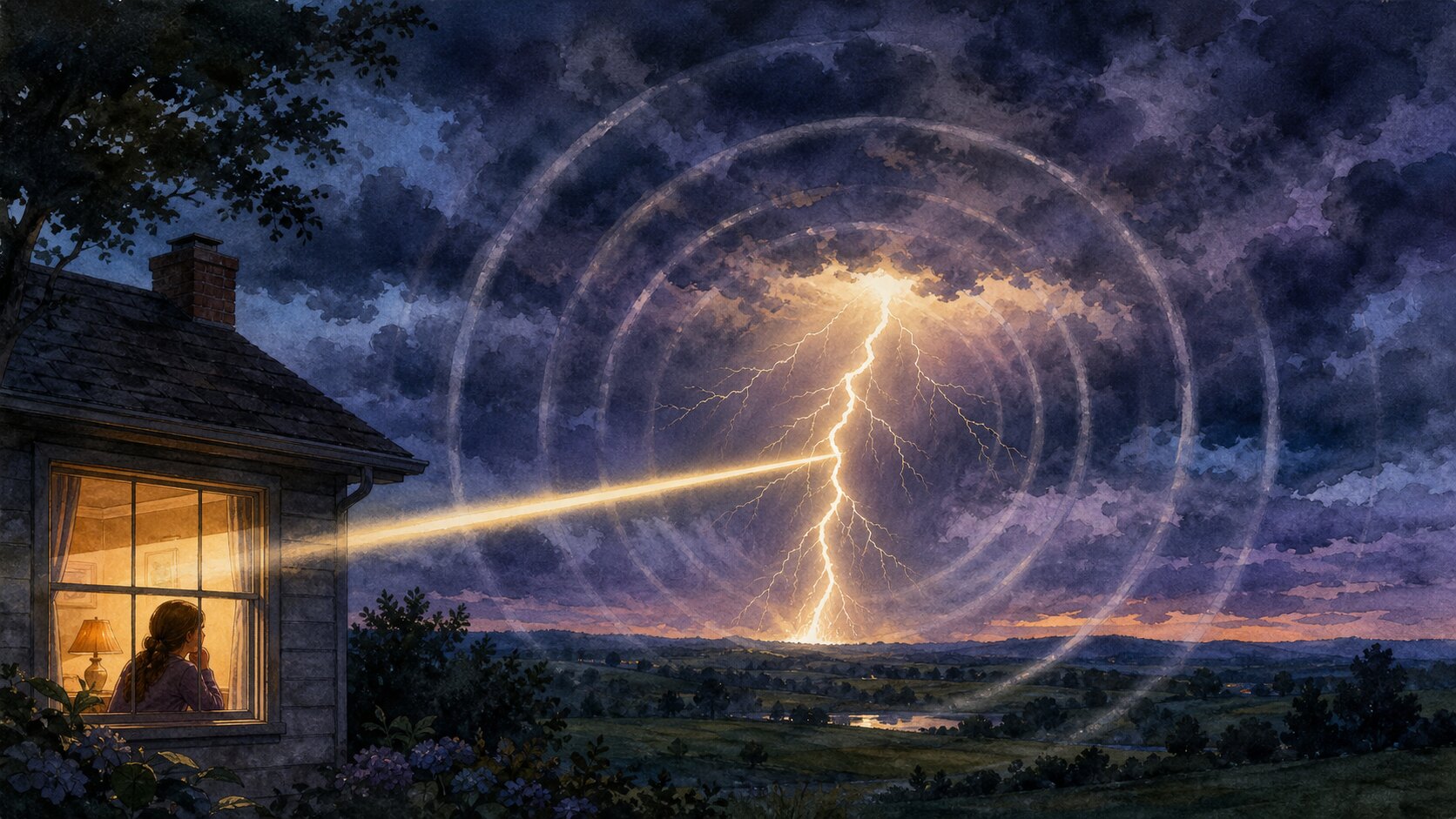
We see lightning before we hear thunder not because they are separate events, but because the light and sound produced by the same discharge travel at radically different speeds. Light crosses an ordinary storm distance in effectively no time to our senses. Sound must move as a pressure wave through air, so it arrives noticeably later.
A lightning channel can heat the surrounding air to roughly 30,000 degrees Celsius in an instant. That air expands explosively and pushes against the air around it, launching a shock wave. As the wave spreads and weakens, it becomes the sound we call thunder. Lightning therefore does more than accompany thunder: it directly creates it.
Light travels at about 300,000 kilometers per second, while sound near Earth's surface moves at roughly 340 meters per second. Across the distances involved in a nearby storm, the light's travel time is negligible, but sound takes about three seconds to cover one kilometer. That is why dividing the seconds between the flash and the thunder by three gives a rough distance in kilometers.
Thunder often rolls instead of arriving as one clean crack because a lightning channel is not a single point. It may twist across several kilometers of sky. Sound from the closest part reaches you first and sound from more distant sections follows. Reflections from terrain and buildings, together with refraction through air layers of different temperatures, can stretch and reshape the rumble.
Counting seconds is useful, but it is not a precision instrument. The speed of sound changes with air temperature, and the brightest visible part of a bolt is not necessarily the part producing the sound you notice most. More importantly, audible thunder means lightning is close enough to be dangerous. Estimating the distance should never delay moving into a substantial building or an enclosed, hard-topped vehicle.
Sometimes a distant flash is visible even though no thunder can be heard. Light remains detectable across a much greater distance, while thunder spreads out, weakens and loses its higher frequencies to absorption in the air. Terrain, wind and layers of air can also redirect sound. The silence does not mean the flash lacked thunder; the sound may simply have faded before reaching the observer.
The quiet interval after a flash is not evidence that the sky performed two actions. A single electrical discharge produced both light and a pressure wave; the fast messenger reached your eyes first and the slow one reached your ears later. Every storm briefly turns the difference between the speed of light and the speed of sound into something we can directly experience.
EDITORIAL RESPONSIBILITY
FactosBrain Editorial Desk
The FactosBrain Editorial Desk researched and reviewed this article under our editorial policy. We assess error reports under our corrections policy.