Look a little closer
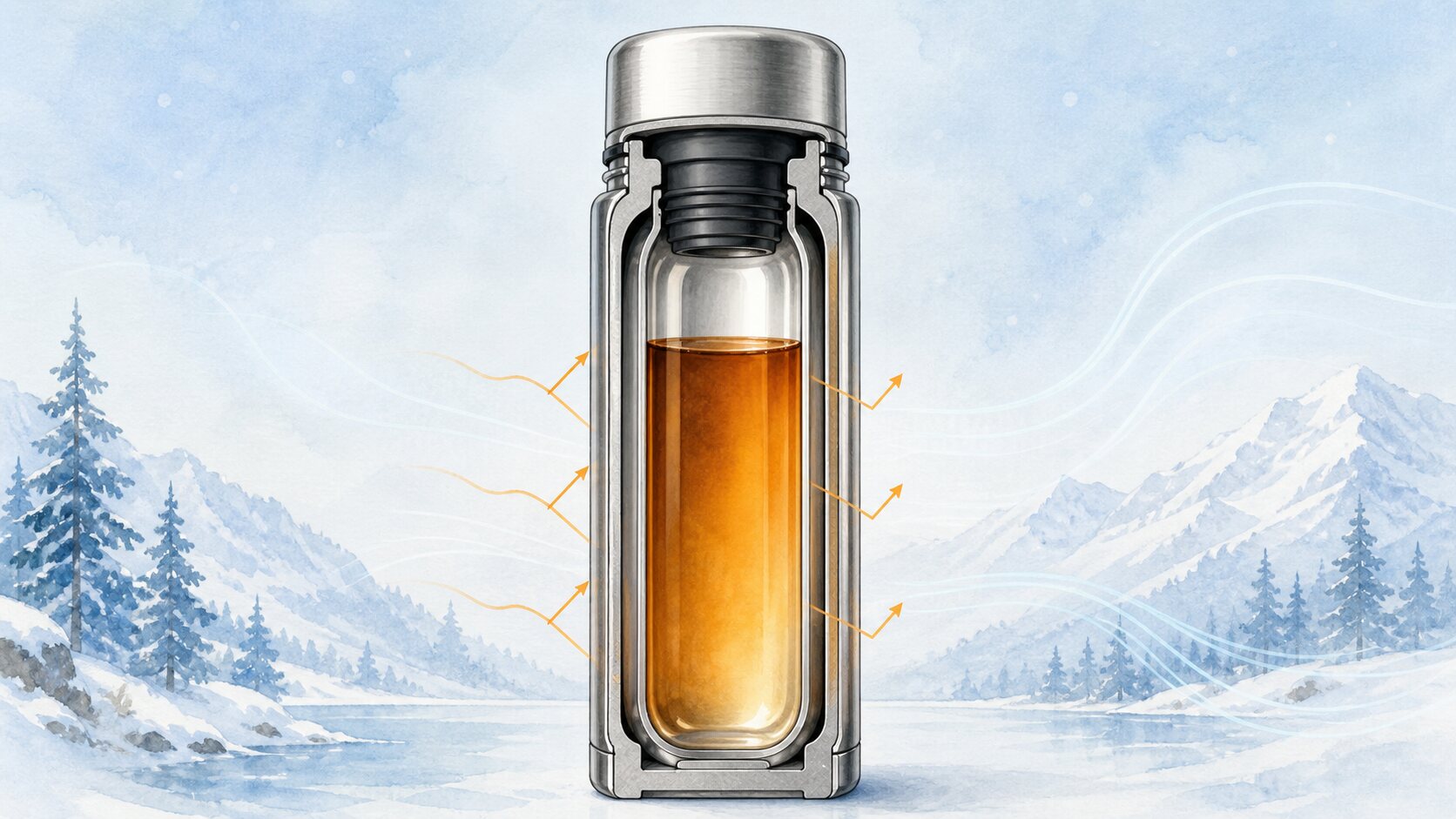
A thermos can keep hot tea warm for hours and ice water cold for hours. In both cases it is doing the same job: slowing the movement of heat between the drink and the surrounding air. Heat naturally moves from a warmer place to a cooler one. With hot tea, heat tends to leave the bottle; with cold water, heat from the room tends to enter it. A thermos is not a machine that creates heat or cold. It is a container designed to make the available routes for heat transfer much less effective.
Heat has three main routes: conduction, convection and radiation. Conduction transfers energy through material in contact. A metal spoon whose handle becomes hot in soup is a familiar example. Convection transfers heat when a fluid such as air or water moves. Radiation transfers energy as electromagnetic waves without requiring contact; sunlight crossing the nearly empty space between the Sun and Earth is an example. A good vacuum flask does not make all three routes disappear. It reduces each of them enough that the contents change temperature much more slowly.
The central feature is the vacuum gap between an inner vessel and an outer vessel. Air can conduct a small amount of heat, and moving air can also transport heat by convection. When most of the air is removed from the gap, there is far less material available to do either job. That is why a vacuum flask is often described as one bottle inside another. The two walls are separated mostly by empty space rather than by a broad, solid path that would let the inside and outside exchange heat easily.
A vacuum is not enough by itself because thermal radiation can travel through empty space. For that reason, surfaces facing the gap are often metallic and highly reflective. They absorb and emit less thermal radiation than a dull dark surface, reflecting a substantial part of the radiation instead. This helps limit heat radiated outward by a warm drink and heat radiated inward from warmer surroundings. The silvery wall is not merely decorative: it slows a route that the vacuum cannot block.
The lid and neck matter too. At those points, solid materials still connect the inner and outer parts, leaving a path for conduction. If the mouth is open, warm air or vapor can also leave and be replaced by cooler air, increasing convection. A tight lid and materials that conduct heat poorly reduce this weak link. Opening a thermos frequently or pouring a drink into a cup for a long time therefore changes its temperature faster even when the double wall itself is excellent.
It is easy to say that a thermos makes cold things cold, but it really slows heat entering from outside. In the same way, it does not keep heating a hot drink; it slows the drink's heat loss. How long that works depends on the starting temperature and amount of the drink, the surrounding temperature, the lid, the mouth of the bottle and how often it is opened. A larger temperature difference drives faster heat transfer, which is one reason many products list a shorter hot-holding time than cold-holding time.
Even a very good thermos cannot keep a temperature forever. The vacuum is not perfectly isolating, supports and the lid remain small thermal bridges, and radiation is reduced rather than eliminated. Given enough time, the contents approach the temperature of their surroundings. Recognizing that limit makes the design more impressive, not less. The achievement of a thermos is not defeating the flow of heat; it is slowing conduction, convection and radiation together so that thermal equilibrium takes much longer to arrive.
EDITORIAL RESPONSIBILITY
FactosBrain Editorial Desk
The FactosBrain Editorial Desk researched and reviewed this article under our editorial policy. We assess error reports under our corrections policy.