Look a little closer
The Sun's corona is hotter than its visible surface because energy is deposited in the outer atmosphere, not because ordinary heat simply conducts outward from the solar interior. Motions at the surface load energy into magnetic fields. The leading pathways are waves that carry energy upward and dissipate through turbulence, and numerous small releases caused by magnetic reconnection. Both probably operate, but their relative importance in different solar structures remains an active research problem.
The yellow disk we see is the photosphere, with an effective temperature near 5,800 kelvin. Above its chromosphere and a remarkably thin transition region, temperature climbs sharply instead of continuing to fall. Much of the corona exceeds one million kelvin. That inversion is unlike the everyday experience of moving away from a stove or flame. It creates the coronal-heating problem: researchers must identify both the energy source and the microscopic route by which that energy becomes disordered particle motion.
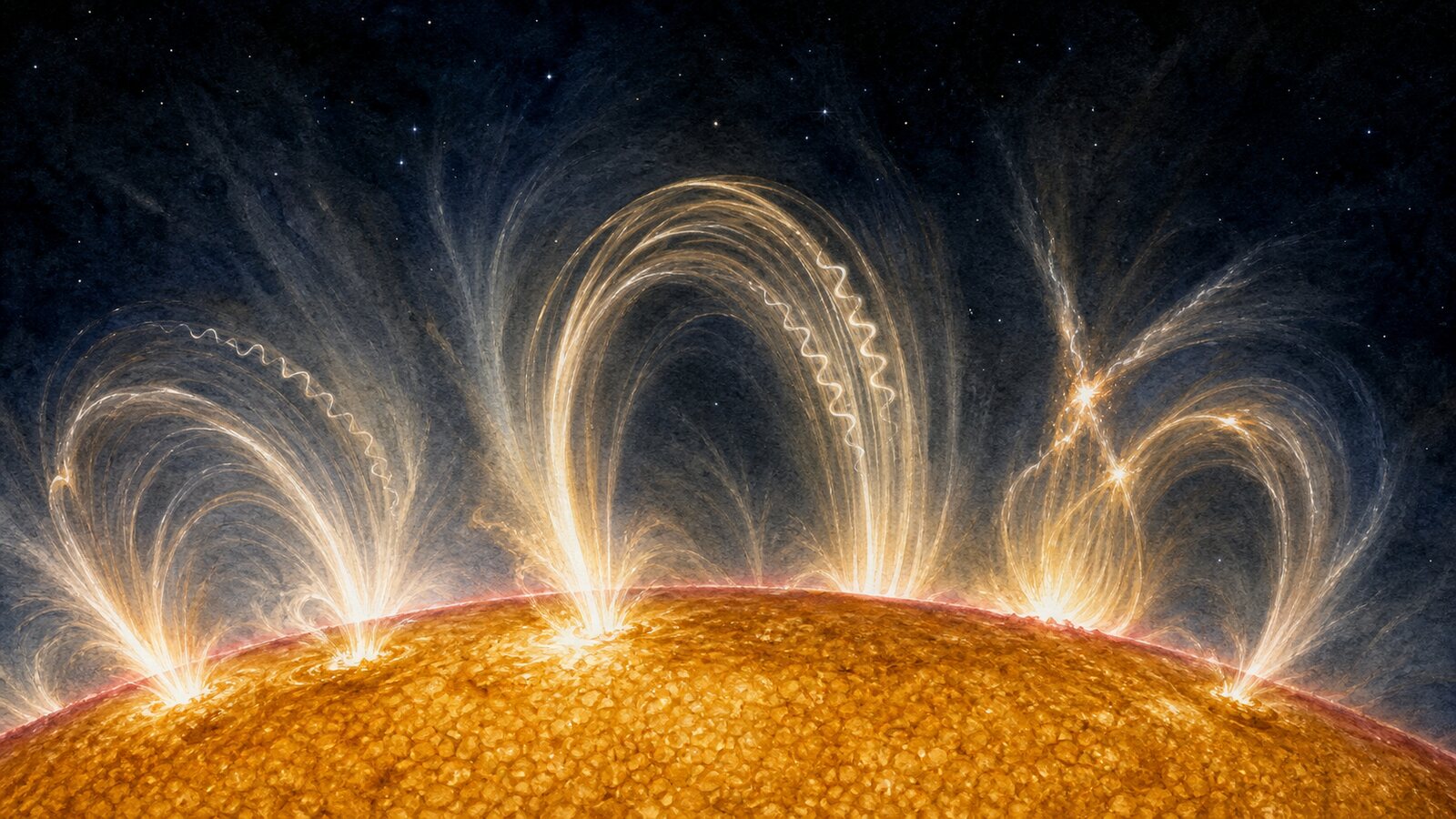
The ultimate reservoir begins with convection below the photosphere. Rising and sinking plasma continually shuffles, twists, and mixes the footpoints of magnetic fields at the surface. Those fields extend upward as closed loops and open bundles, allowing work done at the footpoints to reach the corona. Saying that magnetism matters is only the first step, however. A successful explanation must show how transported or stored magnetic energy is divided among ions and electrons in a tenuous plasma where ordinary collisions are comparatively infrequent.
One family of mechanisms begins with magnetohydrodynamic waves, including Alfvén waves. When convection shakes a field line, coupled disturbances in plasma and magnetic field travel along it and carry energy upward. Changes in density and field strength can reflect part of that traffic, letting oppositely traveling waves interact and form a turbulent cascade. At sufficiently small scales, phase mixing, resonances, and wave-particle interactions can convert coordinated oscillation into heat and nonthermal particle motion.
A second family invokes magnetic reconnection and nanoflares. As moving footpoints braid and stress coronal fields, thin regions of intense electrical current develop. Reconnection abruptly changes which field lines are connected and releases stored energy as local heating, fast particles, bulk flows, and waves. Each event may be far smaller than a conspicuous solar flare, yet a sufficiently frequent population could maintain a hot atmosphere. The prefix nano describes an energy scale; it does not imply that observers can isolate every event as a tiny visible spark.
Treating wave heating and reconnection as sealed rival boxes is also misleading. Reconnection can launch waves, while turbulence can create the narrow current sheets where reconnection occurs. Closed loops, open coronal holes, and dense active-region structures differ in geometry and plasma conditions, so they need not share one heating recipe. Observed wave power, transient brightenings, multi-temperature plasma, and species-dependent particle speeds supply constraints, but no instrument follows every step of the energy cascade everywhere at once.
A million-kelvin corona does not contain more total thermal energy per unit volume than every cooler layer below it. Temperature tracks average energy per particle, while heat transfer also depends on how many particles are present and how they interact. The corona is extraordinarily rarefied compared with the photosphere or Earth's lower atmosphere. Its particles can therefore be individually energetic while the energy delivered to an object remains limited by low density. A spacecraft's heating depends on actual energy flux, radiation, and shielding, not on the temperature number alone.
NASA's Parker Solar Probe approaches the region where the corona opens into the solar wind and directly samples fields, particles, and waves. By the time solar wind reaches Earth's orbit, expansion and interactions have altered much of the evidence about its origin. Measurements closer to the Sun test which wave populations survive, how intermittent magnetic structures behave, and where particles gain energy. Even so, sampling open-flow regions does not instantly settle how every closed coronal loop is heated; remote imaging, spectroscopy, modeling, and laboratory plasma physics remain essential.
The most defensible answer is therefore firm at one level and unfinished at the next. Photospheric convection works on magnetic footpoints. That energy travels as waves or accumulates in stressed fields, then turbulence, damping, reconnection, and particle interactions transform it. The corona stays hot when these inputs balance losses through radiation, thermal conduction, and the escaping solar wind. Its temperature inversion is not heat mysteriously flowing the wrong way. It is evidence that the outer atmosphere has its own magnetic machinery for receiving and dissipating energy.
EDITORIAL RESPONSIBILITY
FactosBrain Editorial Desk
The FactosBrain Editorial Desk researched and reviewed this article under our editorial policy. We assess error reports under our corrections policy.