Look a little closer
Stainless steel can rust. It resists corrosion better than ordinary steel because chromium creates an extremely thin, adherent passive film that slows reactions at the surface, not because the alloy is chemically untouchable. Concentrated chloride, stagnant crevices, an unsuitable grade, embedded iron, or damaged fabrication surfaces can defeat that protection locally and start a deep pit beneath a small stain.
Stainless steels are a family of iron-based alloys containing enough chromium for passivation, often with nickel, molybdenum, nitrogen, and other additions for particular properties. A commonly used definitional threshold is about 10.5 percent chromium, but crossing it does not give every grade identical resistance. Composition, microstructure, heat treatment, surface finish, and exposure all matter. 'Stainless steel' is therefore a category containing many materials rather than one universal metal.
The key defense is a chromium-enriched oxide region that develops naturally when the surface meets oxidizing conditions in air or water. Only a few nanometers thick, it is invisible yet greatly restricts transport between the alloy and its environment. If a light scratch exposes fresh metal where oxygen remains available, chromium can oxidize again and restore passivity. Unlike paint applied on top, the protective behavior comes from alloy constituents continually able to rebuild the surface.
Chloride ions from salt are especially troublesome. If chloride concentrates at a weak location in the film, a tiny area can become active and begin dissolving while the surrounding surface remains passive. Reactions inside the developing cavity lower its pH, and chloride migrates in to maintain charge balance. The confined chemistry then favors further attack. A pinprick opening can consequently hide a much deeper pit even while almost all of the steel still looks bright.
Narrow wet crevices create another unfavorable microenvironment. Beneath a washer, between overlapping plates, or beside a gasket, oxygen is consumed and replenished more slowly than on the open surface. The difference supports an electrochemical cell, while acidity and chloride can build inside the gap. Crevice corrosion is not simply proof that steel cannot rust without oxygen. It reflects an oxygen imbalance that leaves one confined region unable to sustain the same passive state as its surroundings.
Grade selection changes the margin of safety. Common 304-type stainless steel performs well in many indoor, food-handling, and ordinary atmospheric applications. Molybdenum-bearing 316-type grades generally improve resistance to chloride pitting, making them useful in more demanding settings. That does not make 316 immune to seawater. Rough surfaces retain deposits more easily, while an appropriately smooth finish is easier to rinse. Temperature, chloride concentration, flow or stagnation, crevice geometry, and finish may require a more highly alloyed steel or a different material. A grade number alone cannot guarantee service life.
A brown mark does not always prove that the stainless substrate has suffered a deep pit. Ordinary steel particles transferred from tools or abrasives can rust on top of it. Heat tint from welding can also leave an oxide scale and a chromium-depleted region beneath, reducing local resistance. Manufacturing treatments such as pickling remove scale and contamination, while suitable passivation procedures support formation of a clean passive surface. Cosmetic shine and metallurgical cleanliness are not the same result.
Maintenance aims to prevent an aggressive local solution from remaining in place, not to paint on a thick chromium shield. Removing deposited salt and cleaner residue according to the material's guidance, providing drainage, and avoiding carbon-steel contamination from shared tools can preserve the passive condition. Once a safety-critical part has pitting, polishing away the visible stain does not reveal how deep the cavity extends. Its environment, alloy, and remaining section may need professional assessment.
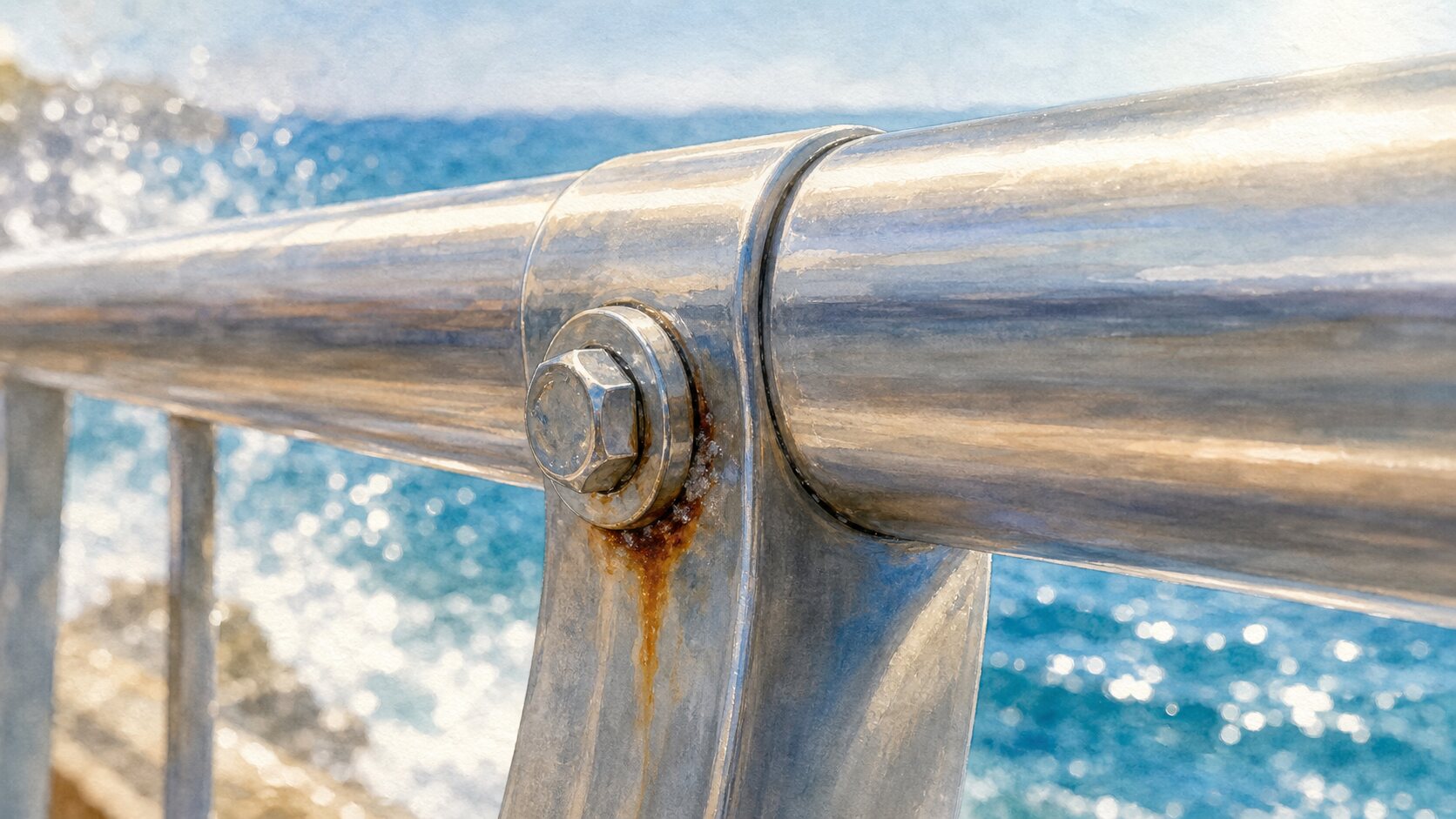
The word stainless describes strong resistance to staining and corrosion, not an absolute ban on rust. Across an open, oxygenated surface, the ultrathin film can be remarkably effective and self-renewing. In a few millimeters of salt-rich, oxygen-depleted crevice, the chemistry may cross the alloy's limit. A tea-colored streak confined to a coastal railing bolt is therefore a record of a local environment overwhelming passivity, not the entire rail suddenly turning into ordinary carbon steel.
EDITORIAL RESPONSIBILITY
FactosBrain Editorial Desk
The FactosBrain Editorial Desk researched and reviewed this article under our editorial policy. We assess error reports under our corrections policy.