Look a little closer
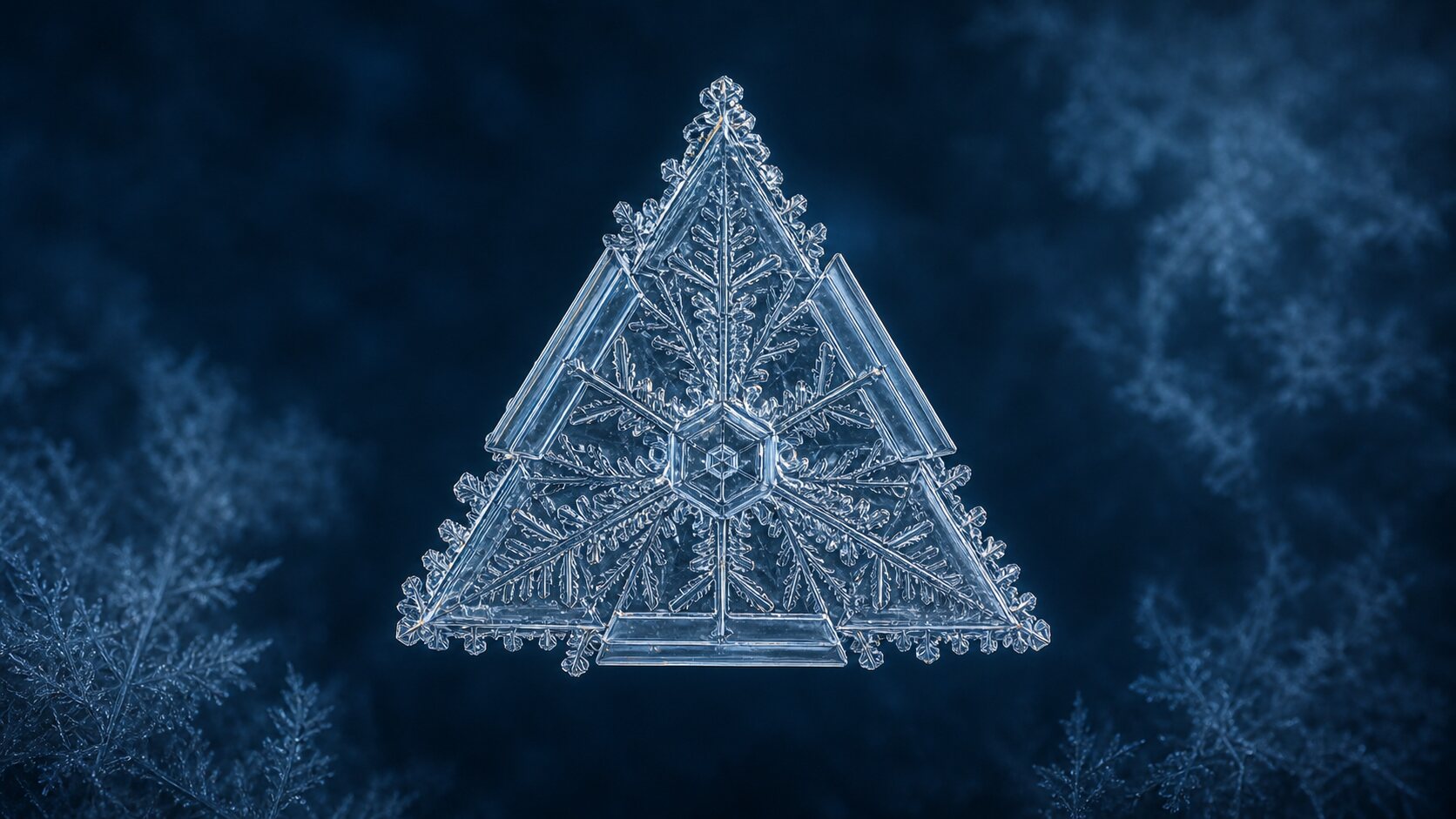
The familiar claim that snow crystals are hexagonal is broadly right. In ordinary hexagonal ice, called ice Ih, water molecules are arranged in a hexagonal lattice. That microscopic arrangement is expressed at a larger scale as a six-sided prism and, under suitable growth conditions, as six arms. Yet careful observers sometimes find thin snow crystals that look strikingly like equilateral triangles. They are not necessarily exceptions to the rules of ice. Many are better understood as six-sided crystals whose alternating sides grew so differently that only three long ones dominate the outline.
That distinction matters. A triangular-looking plate need not have changed from a six-sided molecular framework into a three-sided one. A thin plate of ordinary ice has six prism faces around its edge. If three alternating faces advance rapidly while the intervening three remain very short, the silhouette can look triangular from a distance. Under magnification, many examples are extremely uneven hexagons: the short sides are still present, but visually subordinate. The apparent symmetry of an outline and the symmetry of the crystal lattice are related, not interchangeable facts.
A snow crystal grows from water vapor, not from a pre-cut template. Vapor diffuses through air toward the ice, then molecules become incorporated at surfaces, steps, corners, and edges. Temperature, water-vapor supersaturation, and the surrounding gas affect how readily different parts grow. Even nominally equivalent faces can acquire tiny early differences in edge shape, orientation, or attachment kinetics. Crystal growth does not always erase those differences. Under some conditions it can amplify them into an orderly large-scale pattern.
A 2009 laboratory and theoretical study by Kenneth Libbrecht and Hannah Arnold proposed one route for thin triangular plates. If one face of a hexagonal plate is perturbed slightly, airflow around the falling or suspended crystal can alter how vapor reaches it. That aerodynamic feedback can favor the relative growth of alternating faces. A minute asymmetry may therefore develop into a three-direction pattern rather than remaining a single random defect. The proposal is a growth-instability model, not a claim that every threefold ice particle has one universal cause, but it helps explain why triangular plates appeared more often than purely random imperfections would suggest.
Later experiments showed that triangular-looking structures can be produced reliably under selected conditions. Working with plates grown on the ends of slender ice needles, Libbrecht reported high yields of trigonal forms near minus 14 degrees Celsius with sufficiently supersaturated water vapor. The result is especially useful because it separates shape selection from a change in the underlying material. The experiment did not turn hexagonal ice into a different three-sided substance. It altered the conditions under which the same hexagonal ice added molecules to its competing edges.
There is an important atmospheric caveat. Threefold ice crystals observed in very cold clouds, contrails, and diamond dust may not all belong to the same category as a thin triangular snow plate. Atmospheric researchers have proposed that some such particles are associated with stacking-disordered ice, in which hexagonal and cubic stacking sequences are interlaced. That internal arrangement can reduce the effective symmetry from sixfold to trigonal and may influence the external form. Thus aerodynamic growth feedback and stacking disorder are not rival labels to apply casually to every triangular image; they address potentially different particles and formation histories.
None of this overturns the usual explanation for six-armed snow crystals. Sixfold symmetry remains the powerful starting point supplied by ordinary ice Ih. The triangular case instead reveals that translating molecular symmetry into a visible shape is a dynamic process. A crystal may retain six allowed edge directions while its environment treats those directions unequally. Alternating directions then win the growth competition. Molecular symmetry tells us what forms are favored; transport and surface kinetics help decide which favored features become conspicuous.
A photograph alone rarely identifies the full path. A natural crystal may have rotated while falling, crossed several layers of humidity and temperature, collided with another particle, or partly sublimated after it formed. Its original internal stacking is not visible in an ordinary optical image. Researchers therefore combine field samples with controlled growth chambers, crystallographic evidence, and airflow or diffusion models. This is why a careful account keeps the explanation conditional instead of declaring a single simple reason for every triangular flake.
Triangular snow crystals are a compact lesson in pattern formation. A hexagonal lattice provides six related directions; vapor diffusion, attachment at edges, air motion, and sometimes internal stacking can make some directions outpace others. The rare triangle is not nature breaking geometry. It is geometry filtered through a detailed growth history. In one tiny ice crystal, the arrangement of water molecules and the changing conditions of a cloud can both leave a visible trace.
EDITORIAL RESPONSIBILITY
FactosBrain Editorial Desk
The FactosBrain Editorial Desk researched and reviewed this article under our editorial policy. We assess error reports under our corrections policy.