Look a little closer
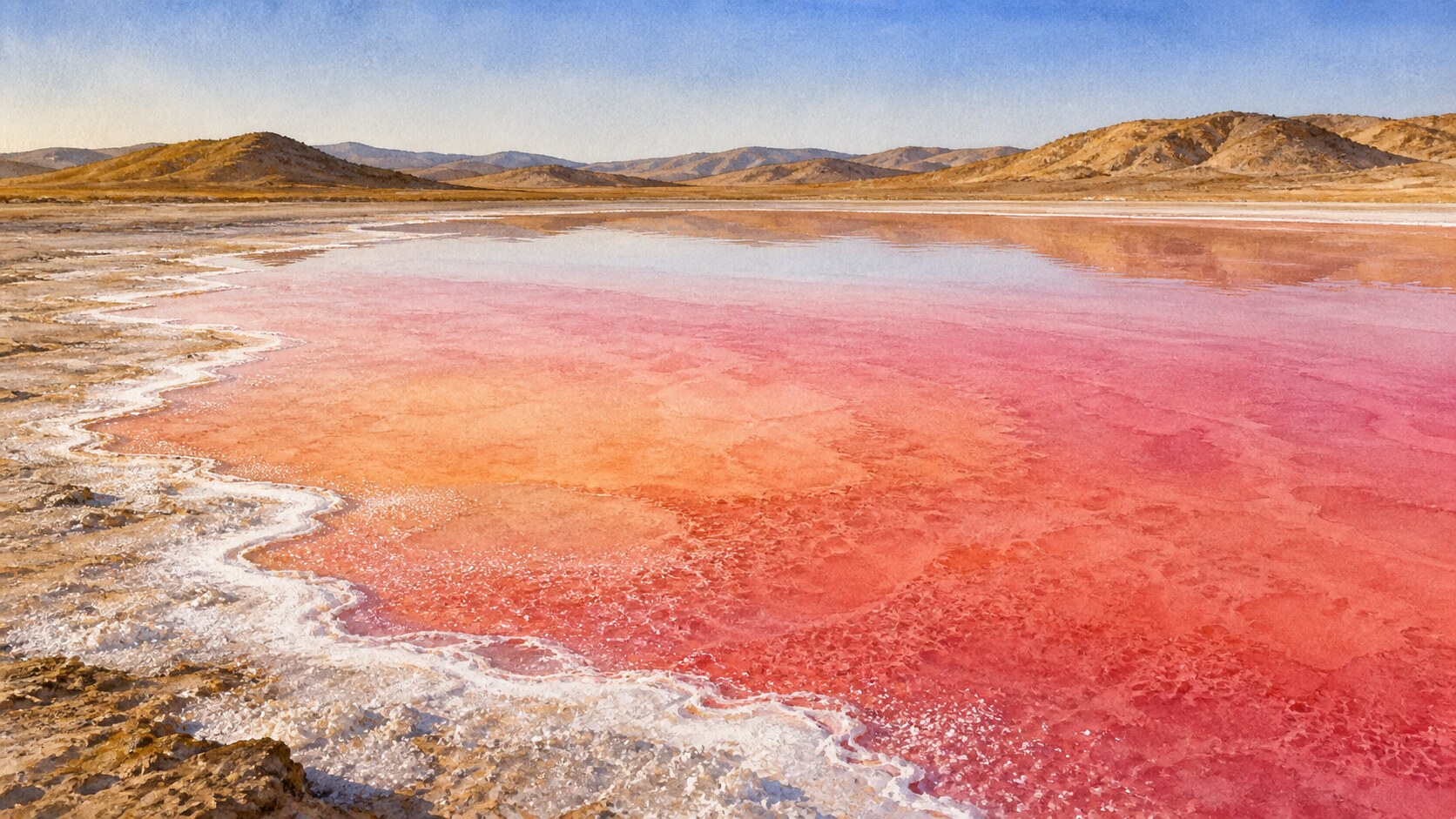
Some salt lakes look pink because enormous populations of salt-tolerant algae, archaea, and bacteria contain orange, red, or purple pigments. The salt itself is normally colorless in solution and white when it crystallizes. Evaporation raises salinity, excludes many ordinary aquatic organisms, and can favor microbes adapted to concentrated brine. Their pigments become visible collectively against shallow water and pale salt. The responsible community differs among lakes, so no single microorganism explains every pink lake.
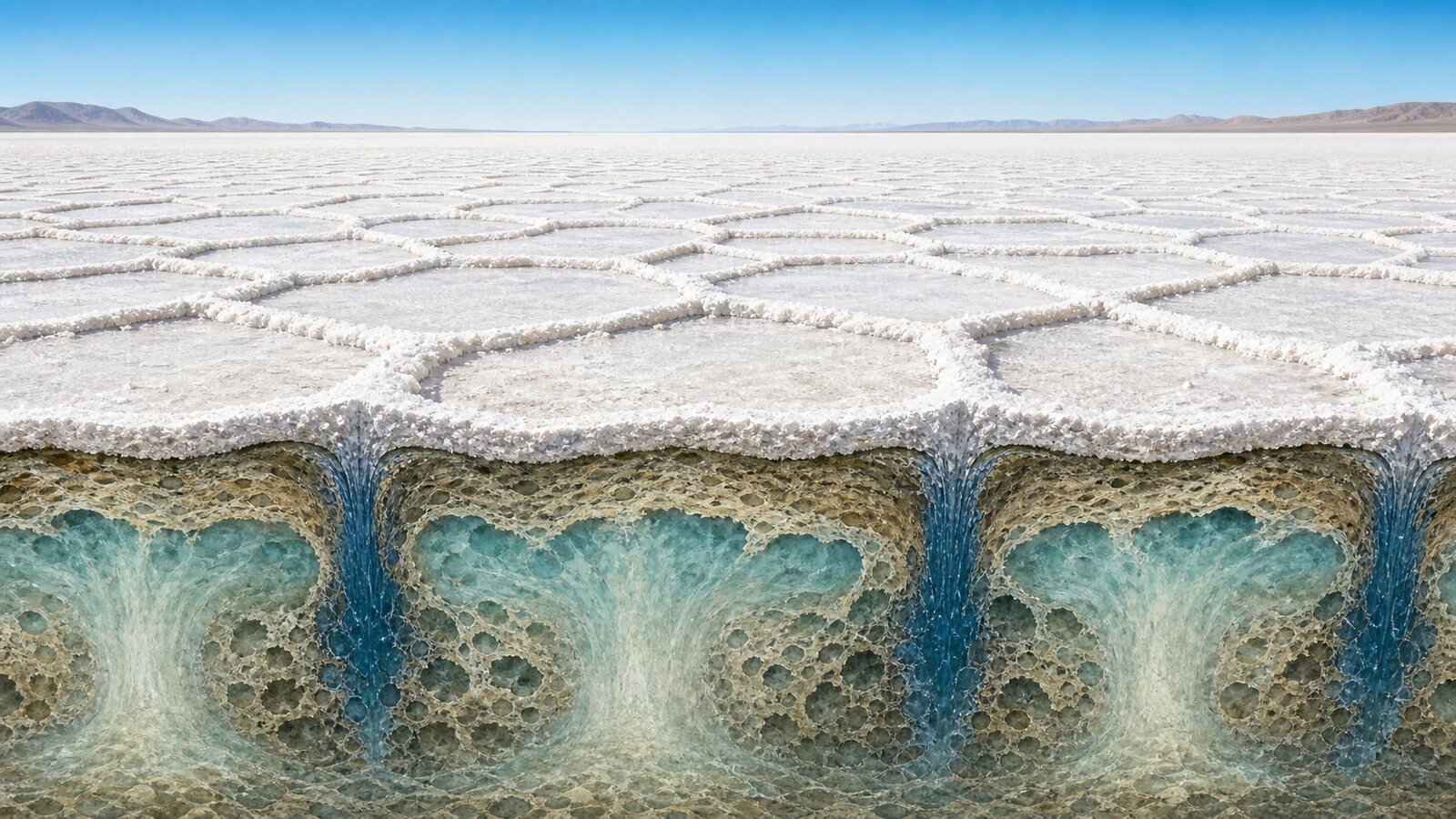
The setting usually begins with a basin that has little or no outlet. Streams and groundwater deliver dissolved ions, but water leaves mainly through evaporation. Salts therefore remain behind and become concentrated as the lake shrinks during dry periods. White crusts can form around the margin while the remaining brine grows more extreme. European Space Agency observations of East Africa's Lakes Natron and Magadi show how algae-rich red and pink colors can become conspicuous during the dry season as evaporation concentrates the salts. Pink is an ecological and hydrological state, not necessarily a permanent property of a lake.
A frequently important organism is the single-celled green alga Dunaliella salina. Under intense light and high-salinity stress, it can accumulate large quantities of beta-carotene. These orange-red carotenoid molecules help protect the photosynthetic machinery from excessive light and oxidative damage. When enough pigment builds up, it can overwhelm the green appearance of chlorophyll. Australian wetland material notes that Dunaliella is only part of the palette: carotenoid and retinal-based pigments in other salt-loving microorganisms can contribute to the visible color as well.
Many haloarchaea—the archaea adapted to very salty habitats—carry red carotenoids, while some use rhodopsin-family pigments associated with harvesting light energy. Salt-loving bacteria such as Salinibacter can add orange-red cells to the mixture. One cell is microscopic and nearly invisible to a visitor, but dense populations change which wavelengths a large body of water absorbs and reflects. A bright lake bed and suspended salt crystals can return additional light through the colored brine, making the effect conspicuous from shore or aircraft.
Research on Western Australia's Lake Hillier illustrates why a one-species story is risky. Scientists combined metagenomic sequencing of environmental DNA with culture-based work to survey the lake's water and sediment. They found a diverse community of algae, bacteria, archaea, and viruses, including multiple potential pigment producers such as Dunaliella, Salinibacter, Halobacillus, Psychroflexus, and Halorubrum. The study does not prove that every organism contributes equally to the color. It does show that Hillier's pink appearance is better investigated as a community-level outcome than assigned automatically to one famous alga.
Salt acts as an ecological filter rather than a dye. High salinity tends to draw water out of cells, placing organisms under osmotic stress. Halophiles survive by accumulating compatible solutes or ions and by using proteins and membranes that remain functional in brine. As less tolerant competitors disappear, specialized microbes can reach densities high enough to color the water. More salt does not guarantee a deeper pink, however. A particular combination of salinity, light, nutrients, temperature, and species composition must favor organisms and pigments that produce the visible hue.
The same lake can fade or change color. Rain and freshwater inflow dilute salts, potentially reducing pigment accumulation in Dunaliella or allowing other algae to dominate. Lower water levels during drought can concentrate both salts and cells, but very shallow or drying conditions also change how the bottom reflects light. Nutrients, temperature, wind-driven gathering of cells, clay, and gypsum can shift the observed shade. A single aerial photograph therefore cannot establish a lake's normal color or identify its microbial population.
Satellite imagery introduces another boundary. Natural-color products approximate what human eyes would see, but scientists also combine near-infrared bands with visible light to reveal vegetation, turbidity, or other surface properties. Red pixels in a false-color image are not automatically pink water. In its description of East African salt lakes, the European Space Agency distinguishes naturally red or pink algae-rich waters from strong reds introduced by near-infrared processing. Interpreting an image requires its date, water level, band combination, and preferably samples from the lake.
Pink salt lakes overturn the idea that an extreme lake is simply lifeless. Fish and many freshwater species may be excluded, yet salt-tolerant microbes form a productive community, sometimes supporting invertebrates and migratory birds. Changes to water inflow, groundwater, salt harvesting, or climate can alter salinity and reorganize that community, causing the color to weaken or vanish. The pink surface is therefore more than scenery. It is a visible signal that hydrology, salt, sunlight, and a pigment-rich microbial community have temporarily aligned.
EDITORIAL RESPONSIBILITY
FactosBrain Editorial Desk
The FactosBrain Editorial Desk researched and reviewed this article under our editorial policy. We assess error reports under our corrections policy.