Soap removes grease by dispersing it in water so the rinse can carry it away, not by making the oil cease to exist. Each soap molecule contains one region that associates with oil and another that interacts with water. That split personality lets soap connect two liquids that ordinarily separate.
Water is polar: its electrical charge is distributed unevenly. Many components of cooking oil and skin grease are largely nonpolar. Water molecules strongly attract one another but do not mix readily with those oils, so plain rinsing leaves the grease gathered in droplets or a film. This is separate from density. Density helps determine whether oil floats, while molecular polarity helps determine whether oil and water mix.
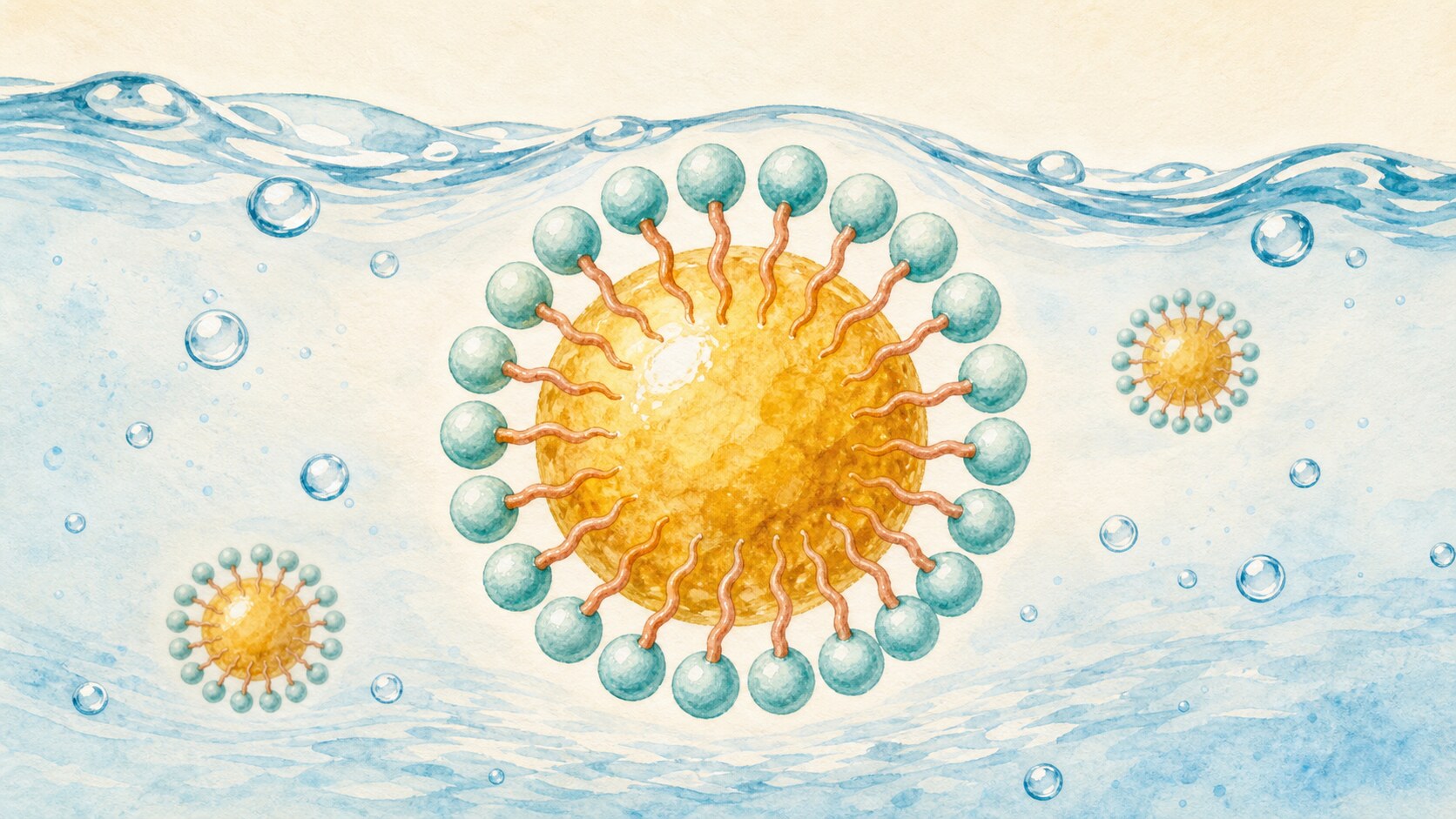
A soap molecule is a surfactant with a long nonpolar hydrocarbon tail and a charged, water-friendly head. The tail embeds in grease while the head remains in the surrounding water. Soap also lowers water's surface tension, allowing the wash water to spread across and penetrate a soiled surface more effectively.
Mechanical action matters too. Rubbing hands or scrubbing a pan breaks a large greasy layer into smaller droplets and exposes more oil-water boundary for soap molecules to occupy. Around each droplet, the tails point inward toward the oil and the heads face outward into the water. These organized clusters are called micelles.
Because the exterior of a micelle interacts with water, the trapped grease can remain dispersed instead of immediately rejoining the larger film. Charged outer surfaces also help keep neighboring droplets apart. A generous rinse then moves the micelles and their oily contents off the surface. Applying soap without rinsing leaves that transport job unfinished.
The water itself can change the result. Calcium and magnesium ions in hard water react with traditional soap to form poorly soluble salts. This consumes useful soap and leaves familiar scum behind. Many synthetic detergents use related surfactant chemistry but are designed to avoid forming the same insoluble deposits in hard water.
Grease is only one category of soil. Protein, starch, pigments, rust and mineral scale may require enzymes, acids, oxidizers or other chemistry. Soap excels at oily dirt not because it destroys every contaminant, but because its two-sided molecules package oil into movable droplets that water can finally take away.
EDITORIAL RESPONSIBILITY
FactosBrain Editorial Desk
The FactosBrain Editorial Desk researched and reviewed this article under our editorial policy. We assess error reports under our corrections policy.