Look a little closer
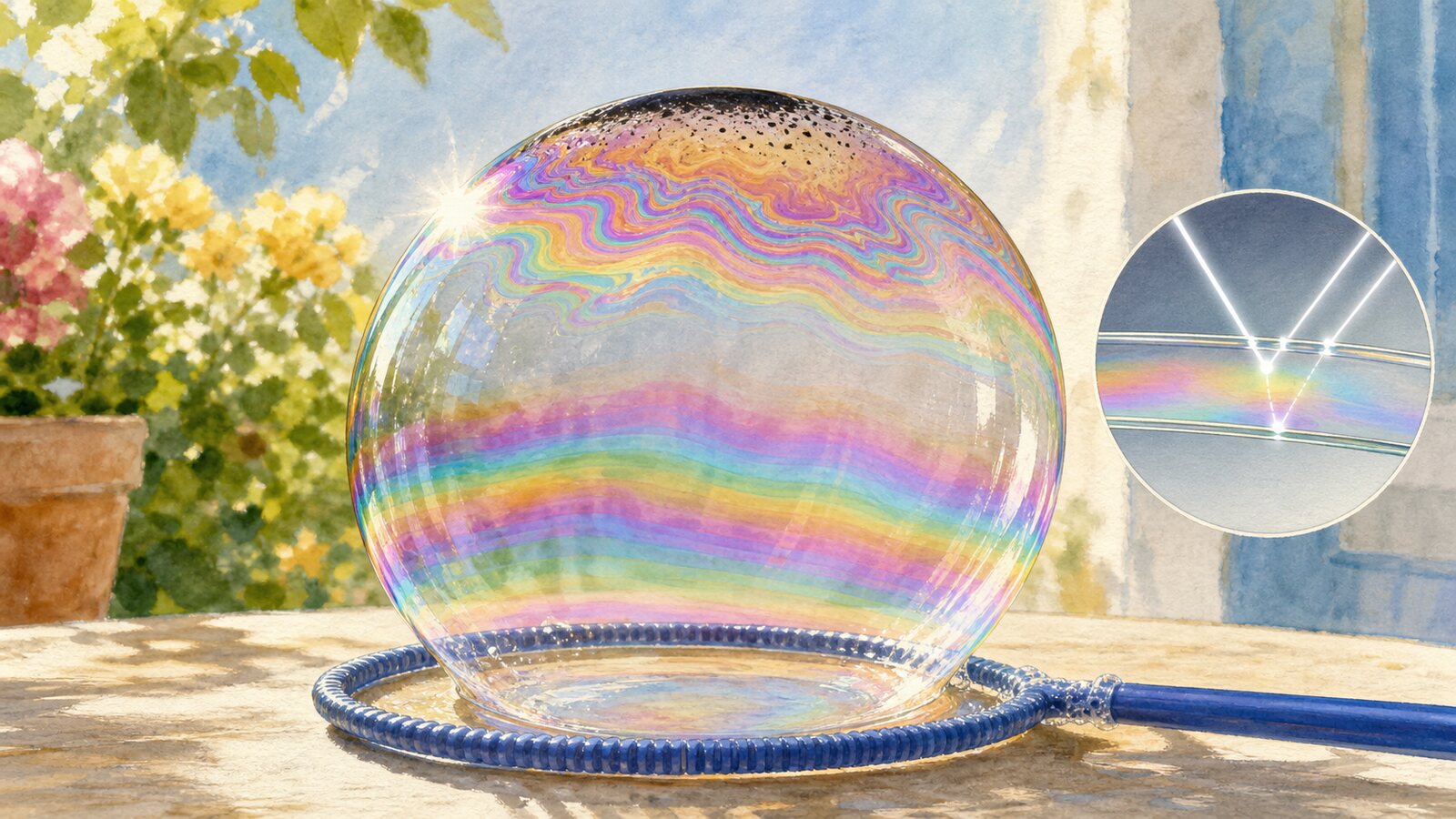
The rainbow bands on a soap bubble come from thin-film interference, not from one prism-like splitting of light. White light reflects from both the outer and inner surfaces of the bubble wall. Those two reflections can reinforce or cancel particular wavelengths, and small changes in film thickness make different colors dominate from place to place.
A bubble wall is not a solid shell of soap. It is a very thin liquid layer, mostly water, stabilized by surfactant molecules at its two air-facing boundaries. Surfactants alter surface tension and slow the rapid failure of a broad sheet of water. The film is still far thinner than a hair, and strongly colored regions can be only hundreds of nanometers thick—comparable to visible wavelengths. At that scale, the extra distance traveled by one reflected wave matters.
When white light reaches the film, one portion reflects at the first air-to-liquid boundary. Another portion enters, reflects from the second liquid-to-air boundary, and emerges again. The second ray has traveled farther, so its wave crests do not necessarily arrive alongside those of the first. Reflection from lower-index air toward higher-index liquid also introduces a half-cycle phase shift at the first surface. Depending on the combined phase difference, a wavelength is strengthened by constructive interference or weakened by destructive interference.
The selected color depends on film thickness, refractive index, illumination angle, and viewing angle. Green reflections might add at one point while red largely cancels; a slightly thinner neighboring patch may emphasize violet or gold instead. The color is therefore not fixed to the surface like pigment. Move the bubble, the lamp, or your head, and the path geometry changes, allowing the same patch to shift color. A light source lacking part of the visible spectrum cannot produce that missing color either.
The patterns flow because the liquid itself is moving. Gravity drains water downward, generally leaving the upper region thinner and the lower region thicker. Surface flows and temperature variations make the thickness ripple, while evaporation gradually removes water. Lines of similar thickness produce related interference colors, so the bands function like contour lines on an invisible thickness map. In vertical-film demonstrations, horizontal fringes migrate as drainage changes that map.
A relatively thick film may look pale or silvery because many interference orders and tiny thickness variations overlap within what the eye can resolve. As it thins, separated bands can become vivid. It is too simple to say that red always means the thickest film and violet the thinnest. Conditions that strengthen a given wavelength recur at multiple thicknesses, and angle and refractive index shift them. The surface is not a single rainbow ruler with each color occurring only once.
A black patch near the top provides an especially revealing final stage. When the film becomes extremely thin compared with visible wavelengths, the geometrical path difference between its two reflections approaches zero, yet the phase reversal at the first surface remains. The reflected waves then cancel over much of the visible spectrum, returning very little light to the observer. No black dye has appeared; the region is dark because reflection is suppressed. Such a black film can precede rupture, although molecular forces and a suitable surfactant mixture may stabilize an ultrathin patch briefly.
This is different from the rainbow made by raindrops. An atmospheric rainbow relies chiefly on refraction, internal reflection, and dispersion, which send different wavelengths out at different angles. A soap film relies on phase differences between light returned by two very close boundaries. Oil slicks, thin oxide layers, and some optical coatings show related colors because their layer thickness is also comparable with the wavelength of light.
Bubble diameter and the original color of the soap therefore do not determine the band sequence by themselves. What the eye reads is the local wall thickness and viewing geometry. A broad white light and a dark background often make the weak reflected colors easier to see. The moving display is a live measurement of drainage, evaporation, and surface flow acting on a nanometer-scale sheet. As color bands drift and give way to a dark patch, the bubble is using visible wavelengths as its own thickness gauge.
EDITORIAL RESPONSIBILITY
FactosBrain Editorial Desk
The FactosBrain Editorial Desk researched and reviewed this article under our editorial policy. We assess error reports under our corrections policy.