Sign language is not universal because signed languages, like spoken ones, arise and change within communities. They are not ciphers that replace each spoken word with a gesture. Deaf communities develop complete systems of vocabulary and grammar through generations of interaction.
A sign is distinguished by more than its handshape. Location, orientation, movement and the relationship between two hands can change its form, while facial expression and movements of the head or body may carry grammatical information. The rules combining these elements are not identical across sign languages.
Some signs resemble an object's shape or an action and may look intuitive. Iconicity does not make them universal, however. Unrelated languages can conventionalize different forms for the same idea, and many meanings become clear only through shared usage. Spoken languages likewise contain sound-imitating words without forming one global language.
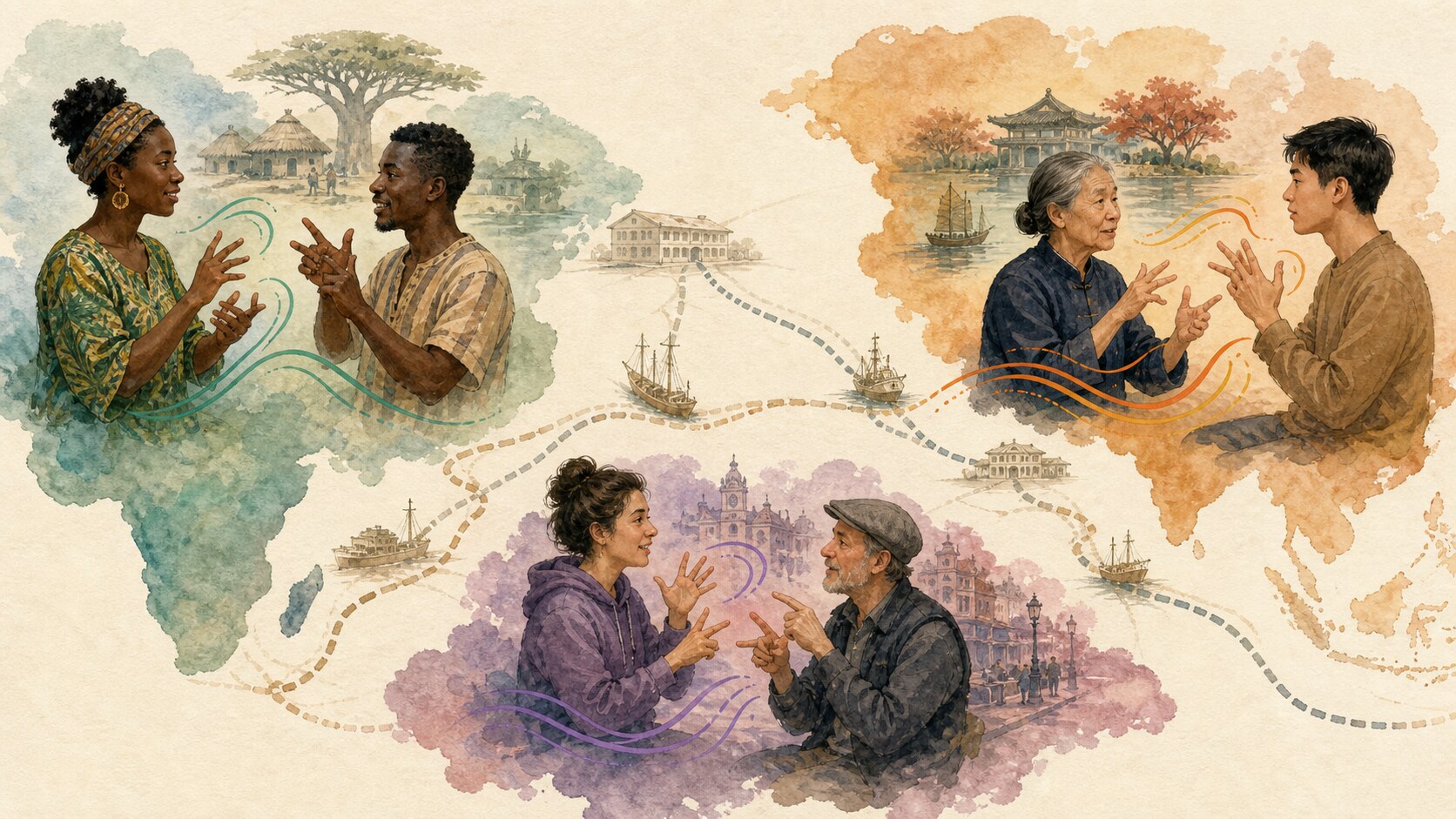
When communities are separated, their expressions accumulate and change independently. The founding of schools for Deaf students, movement of teachers and pupils, and contact among local communities have all shaped how particular languages spread or mixed. Their historical families therefore do not have to follow the borders of surrounding spoken languages.
The United States and Britain both predominantly use English, yet American Sign Language and British Sign Language are separate and are not automatically mutually intelligible. ASL is generally described as developing from a mixture of existing signs in America and influence from French Sign Language in the nineteenth century. Modern ASL and French Sign Language are nevertheless distinct.
Variation also exists within countries, where regional dialects or multiple sign languages may coexist. Conversely, communities across national borders can use related languages because their schools and Deaf networks were historically connected. Calling a sign language the signed version of a local spoken language hides this linguistic independence and diversity.
International Sign is used to support communication among signers from different backgrounds at international events. It is not a fixed universal mother tongue used by all Deaf people; its forms are adjusted to context and participants' linguistic experience. Accessibility providers should therefore identify the specific sign language required instead of requesting an unspecified sign-language interpreter.
EDITORIAL RESPONSIBILITY
FactosBrain Editorial Desk
The FactosBrain Editorial Desk researched and reviewed this article under our editorial policy. We assess error reports under our corrections policy.