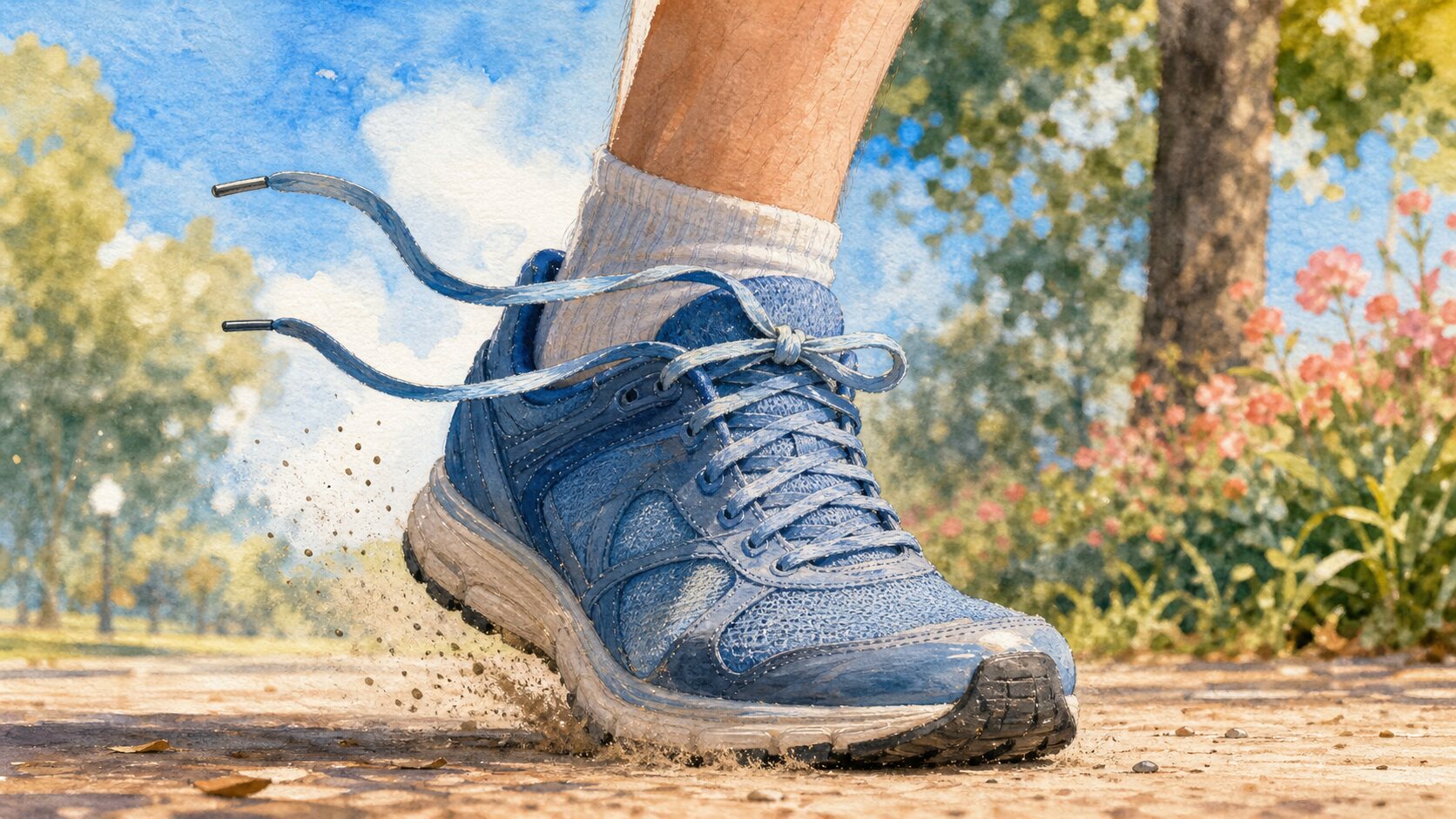
Look a little closer
A shoelace can come untied while walking or running because repeated foot strikes deform and loosen the knot, after which the inertia of the swinging loops and free ends pulls lace through its center. Together, those effects can push an apparently stable bow past a threshold and produce complete failure within one or two strides. Poor initial tightening makes failure easier, but dynamic loading can also work on a knot that began in a respectable state.
A common shoelace bow starts with one half-knot and adds a second, slipped half-knot made with loops. Friction and the tight curvature of lace inside the center hold the finished structure together. That restraint is not a permanent bond. If the center opens slightly, contact pressure and friction fall, leaving more room for a loop or free end to slide. Untying is a feedback process that enlarges this initially small freedom.
In 2017, UC Berkeley researchers filmed a runner's shoes at 900 frames per second and placed accelerometers beneath the knots. The video showed little obvious change over many strides. Then a free end began pulling through the center in place of its corresponding loop, and the bow collapsed within another one or two steps. The knot had been changing slowly, but most visible length change occurred at the end, explaining why failure feels sudden to the wearer.
Ground impact supplies the first part of the mechanism. When the heel or sole hits, the shoe and knot experience a short, large acceleration and repeatedly stretch and relax. The Berkeley team measured running peaks near seven times gravitational acceleration at the knot. Rather than opening the bow in a single blow, these impulses deform its center cycle after cycle. That incremental loosening lowers the frictional barrier that had kept the strands from moving relative to one another.
Leg swing supplies the second part. As the foot accelerates forward and backward, free lace ends and loops tend to preserve their motion, so they whip relative to the knot. A tight center can resist those inertial pulls. Once impact has created enough slack, a free end slips outward. The growing end then experiences a greater inertial effect while its matching loop becomes smaller, creating an imbalance that makes the next slip larger. This positive feedback produces runaway untying.
The researchers separated the effects by swinging a shoe without striking the ground and by stamping without the usual leg swing. Neither motion alone readily reproduced complete failure over comparable cycles. They also added small weights to free ends; greater inertial loading increased the rate and frequency of untying. The important sequence is therefore not merely “the shoe hits hard” or “the laces flap.” Impact weakens the frictional lock, and swing provides the pull that exploits it.
Two bows that look similar can also have different internal topology. If the first half-knot and the bowed half-knot have opposite handedness, the result is the stronger, square-knot-like form. Repeating the same handedness creates a weaker granny-knot form. In the experiments, the weak form failed more frequently and slipped faster under cyclic impacts. Loops that settle neatly across the shoe are often a clue to the stronger form, while loops twisting along the shoe may indicate the weaker one, although lace shape can make appearance an imperfect test.
A strong bow is not invulnerable. Lace material, surface friction, round or flat cross-section, coatings, initial tightening, the lengths of loops and tails, and gait can all change the time to failure. Very long free ends have more room to whip and snag. Tightening the center firmly, balancing loop and tail lengths, tying the two half-knots with opposite handedness, and using an activity-appropriate secondary securing method all raise the number of loading cycles the bow can tolerate.
Sudden untying does not mean the knot forgot how to hold in one instant. Each strike erodes a little of its frictional margin, and each swing tests the loosened center. Once one tail becomes sufficiently longer than its loop, inertial imbalance amplifies itself and pulls the bow apart. The lace can therefore remain visually unchanged for minutes and fail in seconds because slow preparation and fast runaway occupy two different time scales.
EDITORIAL RESPONSIBILITY
FactosBrain Editorial Desk
The FactosBrain Editorial Desk researched and reviewed this article under our editorial policy. We assess error reports under our corrections policy.