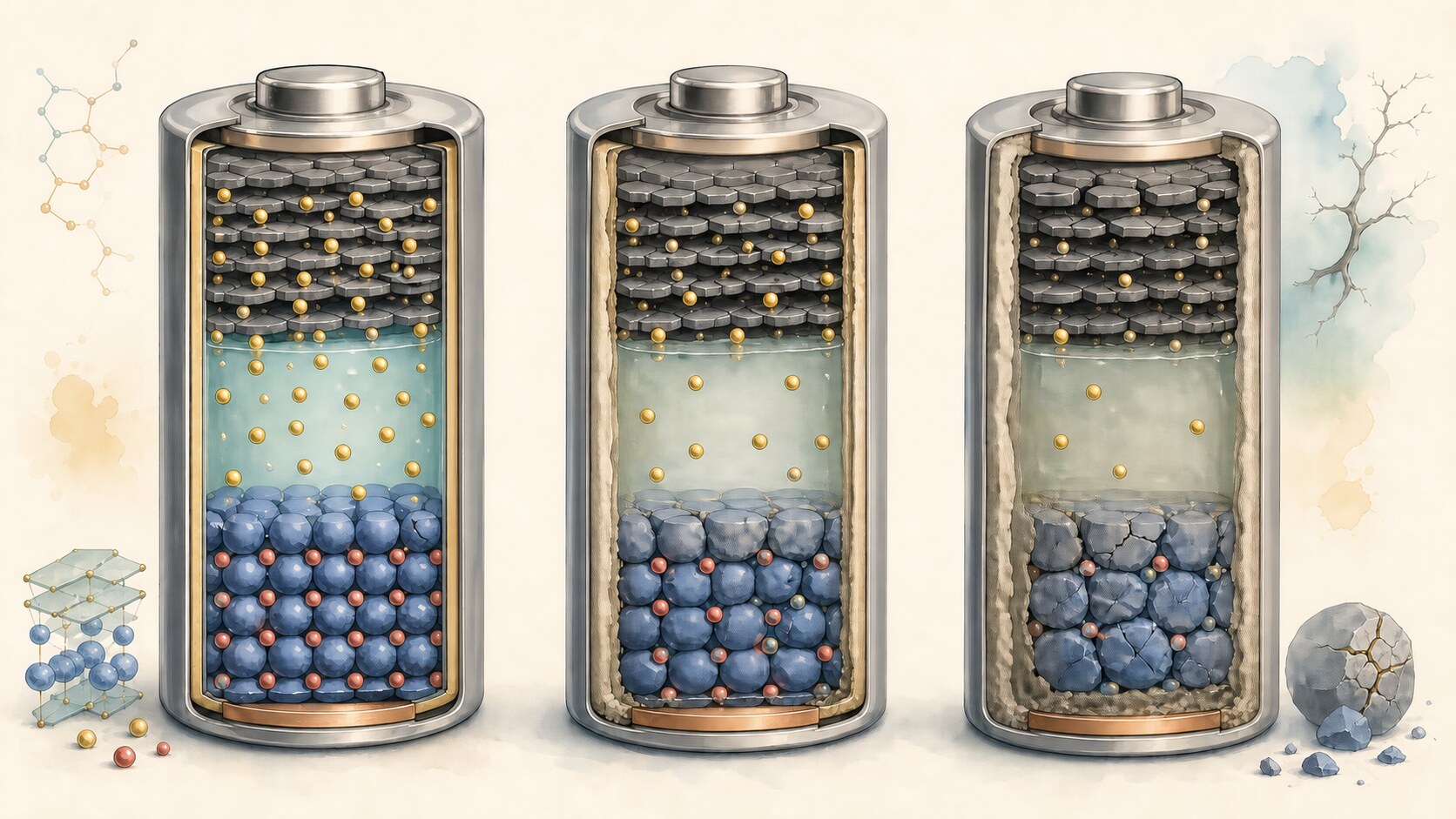
A rechargeable battery is not a bucket that simply receives electrons again. In a lithium-ion cell, lithium ions shuttle between two electrodes while the electrode materials change chemical state. That trip is never perfectly reversible. With use, less lithium and active material remain available for storage, while internal resistance makes current harder to move.
During early charging, part of the electrolyte decomposes on the anode and forms the solid-electrolyte interphase, or SEI. This film is necessary because it limits further decomposition, but forming and repairing it consumes lithium and electrolyte. As the layer grows, it can also become a larger barrier to ion transport, affecting power and charging efficiency.
Electrode particles expand and contract as lithium enters and leaves. Repeated mechanical strain can crack particle boundaries and interrupt electrical connections. In research on an NCA cathode highlighted by Argonne National Laboratory, intergranular cracks reduced conducting pathways and increased impedance, leaving part of the electrode with a sluggish charging response. That was a major source of the observed capacity fade in that particular material and test.
Charge rate and temperature can change the reaction pathway. During very fast charging, lithium may fail to enter graphite quickly enough and instead deposit as metallic lithium on its surface. Real-time X-ray work described by the National Renewable Energy Laboratory showed increasingly uneven charging through an electrode at higher rates, with plating concentrated near the separator. A cold cell is generally more vulnerable to this problem.
Heat accelerates unwanted side reactions, and keeping some chemistries at a high state of charge for long periods can also increase aging. Battery-management systems slow the process by limiting voltage, current and temperature and by keeping displayed zero and 100 percent inside the cell's true chemical limits. Users cannot stop aging, but avoiding unnecessary heat and following the manufacturer's charging guidance can reduce avoidable stress.
Not every rechargeable battery ages at the same rate or by exactly the same mechanism. Cathode and anode materials, electrolyte, cell design, calendar time, temperature, charging rate and depth of cycling all matter. It is therefore more accurate to see capacity loss as the accumulated result of interphase growth, particle damage, electrolyte reactions and lost lithium than as a countdown to one fixed number of charges.
EDITORIAL RESPONSIBILITY
FactosBrain Editorial Desk
The FactosBrain Editorial Desk researched and reviewed this article under our editorial policy. We assess error reports under our corrections policy.