Look a little closer
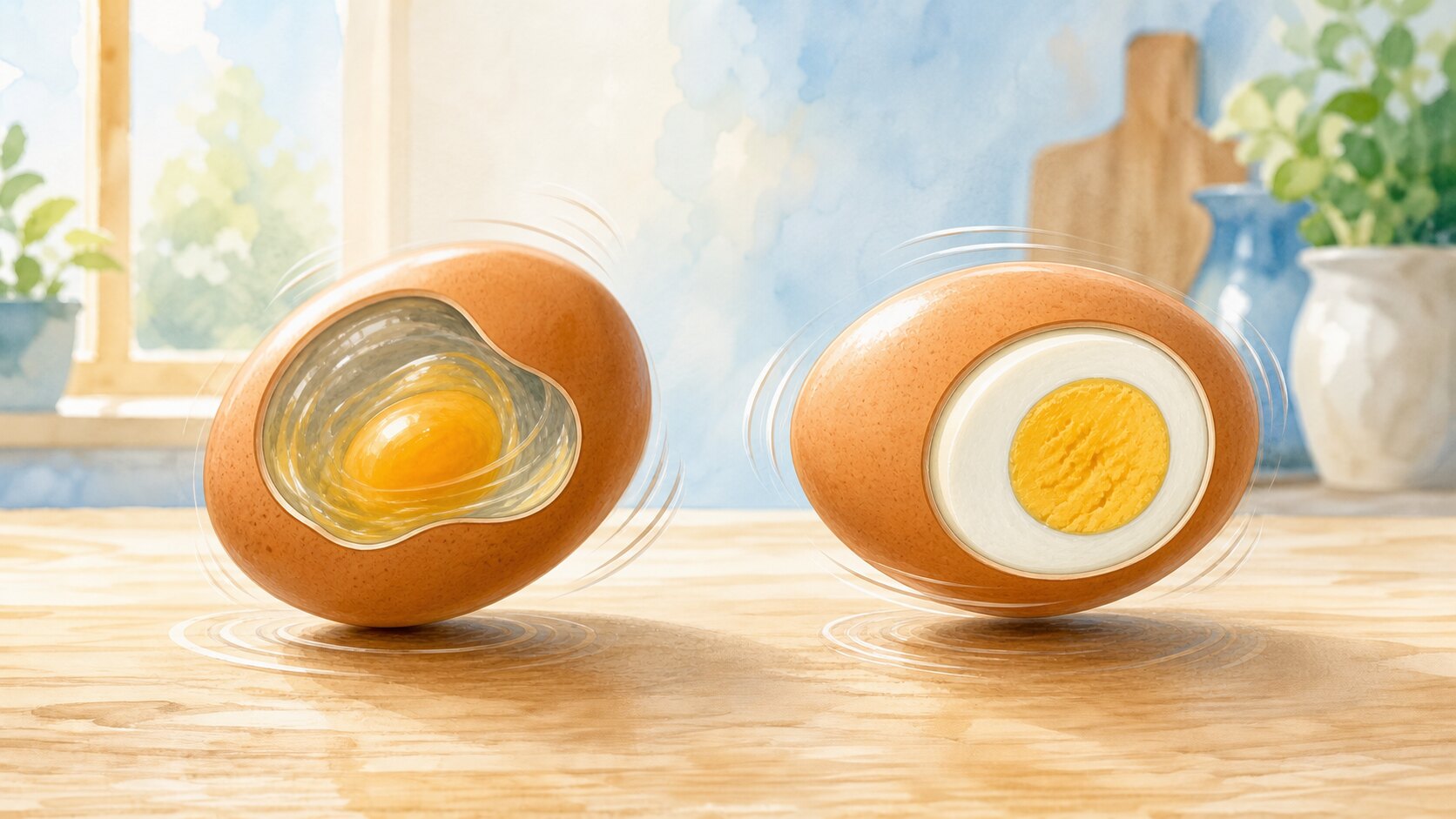
Given a similar twist, a hard-boiled egg tends to spin quickly and smoothly, whereas a raw egg turns sluggishly, wobbles, and stops sooner. The cooked interior is locked to the shell and rotates nearly as one rigid body. In a raw egg, the shell moves first while the liquid white and yolk are dragged into rotation through viscosity, dissipating useful rotational energy through internal shear.
The difference begins during the flick. Your fingers apply a brief torque to the shell, giving it angular momentum immediately. In a hard-boiled egg, coagulated white and yolk cannot slide freely past one another, so nearly the entire mass responds with the shell. In a raw egg, fluid nearest the inner membrane starts moving first, while fluid closer to the center initially lags because of inertia. Identical-looking shells therefore do not receive the same whole-body rotation from the same hand motion.
The lagging liquid does eventually catch up. Different fluid layers have different speeds, creating shear, and viscosity transfers momentum from the faster outer layers toward the slower interior. That coupling also drags back on the shell and converts some organized rotational energy into heat and complicated internal flow. As a University of Illinois physics explanation notes, the layers approach an intermediate common speed only after this redistribution. By then the raw egg has already lost more of the motion that would keep a rigid egg spinning briskly.
The same imperfect coupling helps explain the wobble. An egg is not a sphere, so its moving contact point with the table lets gravity and friction exert small torques as the body tilts. A cooked egg has a fixed mass distribution relative to its shell and can settle into rotation about a comparatively stable axis. In a raw egg, the internal flow responds late to each change in the shell and then pushes back. Tilt and speed fluctuate more visibly while internal dissipation continues.
A stop-and-release test makes the hidden motion especially clear. Spin both eggs, touch each shell just long enough to stop it, and release immediately. The hard-boiled egg remains still because its exterior and interior stopped together. The raw egg often begins turning again. During the brief touch, the shell was braked while much of the liquid retained angular momentum. After release, viscous coupling between that moving liquid and the stationary shell pulls the shell back into motion.
No angular momentum appears from nowhere in this demonstration. Your finger and the table exert external torques, so the angular momentum of the egg by itself is not perfectly conserved through the stop. The important point is timing: a short touch can halt the low-mass shell before friction has had time to halt every internal fluid layer. The remaining motion is then transferred outward. Hold the raw egg still for long enough, and its contents also stop; it will no longer restart when released.
A rapidly spun hard-boiled egg may also rise from its side and rotate on one end. The Exploratorium's classroom activity says the effect becomes practical above roughly ten revolutions per second. Friction acting at an off-center, changing contact point redirects the rotation and lifts the center of mass, even as total mechanical energy is being lost. A raw egg generally cannot sustain the same fast, coherent motion because its fluid interior dissipates energy and fails to behave as a rigid rotor.
One spin is not a precision measurement of doneness. Egg shape, surface roughness, starting speed, initial tilt, and the viscosities of white and yolk all affect the result. A soft-boiled egg has both solid and fluid regions and can behave somewhere between the two extremes; refrigeration also changes fluid viscosity. The method is therefore a useful nondestructive comparison between clearly raw and thoroughly cooked eggs, not a timer capable of distinguishing every stage of cooking.
For a safe kitchen version, use a clean, flat plate or a shallow tray and spin gently enough that a raw egg cannot roll onto the floor. The lesson is not that liquids refuse to rotate. It is that a liquid takes time to receive boundary motion through viscosity, and that shearing layers dissipate energy while doing so. Cooking barely changes the egg's total mass, but it transforms sliding internal parts into one coupled rotor—and that mechanical change becomes visible before the shell is ever cracked.
EDITORIAL RESPONSIBILITY
FactosBrain Editorial Desk
The FactosBrain Editorial Desk researched and reviewed this article under our editorial policy. We assess error reports under our corrections policy.