Look a little closer
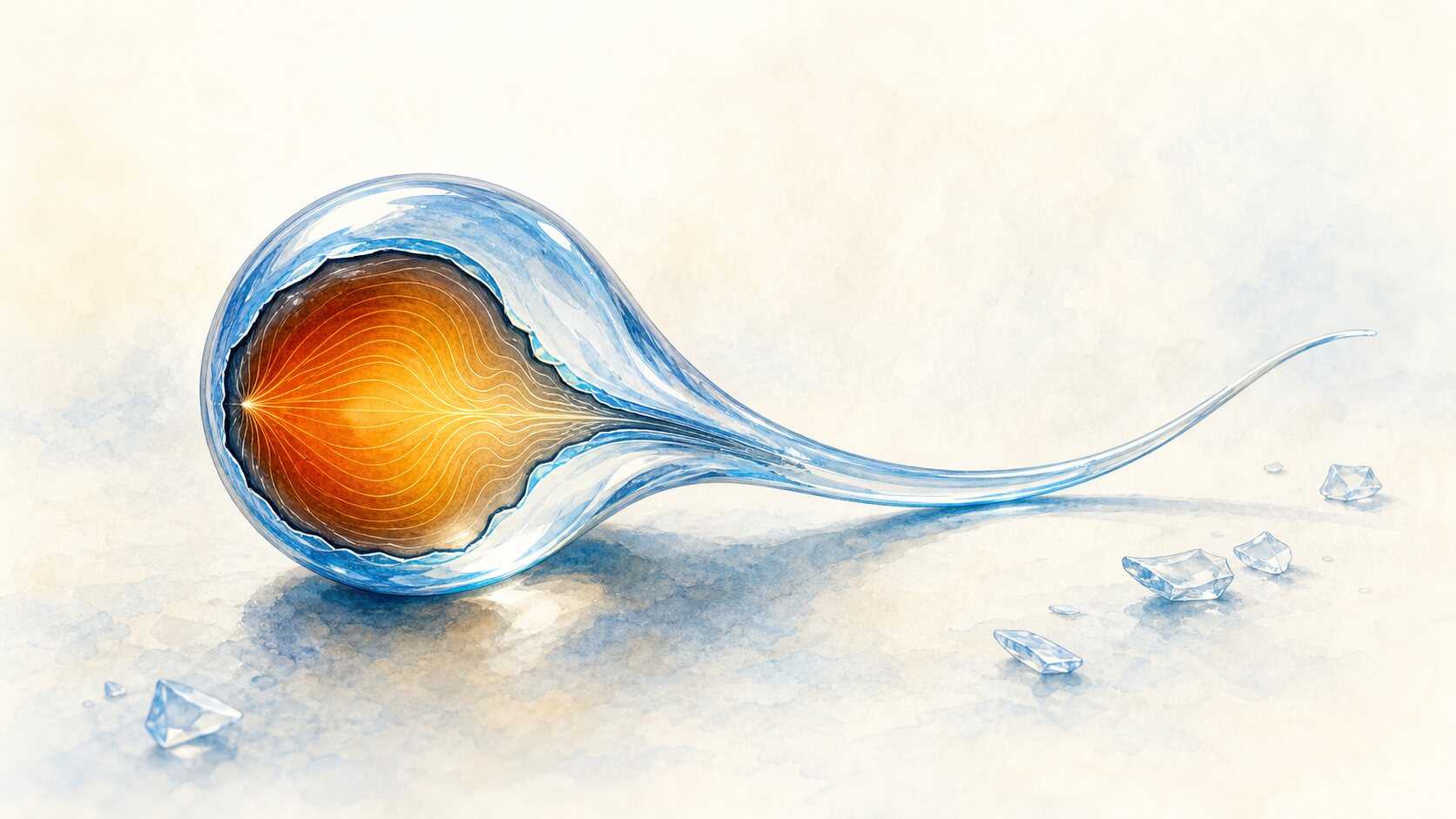
A Prince Rupert's drop looks like a tadpole made of glass: a rounded head trails into a thin tail. Its behavior seems contradictory. The bulbous head can resist surprisingly severe blows, yet breaking the tail can make the whole object disintegrate almost instantly. The explanation is not a magical kind of glass. It is an extreme arrangement of residual stress, locked into the glass during a very rapid change in temperature.
When a very hot glass droplet is quenched, its outside cools and solidifies first. That outer skin becomes rigid while the interior remains hotter for longer. As the interior later cools, it tries to contract, but the already-solid shell constrains it. The final object is left with a compressed outer layer and a tensile region inside. Those opposing stresses balance across the whole drop, so it can sit still on a table while carrying a large amount of stored elastic energy.
This stress pattern explains the tough head. Glass normally fails readily because tiny surface flaws concentrate stress at their tips. A crack opens when the material is pulled apart across it. On the head of a Prince Rupert's drop, the surface is already strongly compressed. A small crack has to overcome that compression before it can open and travel inward. The drop is not soft or ductile; rather, the surface stress makes a usual crack much harder to activate. That is why a local impact can be much less effective than intuition suggests.
The tail offers a route into the opposite part of the stress field. When its thin end breaks, a crack can reach material under internal tension. The stored stress then drives the crack rapidly through the drop. It branches repeatedly and releases energy into creating many new fracture surfaces, so the bulb often turns into a cloud of small fragments rather than a few large pieces. The event can look explosive, but it is a mechanical release of elastic energy, not a chemical explosion.
Compression does not turn the glass into a fundamentally different, ductile substance. It changes the conditions under which a crack can begin. A surface flaw on the head must first overcome the compressive stress that keeps its faces closed. In the tensile interior, by contrast, an opened crack is encouraged to widen. The same object therefore contains regions that suppress crack growth and regions that power it. This contrast, rather than an unusual chemical recipe, produces the famous combination of a resistant head and a fragile tail.
Quenching is not a simple rule that any water-cooled glass will become stronger. If cooling is too slow, the extreme stress pattern does not develop; if it is irregular, the object may fail before it can be studied. That is why researchers compare drop shape and cooling history rather than treating all drops as identical. The central issue is the difference between how quickly the surface and the interior cool, and the stress distribution frozen in as a consequence. Similar questions guide heat treatment in many brittle materials.
The effect has limits. A drop head is not indestructible: a sufficiently strong impact or damage that penetrates the protective compressed layer can still make it fail. Its exact strength and fragmentation depend on glass composition, size, shape, cooling history, and internal defects. Researchers can visualize residual stress through photoelastic methods, which detect changes in polarized light passing through stressed glass, and use high-speed imaging to follow the fracture wave. The drop is a vivid way to see that a material's hidden stress history can matter as much as its visible shape.
The basic idea connects to modern toughened glass, which is designed to place surface regions in compression so ordinary flaws are less likely to grow. But a Prince Rupert's drop is not a substitute for engineered safety glass. Architectural, vehicle, and device glass are manufactured with controlled thicknesses, stress profiles, and safety requirements; some are strengthened by chemical as well as thermal methods. The historical glass drop is best understood as a dramatic demonstration of fracture mechanics, not a general recipe for making glass safe.
It is also not a home experiment. Hot glass and unpredictable fine fragments can seriously injure eyes and skin, and the familiar demonstrations are handled with appropriate protection and controls. The enduring lesson is more interesting than the stunt: strength is not always visible from the outside. A transparent object can owe its impressive resistance to a compressed skin while hiding a tensile core that makes it vulnerable once the wrong path for a crack is opened.
EDITORIAL RESPONSIBILITY
FactosBrain Editorial Desk
The FactosBrain Editorial Desk researched and reviewed this article under our editorial policy. We assess error reports under our corrections policy.