Look a little closer
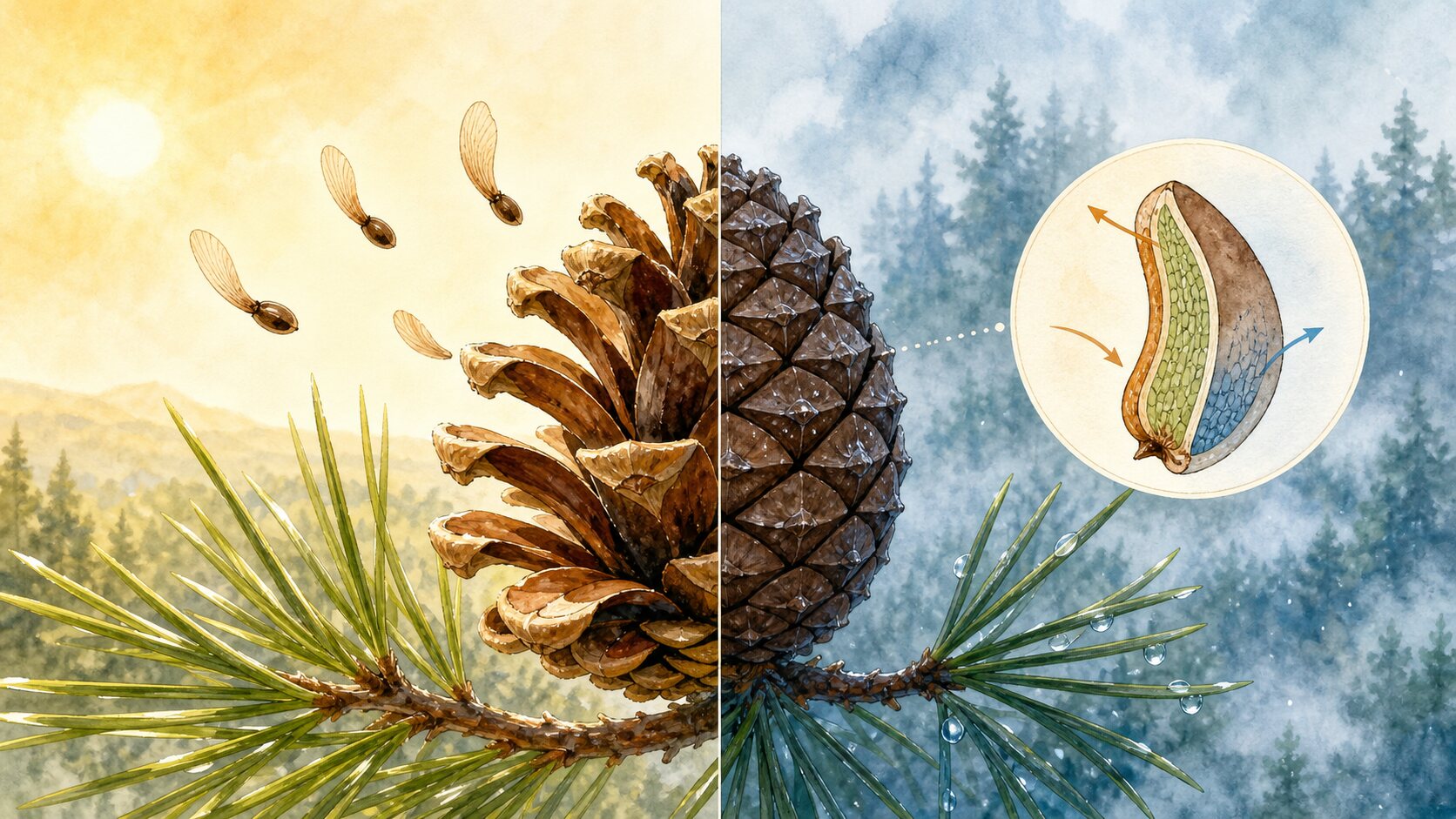
Many pine cones draw their scales closed in damp air and spread them open when conditions become dry. This is not a living cone flexing muscles. In a mature seed cone, the cells of the scales are already dead. The motion is passive: as the tissues absorb or lose water from the air, different parts of a scale expand and shrink by different amounts. The result is useful for seed dispersal. Dry air, which is often better for wind transport, tends to open the cone, while wet conditions tend to keep seeds protected.
The key is that a cone scale is not a sheet made from one uniform material. It contains tissues with different responses to moisture. One tissue layer changes its dimensions comparatively strongly as it takes up water, while a more fibrous layer changes much less in the relevant direction. Because the layers are joined, they cannot each change shape freely. Their mismatch becomes bending. The principle resembles a bimetallic strip that curves when two bonded metals expand differently with temperature, except that a pine cone uses humidity as the trigger.
When humidity rises, the more water-responsive tissue swells and changes the scale angle, bringing the cone toward a more closed state. When the air dries, that tissue contracts and the scale bends the other way, opening spaces between scales. A small change near the base of each scale is amplified by the length of the scale, making the whole cone visibly open. Researchers describe this as hygroscopic movement: a change of shape driven by water uptake and loss rather than by metabolic energy.
The motion fits seed dispersal well. The winged seeds of many pines can slip from open scales in dry air and travel more readily on the wind. In wet weather, closed scales can reduce the chance that seeds are released immediately into rain or into heavy, humid air that is less favorable for long travel. Not every pine cone uses exactly the same schedule, however. Species differ in scale shape, resin, seed release timing and sensitivity to temperature as well as humidity.
Cones that remain sealed for a long time and open after intense heat are a separate case worth distinguishing. In some species, resin holds the scales together until fire or high heat changes the resin and permits opening. That is not the same mechanism as the everyday closing in damp air and opening in dry air. Both strategies can help release seeds at an advantageous time, but their conditions and structures are not identical. A simple rule about rain and dryness should not be applied to every pine species.
What makes the ordinary humidity response remarkable is that it needs no nerves, muscles or continuous energy supply. The arrangement of cell walls and the way their tissues take up water turn a change in air humidity into mechanical motion. This has made pine cones a model for materials scientists and architects studying shutters, fibers and sensors that open or close by themselves. A pine cone is not a living weather forecast device. It is a passive natural structure that uses moisture and material design to adjust the timing of seed release.
EDITORIAL RESPONSIBILITY
FactosBrain Editorial Desk
The FactosBrain Editorial Desk researched and reviewed this article under our editorial policy. We assess error reports under our corrections policy.