Look a little closer
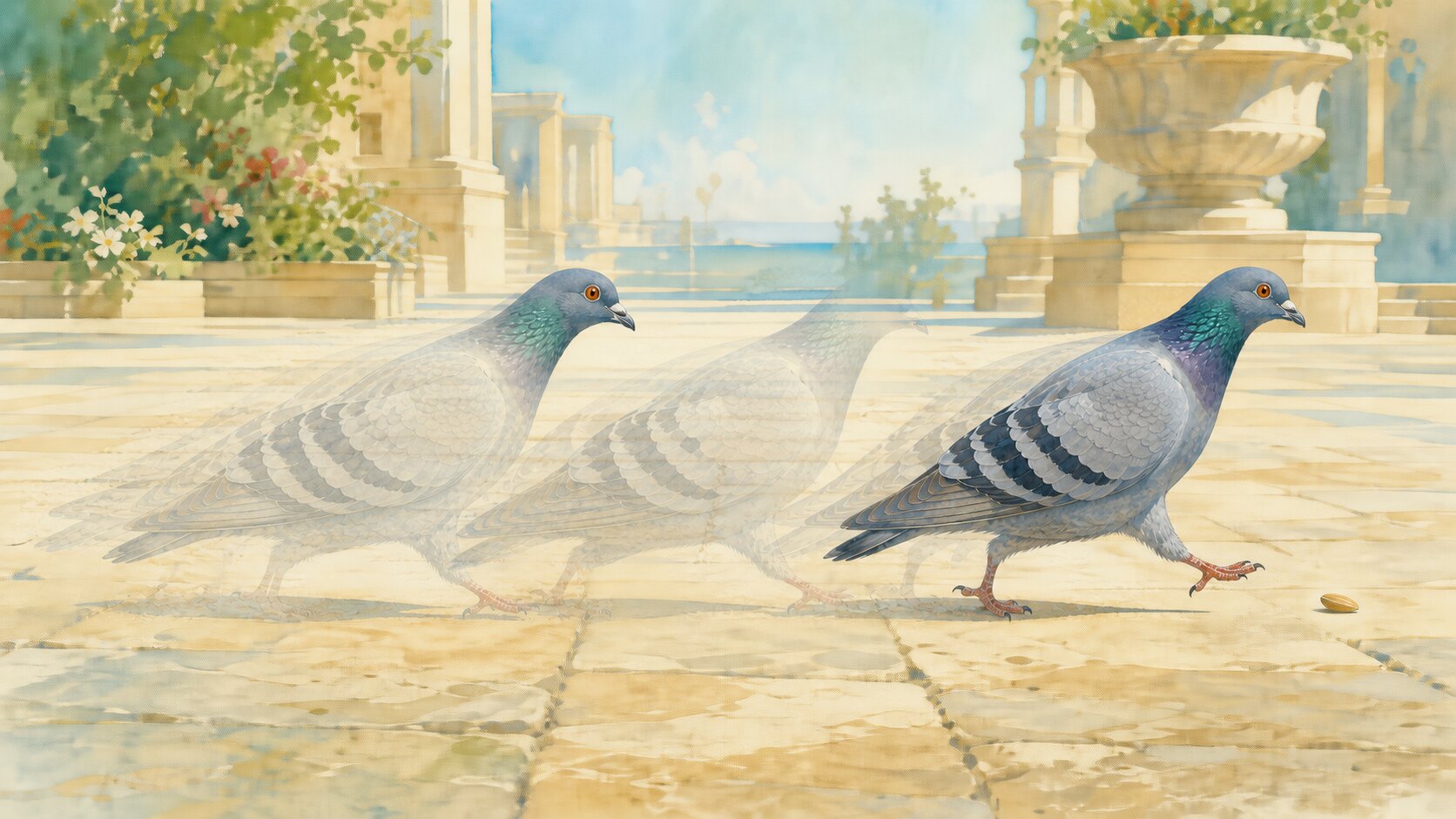
The best-supported reason pigeons bob their heads while walking is to create brief periods of visual stability on a moving body. What looks like a backward-and-forward swing is actually an alternation between a hold phase, when the head stays nearly fixed in external space, and a thrust phase, when it darts to a new position. Because the torso advances beneath the held head, the head only appears to slide backward before jumping forward.
A continuously jostled eye would make the scene sweep across the retina. Pigeons cannot rely on large, smooth eye movements to cancel all of that motion in the way a human gaze often can; movements of the head make a larger contribution to their gaze control. During the hold phase, the body proceeds but the head remains almost stationary relative to the ground and surroundings. Food, obstacles, and other animals therefore move less across the retina for a short interval, providing a cleaner opportunity to resolve detail.
The neck cannot keep extending as the body walks on. When the torso catches up, the pigeon rapidly thrusts its head ahead and establishes another viewing position. The distance covered in a cycle is linked to the length of a step, and the rhythm changes with walking speed. Instead of letting the head travel continuously at body speed, the bird separates movement into a near-still interval and a quick reset. That timing maximizes repeated windows in which its view is stable.
A classic treadmill experiment supplied unusually clear evidence for the visual explanation. A pigeon could keep stepping on a moving belt while remaining in roughly the same place relative to the room. Under that condition, its characteristic bobbing was greatly reduced or abolished. If every bob were merely a mechanical consequence of moving the legs or balancing each step, it should have persisted. Its disappearance when there was little forward visual flow showed that relative movement between bird and surroundings is an important trigger.
High-speed measurements also established that 'holding' is more than a casual description. A 2000 study tracked walking pigeons and found that the head remained highly stable during the hold phase not only in forward translation but also vertically and in important rotations. It was not perfectly frozen: a small, systematic slip remained. The researchers suggested that this residual motion could provide an error signal used to adjust the compensating movement, much as a stabilization system must sense drift in order to correct it.
Pigeons do not become blind during the rapid reset. In a 2009 experiment, birds learned to discriminate shapes that were presented selectively during the hold phase, the thrust phase, or at other times. Their performance showed that they could process shape information during the thrust as well. The result argues against a simple story in which vision is completely switched off whenever the head advances. Stable hold periods can improve visual sampling without making the intervening phase useless.
The thrust may also supply information about distance. When a viewpoint changes, nearby objects shift across the retina more than distant ones, a cue called motion parallax. Moving the head to a new station could generate this relative motion. Researchers have therefore considered depth perception alongside image stabilization, and gait mechanics may contribute benefits of their own. The evidence does not justify reducing every head bob to one exclusive purpose, although visual control—and especially stabilization during the hold—is firmly supported.
Not every bird uses the same pattern. It is conspicuous in pigeons, chickens, and a number of other walking birds, but species differ in eye mobility, visual-field organization, neck control, and gait. Even a pigeon may shorten or lose the hold phase at sufficiently high walking speeds. Similar stabilization can appear while a bird examines its surroundings or prepares to peck, while apparent movement in other situations, such as some views of landing, need not be the same walking cycle.
The familiar plaza pigeon is thus not nervously jerking its head or revealing poor balance. It carries its body forward continuously while dividing head motion into carefully timed episodes, repeatedly giving the retina a steadier picture. The head holds the visual world for a moment, then rapidly updates the point from which the world is viewed. Head-bobbing is the visible signature of a precise compromise between locomotion and seeing.
EDITORIAL RESPONSIBILITY
FactosBrain Editorial Desk
The FactosBrain Editorial Desk researched and reviewed this article under our editorial policy. We assess error reports under our corrections policy.