Look a little closer
Food from a microwave can be hot enough to burn your mouth on one side and disappointingly cold on the other. That does not necessarily mean the oven is broken. It is the result of two things working together: the uneven pattern of electromagnetic energy inside a small metal cavity and the uneven way a real piece of food accepts and moves heat. A conventional oven mostly heats food through hot air, hot cookware and slow conduction. A microwave oven sends electromagnetic energy into food, where part of that energy is converted into heat. It does not deliver the same amount of energy to every point at once.
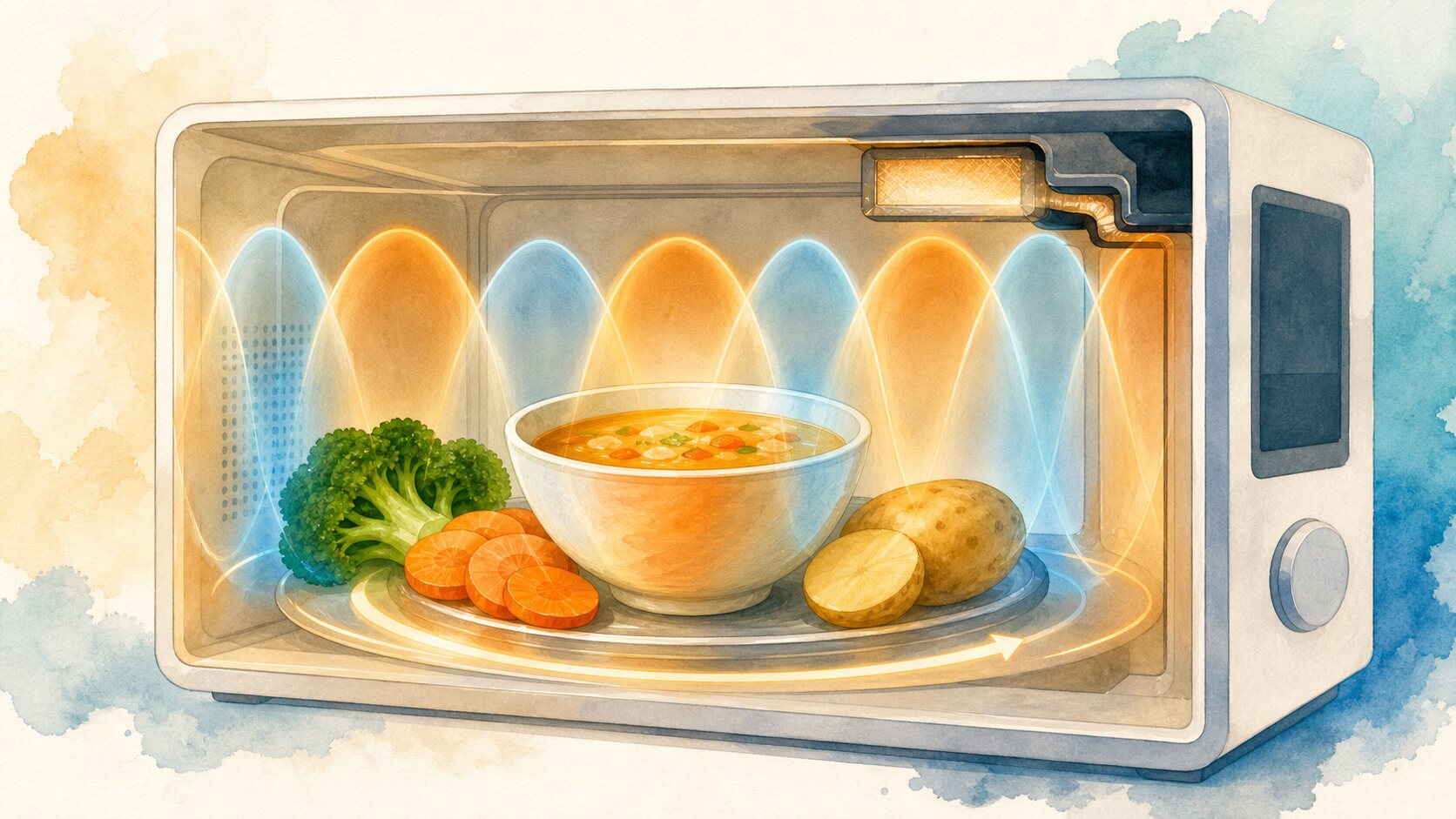
Inside the oven, microwaves produced by the source travel toward the food and reflect from the metal walls. Incoming and reflected waves overlap. In some places their electric fields reinforce one another; in other places they are weaker. This spatial pattern is called a standing-wave pattern. Food sitting in a stronger region can absorb energy faster, while food in a weaker region receives less. The pattern is invisible, but it is the first reason a single plate can develop hot spots and cold spots.
The waves are only part of the explanation. The USDA notes that microwave energy interacts with water, fat and sugar in food to produce heat. A watery soup, dry bread, fatty sauce and pieces of vegetables do not absorb energy or spread their heat in the same way. Thickness, shape, air gaps and bones can change heating as well. Frozen food adds another complication: ice can absorb microwave energy less readily than liquid water, so an area that has already thawed may warm much faster while another area remains cold.
A turntable is not a device that erases unevenness; it is a device that averages it out. As the plate rotates, each part of the food travels through stronger and weaker regions instead of staying in one location. That usually gives a more even result than a stationary dish. A part placed farther from the center also travels through a wider path. But a turntable cannot instantly equalize the center of a thick, dense food. This is why cooking directions may still ask you to stir, rotate or turn food over halfway through, even when the oven has a rotating plate.
The instruction to let food stand after heating is useful for the same reason. Just after the microwave stops, neighboring parts of the food can have very different temperatures. During a short rest, heat already stored in the hotter regions conducts toward cooler regions, and cooking can continue farther into a dense item. This does not mean microwaves keep entering the food after the oven is off. It means that ordinary heat transfer inside the food has time to reduce some of the temperature difference.
That is why the popular explanation that a microwave simply shakes water molecules and cooks everything equally from the inside is too simple. Microwave-safe glass, ceramic and some plastics allow microwaves to pass through relatively well, though the container can become hot from the food. Metal reflects microwave energy, which is why ordinary metal containers or aluminum foil should not be used unless the appliance instructions specifically allow them. The food's shape and ingredients, the container, rotation, power setting and heating time all affect the final temperature pattern.
For leftovers, the practical response is to spread food into a broad, shallow layer when possible, stir or rearrange it partway through, cover it to retain moisture, and follow the stated standing time. For food that needs thorough cooking, do not judge safety from the appearance of one spot or one spoonful; check more than one place. The USDA specifically recommends stirring, rotating and allowing standing time because microwave cooking can leave cold spots. Uneven microwave heating is therefore more than a kitchen annoyance. It is an everyday example of waves, material properties and heat conduction all shaping the same meal.
EDITORIAL RESPONSIBILITY
FactosBrain Editorial Desk
The FactosBrain Editorial Desk researched and reviewed this article under our editorial policy. We assess error reports under our corrections policy.