Look a little closer
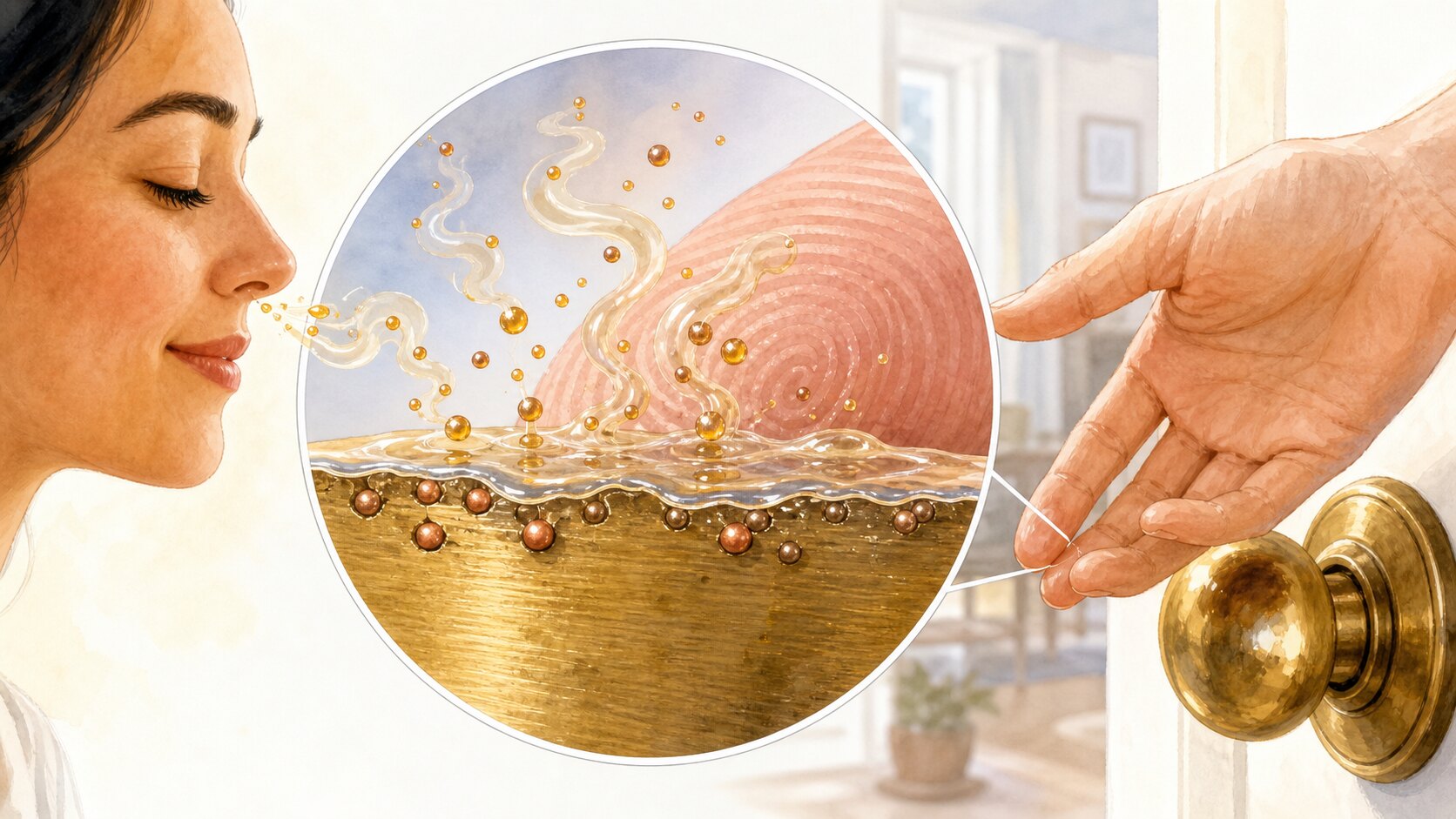
The metallic smell left after handling a coin, iron railing, or brass doorknob is not a vapor of metal atoms reaching the nose. Reactive metal ions released at the damp contact surface rapidly break down peroxides in skin oils, producing volatile aldehydes and ketones. The nose interprets that organic mixture as metallic. In a precise sense, the odor is made from skin material at the meeting point between hand and metal.
Odor requires molecules that can leave a surface, travel through air, and reach olfactory receptors. A room-temperature lump of iron or copper is not volatile enough to supply such a cloud of metal. Yet a key held near the nose seems to smell, and the scent transfers to the fingers. Ordinary grime can contribute, especially on a shared object, but it is not the full explanation. Even clean metal can generate new volatile compounds within seconds when it encounters sweat and skin lipids.
In a 2006 Angewandte Chemie study, volunteers reported an immediate musty-metallic odor after their skin contacted artificial-sweat-moistened pure iron, steel, cast iron, or a ferrous-ion solution. The researchers collected vapor above the skin and combined gas chromatography, mass spectrometry, and human olfactory measurements. They detected numerous six- to ten-carbon aldehydes and ketones. Controls using iron without skin, skin without iron, or ferric rather than ferrous ions produced diminishing quantities of those compounds and no detectable metallic odor.
A thin film of sweat starts the chemistry. Its water, chloride, and mild acidity help corrode microscopic regions of iron and release ferrous ions, Fe2+. As those ions are oxidized to Fe3+, they reductively decompose lipid peroxides already present in the skin's surface oils. Such peroxides arise when unsaturated lipids react through processes involving oxygen, ultraviolet exposure, enzymes, and other oxidative stresses. Breaking their long carbon chains yields smaller carbonyl molecules that escape into air far more readily than the original oils.
One key odorant was 1-octen-3-one, a ketone described as mushroom-like and metallic. The 2006 team estimated that it contributed roughly one third of the total odor concentration above treated skin and cited an odor threshold near 50 nanograms per cubic meter. A separate study of ferrous sulfate solutions conclusively identified 1-octen-3-one and 1-nonen-3-one among metallic-smelling vapors. Because human noses can detect these compounds at extremely low concentrations, the new scent seems to emerge from the solid metal itself almost as soon as contact begins.
Iron is not the only surface that creates the illusion. The original study reports similar skin–metal odor mechanisms for copper and brass. Brass is copper-based, while coins, keys, and hardware use many alloys, coatings, and surface treatments, so they need not produce identical mixtures or intensities. Oxide layers, humidity, skin acidity, lipid composition, contact time, and oils left by previous users all matter. That is why one doorknob can smell different to different people or on different days.
The familiar description of blood as metallic is related. When the researchers rubbed blood onto skin, they observed a similar odor and similar volatile products; adding FerroZine, which binds ferrous iron, strongly suppressed the reaction. The result supports iron-driven decomposition of lipid peroxides in blood or at the skin interface. It does not mean that every aspect of blood odor comes from one ketone. Proteins, lipids, microbes, oxidation time, and the state of the tissue can all change the overall scent.
A garlic-like smell from acid-treated cast iron is a different case. The same paper investigated phosphorus- and carbon-containing iron dissolving under acid and attributed that odor to volatile organophosphorus compounds plus certain hydrocarbons. That route is distinct from the aldehyde-and-ketone mixture formed when an everyday metal touches skin. Several chemistries can therefore be grouped under the sensory label “metallic.” Smell alone cannot reliably identify an alloy, diagnose corrosion, or determine whether an exposure is hazardous.
Washing with soap fits the contact-chemistry explanation: water and surfactant remove residual metal ions, volatile products, and the oily film in which further reaction can occur. The mere presence of a metallic odor does not by itself indicate poisoning or skin damage, while materials with separate hazards, such as lead-containing objects or sharp filings, still require precautions unrelated to smell. What reaches the nose after touching metal is not a breath from the solid. It is the fleeting organic signature of a reaction that the hand and surface made together.
EDITORIAL RESPONSIBILITY
FactosBrain Editorial Desk
The FactosBrain Editorial Desk researched and reviewed this article under our editorial policy. We assess error reports under our corrections policy.