Look a little closer
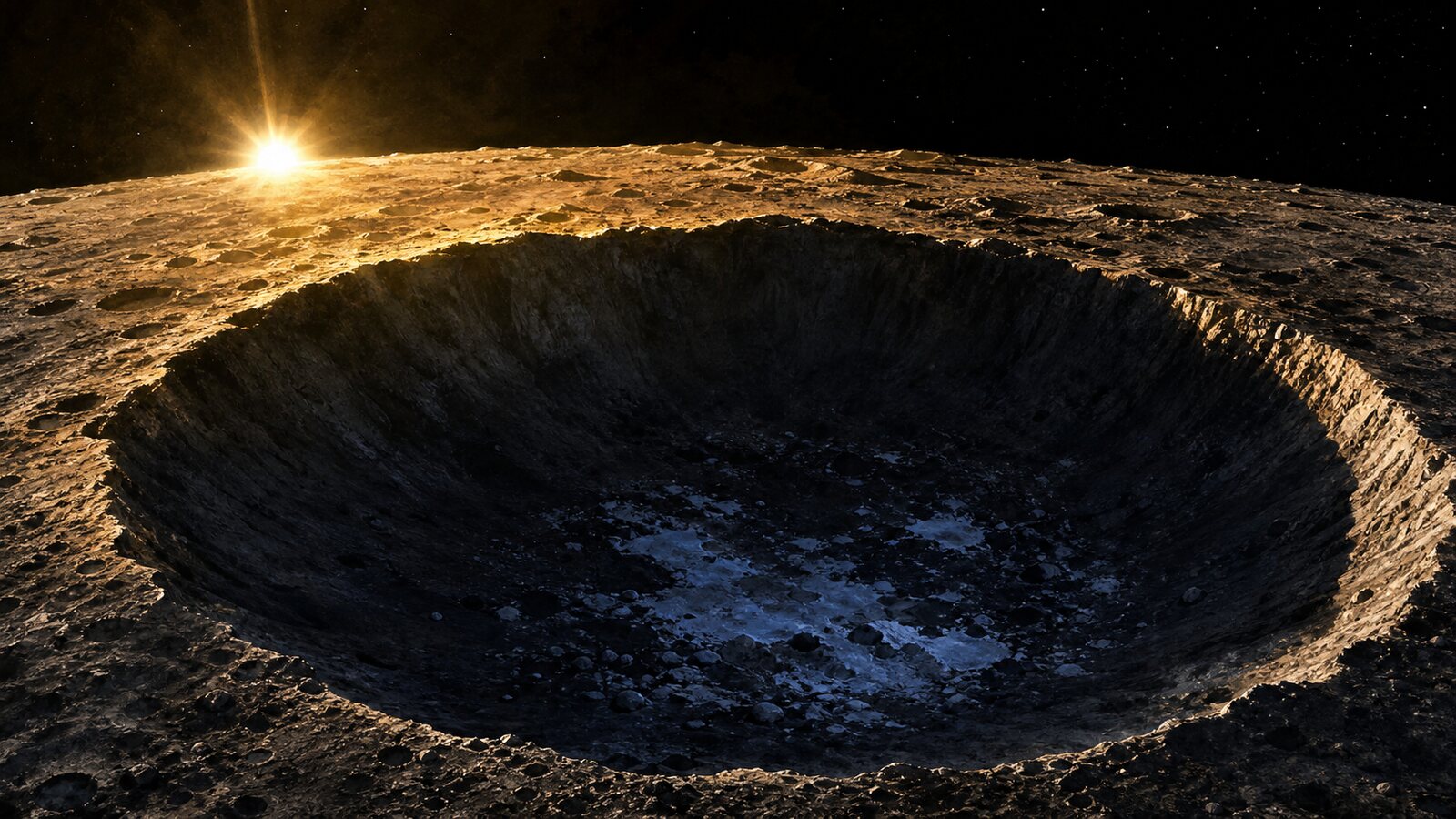
Mercury can preserve water ice despite being the planet closest to the Sun because the floors of some deep polar impact craters never receive sunlight. These permanently shadowed regions act as cold traps: water molecules that reach them can freeze and remain while nearby illuminated ground becomes intensely hot. Distance from the Sun sets the broad energy supply, but the local angle and obstruction of sunlight decide whether a particular patch of ground can retain ice.
The claim does not mean that snow lies across Mercury's sunlit plains. The planet has almost no atmosphere to moderate temperature, and exposed ground experiences severe heating. What creates the exception is Mercury's extremely small axial tilt—less than one degree. At its poles, the Sun follows a path very close to the horizon instead of climbing high during a season. A sufficiently deep crater wall can therefore block the solar disk on every orbit, leaving part of the floor in continual darkness.
Once direct sunlight is excluded, the main source of radiant heating disappears. There is no thick atmosphere to carry warm air into the hollow, and conduction through rock is not enough to make a deeply shadowed floor match its illuminated rim. Some polar depressions consequently remain cold enough for water ice to be stable over geological time. A blazing ridge and a cryogenic floor can sit only kilometres apart, not because either violates the laws of heat, but because each has a radically different view of the Sun.
The first clue came from radar rather than a photograph of white ground. In 1991, observations with the Arecibo radio telescope revealed unusually radar-bright patches near Mercury's poles. Thick, relatively clean water ice can return radio waves in this distinctive way, but radar brightness by itself does not identify a substance uniquely. After NASA's MESSENGER spacecraft entered orbit, its maps showed that the major radar-bright deposits coincided with crater terrain that remained in persistent shadow. The geometry made the ice interpretation much more plausible.
MESSENGER then supplied several independent tests. Images and laser-altimeter topography established which pole-facing slopes were continually shaded, while thermal models calculated whether those exact places were cold enough to preserve volatile material. Near-infrared measurements by the laser altimeter found both unusually bright and unusually dark deposits. Bright surfaces in the coldest zones were consistent with exposed ice; dark surfaces in somewhat warmer cold traps were consistent with ice hidden under a different insulating material.
The spacecraft's neutron spectrometer approached composition from another direction. Energetic particles striking Mercury's soil generate escaping neutrons, and collisions with hydrogen slow those neutrons efficiently. Over the north polar radar deposits, MESSENGER measured deficits in particular neutron-energy ranges. When combined with radar data, the signal was best explained by a hydrogen-rich layer more than tens of centimetres thick whose buried portion was close to pure water ice. The conclusion rests on location, thermal stability, reflectance, and hydrogen all agreeing—not on a single ambiguous image.
Ice is not exposed uniformly in every shadow. At the very coldest sites it can survive at the surface, but in a slightly warmer permanent shadow, bare ice would gradually sublimate and escape. Neutron results indicated that much of the buried ice lies beneath roughly 10 to 30 centimetres of material poorer in hydrogen. That dark cover can slow heat flow and loss of vapor like an insulating lag. Its exact composition remains uncertain; complex organic-rich material delivered with volatile-bearing impactors is a leading interpretation rather than a directly sampled fact.
The source of Mercury's water is also not settled as one event. Impacts by comets and water-bearing asteroids are the main proposed suppliers, and many deliveries over time could have contributed. Most vapor released on a hot surface would escape or be destroyed, but some molecules can hop across the airless planet until they encounter a polar cold trap and freeze. The present deposits therefore record a balance among delivery, migration, burial, and loss. They are not frozen lakes formed by liquid water pooling in a crater.
Mercury's polar ice demonstrates why the temperature of an airless world cannot be inferred from solar distance alone. A low-latitude plain with an open view of the Sun and a crater floor hidden behind a polar wall occupy the same planet but inhabit different radiative environments. The ice is not an inexplicable pocket in an otherwise hot world. It is the predictable outcome of a nearly upright rotation axis, permanent topographic shadow, weak redistribution of heat, and mobile water molecules finding the coldest available surfaces.
EDITORIAL RESPONSIBILITY
FactosBrain Editorial Desk
The FactosBrain Editorial Desk researched and reviewed this article under our editorial policy. We assess error reports under our corrections policy.