Look a little closer
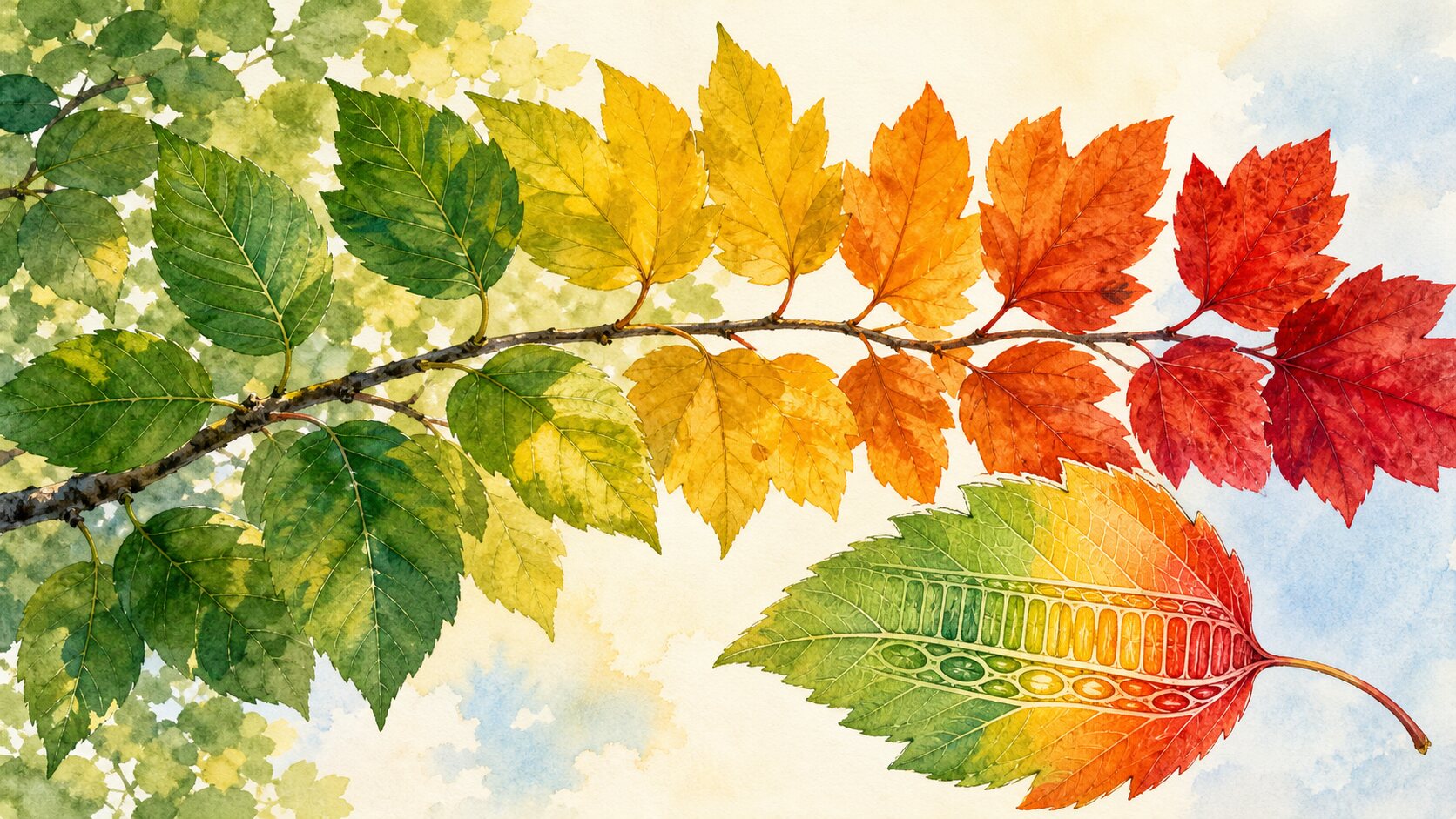
Autumn leaves change from green to yellow, orange and red because a tree is winding down the work its leaves do before winter. In spring and summer, leaves make sugars through photosynthesis. When days shorten and the season changes, many deciduous trees gain less from continuing to invest in those leaves. The change is not paint appearing on the surface. It is a shift in the balance of pigments: the green pigment that dominated the leaf becomes less abundant, while pigments already present or newly made become easier to see.
The main reason a summer leaf looks green is chlorophyll. Chlorophyll captures light energy for photosynthesis, and when it is abundant it masks other pigments. Carotenoids, which produce yellow and orange colors, are present in many leaves throughout the growing season but are hard to notice beneath strong green chlorophyll. In autumn, chlorophyll production stops and its breakdown speeds up. Carotenoids that remain become visible, producing the yellow tones seen in trees such as birches and aspens.
A tree does not simply throw chlorophyll away. Chlorophyll molecules contain nutrients, including nitrogen, that the tree can use again. Before leaves fall, the tree can recover part of those nutrients and store them in twigs, branches and trunks. At the same time, a separation layer develops at the base of each leaf stalk. As that layer develops, movement of water and sugars is reduced, and wind or gravity can eventually detach the leaf. Autumn color is therefore part of a visible transition involving nutrient recovery and preparation for leaf drop.
Red leaves have a somewhat different story. Red and purple anthocyanins are actively made in autumn by many trees and shrubs. Harvard Forest explains that some species synthesize anthocyanins while their leaves are aging, and the amounts of remaining chlorophyll, carotenoids and anthocyanins combine to produce shades ranging from red to orange and brown. Anthocyanins are not made to the same extent by every species, and their precise roles can vary with the plant and conditions. It is not accurate to say that cold weather simply turns every leaf red.
Day length is an important seasonal signal, while temperature and moisture influence the timing and brightness of color. National Park Service explanations note that sunny days and cool, nonfreezing nights can favor vivid red color in some places. Weather alone cannot predict a particular year’s foliage, however. Tree species, sunlight on an individual leaf, soil moisture, drought, pests and the tree’s growing condition all matter. Even on the same tree, sun-exposed leaves may become redder while shaded leaves remain more yellow.
Not every tree follows the same autumn schedule. Many conifers, such as pines, keep needles through winter because their needle-like leaves lose less water and can be used for more than one year. Among deciduous trees, species differ widely in color; some oaks turn brown rather than scarlet, and some dry leaves remain attached to branches well after other leaves have fallen. Fall foliage is not simply a sign that trees are dying from cold. It is a collection of different strategies for surviving winter water limits and low temperatures.
In the end, autumn color is a story of timing as much as color chemistry. Trees keep chlorophyll while it is useful for photosynthesis, then recover nutrients and loosen their leaves as the growing season ends. Green recedes, yellow and orange become visible, and some trees add red pigments of their own. The landscape we call fall foliage is not a tree becoming inactive all at once. It is a moment in a carefully organized transfer of resources and a preparation for the next spring.
EDITORIAL RESPONSIBILITY
FactosBrain Editorial Desk
The FactosBrain Editorial Desk researched and reviewed this article under our editorial policy. We assess error reports under our corrections policy.