Look a little closer
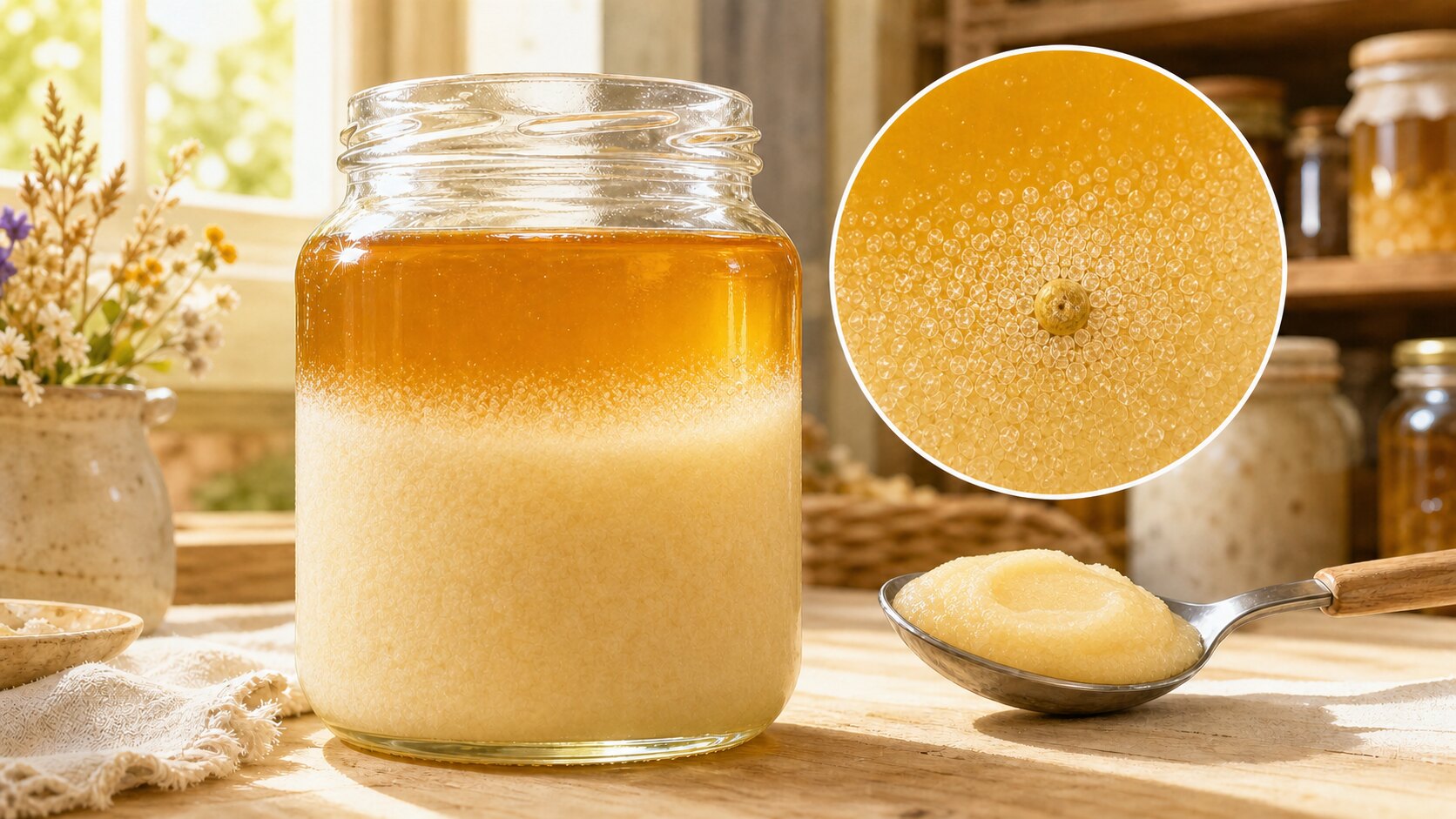
Honey usually turns cloudy and grainy not because it has spoiled, but because glucose in its highly concentrated sugar solution leaves the liquid and forms crystals. Fructose is more soluble and tends to remain in the surrounding syrup. As glucose crystals nucleate and grow, transparent flowing honey becomes a pale, textured semisolid. Crystallization is therefore a natural physical change in honey, not automatically a defect.
Honey is more concentrated than ordinary sugar water. Bees transform nectar sugars and evaporate water in the comb, leaving a mixture dominated by glucose and fructose in relatively little water. The Codex Standard for Honey requires at least 60 grams of fructose plus glucose per 100 grams for most blossom honeys and generally permits no more than 20 percent moisture. At such concentrations, honey can be supersaturated: it contains more dissolved glucose than would remain stable at equilibrium under the same conditions.
Supersaturation does not mean the whole jar must solidify immediately. The first molecules must assemble into a sufficiently stable ordered cluster, a step called nucleation, and that carries an energy barrier. A microscopic glucose crystal already present, a pollen grain, a wax particle, or a rough spot on the container can provide a surface on which order starts more easily. Once a nucleus survives, glucose molecules join its lattice; every growing crystal then supplies more surface for further growth.
Floral origin matters because different nectars produce different ratios of glucose, fructose, and water. More glucose and less water generally increase the driving force for crystallization, while fructose-rich honey can remain fluid much longer. No single ratio predicts an exact date, however. Minor sugars, acids, colloidal material, viscosity, the number of seed crystals, and the honey's processing and storage history all affect whether a jar changes in days, months, or much longer.
Temperature has two opposing effects, so colder is not always faster. Food-property studies often report the fastest crystallization around 13 to 15.5 °C. At warmer temperatures, glucose becomes more soluble and supersaturation falls. At substantially colder temperatures, the thermodynamic drive may remain, but honey becomes so viscous that glucose molecules move slowly toward crystal surfaces. The observed rate is a compromise between the tendency to leave solution and the molecular mobility needed to build a lattice.
Crystal size changes texture and appearance more than flavor. If relatively few nuclei grow into large crystals, the honey can feel sandy on the tongue. Producers of creamed honey deliberately distribute very fine seed crystals and control conditions so that many tiny crystals form, creating a smooth, spreadable body. Crystallized honey also looks lighter because the countless boundaries between crystals and syrup scatter light in many directions. Its pigments have not simply vanished; the material now redirects light differently.
Crystallization is not a reliable home test for authentic honey. Genuine honey with abundant fructose or few nucleation sites may stay clear for a very long time, while other sugar mixtures can crystallize under suitable conditions. Heating and fine filtration can delay the process by dissolving small crystals and removing suspended particles, but that history alone does not prove purity or quality. International standards explicitly recognize liquid honey, crystallized honey, and mixtures of the two as normal presentations.
Crystals alone are not spoilage, but that does not make every unusual jar harmless. As glucose enters the solid phase, the remaining liquid fraction becomes relatively richer in fructose and water. Honey that began with excessive moisture can leave that fraction more vulnerable to osmotolerant yeasts and fermentation. Fine solid grains are different from persistent new foam, pressure in a sealed jar, or a sour or alcoholic smell. Those signs point to another process, and appearance alone should not be used to certify food safety.
To make the honey pourable again, a tightly closed container can be warmed gradually in a warm-water bath and stirred until the crystals dissolve. Direct high heat or boiling water can damage the container and alter aroma or heat-sensitive quality markers; the National Honey Board recommends gentle warming. Liquefaction does not change the underlying sugar ratio, so crystals may return later. Whether eaten creamy or melted, the pale grains are not a foreign substance: they are glucose that was present all along, rearranged from an invisible dissolved state into an ordered solid.
EDITORIAL RESPONSIBILITY
FactosBrain Editorial Desk
The FactosBrain Editorial Desk researched and reviewed this article under our editorial policy. We assess error reports under our corrections policy.