Look a little closer
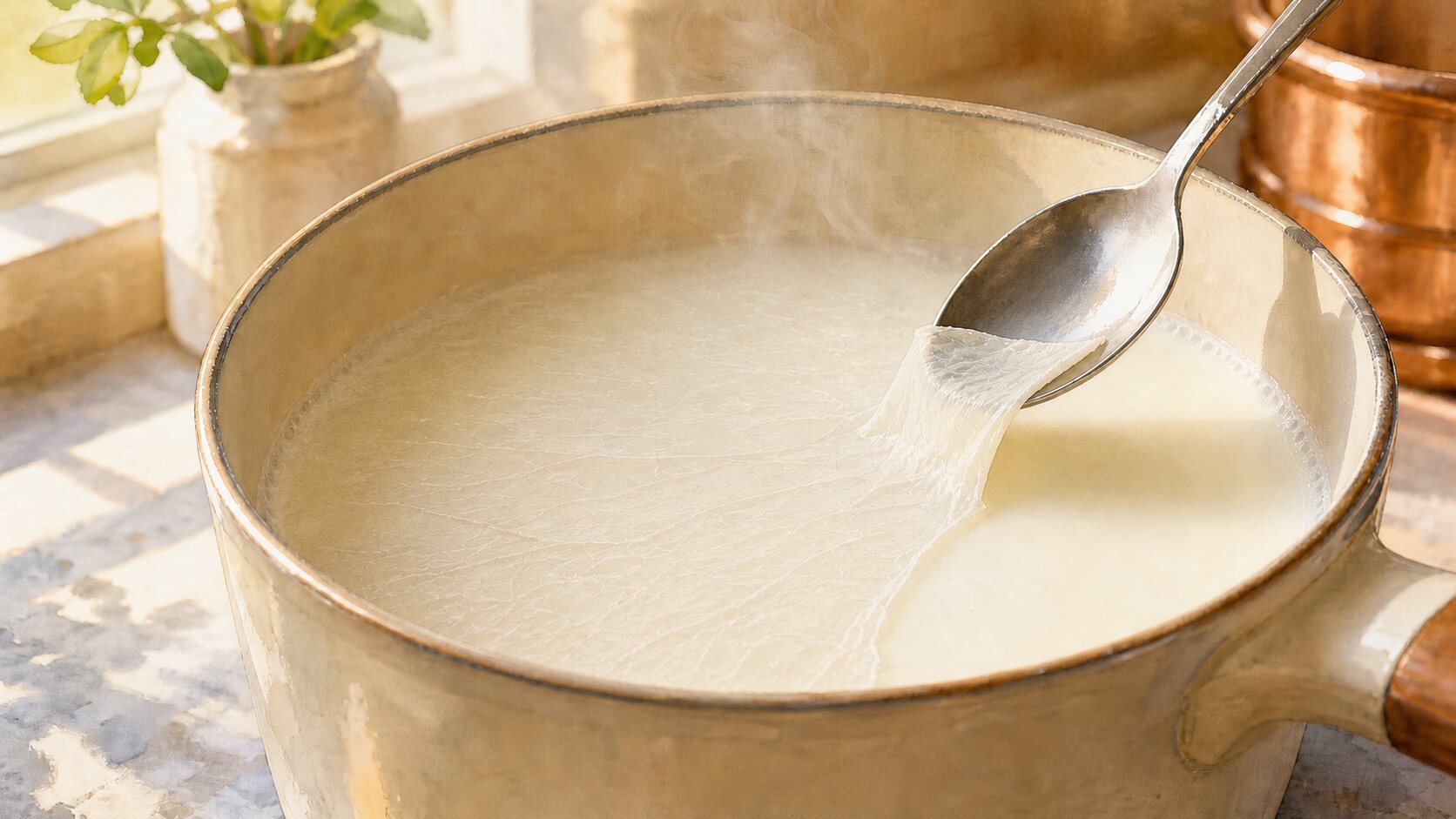
The skin on heated milk is not simply a layer of fat that floated to the top. It is a thin interfacial gel containing heat-altered whey proteins, casein, and trapped fat globules. Heating makes some proteins more able to connect, while evaporation concentrates nonvolatile milk solids where milk meets air. Together, those processes create a continuous membrane across the liquid.
Milk is not a uniform solution of nutrients in water. Fat is dispersed in globules, most protein is organized into casein particles called micelles, and smaller whey proteins occupy the surrounding liquid. Those components move throughout the milk, but the air–water interface has different energetic conditions from the bulk. Proteins with both water-friendly and water-avoiding regions can adsorb there, and fat globules can become incorporated into the interfacial layer.
As temperature rises, whey proteins—especially beta-lactoglobulin in cow's milk—begin losing their original folded shape. Denaturation does not mean that the protein vanishes; it exposes reactive regions that had been buried inside. Unfolded whey proteins can link with one another and associate with kappa-casein on casein micelles. Casein itself is comparatively resistant to ordinary heat denaturation, but it can join the network through these interactions with altered whey protein.
Evaporation explains why the network develops at the top. Water molecules escape from hot milk into the air, whereas protein and fat remain behind. Liquid from below replenishes the surface, but when water leaves rapidly enough, the concentration of solids there keeps rising. Protein complexes, casein particles, and fat globules approach one another and connect. An initially invisible interface eventually becomes a thin hydrogel strong enough to lift with a spoon.
A 2017 Soft Matter study heated milk to about 78°C and examined the resulting skin with confocal imaging and surface profilometry. The researchers described a micrometer-scale layer composed of denatured proteins and fat globules. Its total wrinkle length increased over time. They modeled the skin as a thin poroelastic film: liquid can move through a deformable porous network, and evaporation-driven flow plus a hydration gradient generates in-plane stress that makes the film buckle.
The wrinkles are therefore not merely a cold film shrinking after the milk cools. In the experiment, changing relative humidity altered wrinkle growth in a way consistent with the evaporation model. Drier air can remove water faster and intensify differences in hydration across the film. Once a connected layer has formed, it cannot always remain flat while those stresses develop, so it bends into fine ridges. Touching one region then pulls neighboring material because the surface has become a membrane rather than a collection of separate flakes.
Higher-fat milk may produce a richer-feeling skin, but fat is not the sole cause. Skim milk still contains protein and can form a film under suitable conditions. Cream rising in nonhomogenized milk is a different phenomenon driven mainly by the buoyancy and clustering of fat globules over time. Bulk curdling is different again: acid or other destabilization causes particles throughout the milk to aggregate, whereas ordinary milk skin begins at the heated air–milk interface.
Removing the first skin does not exhaust the ingredients. Protein and fat remain below, and a new interface is exposed to continued heat and evaporation, so another film can develop. Stirring disrupts and redistributes the surface layer before it spans the vessel. During cooling, limiting evaporation or placing an appropriate food-contact covering directly against the surface can also reduce film formation. Those practices alter the interface; they do not reverse protein changes already caused by heat.
Milk skin is made from components that were already present, rearranged by heat and contact with air. Whey proteins unfold and connect with casein, evaporation crowds those materials at the surface, and further water loss wrinkles the thin gel. The film is thus more informative than the idea of fat simply hardening. It shows a dispersed food turning into a new material locally: molecules and particles that behaved separately in the liquid begin acting as one elastic sheet at the boundary.
EDITORIAL RESPONSIBILITY
FactosBrain Editorial Desk
The FactosBrain Editorial Desk researched and reviewed this article under our editorial policy. We assess error reports under our corrections policy.