Look a little closer
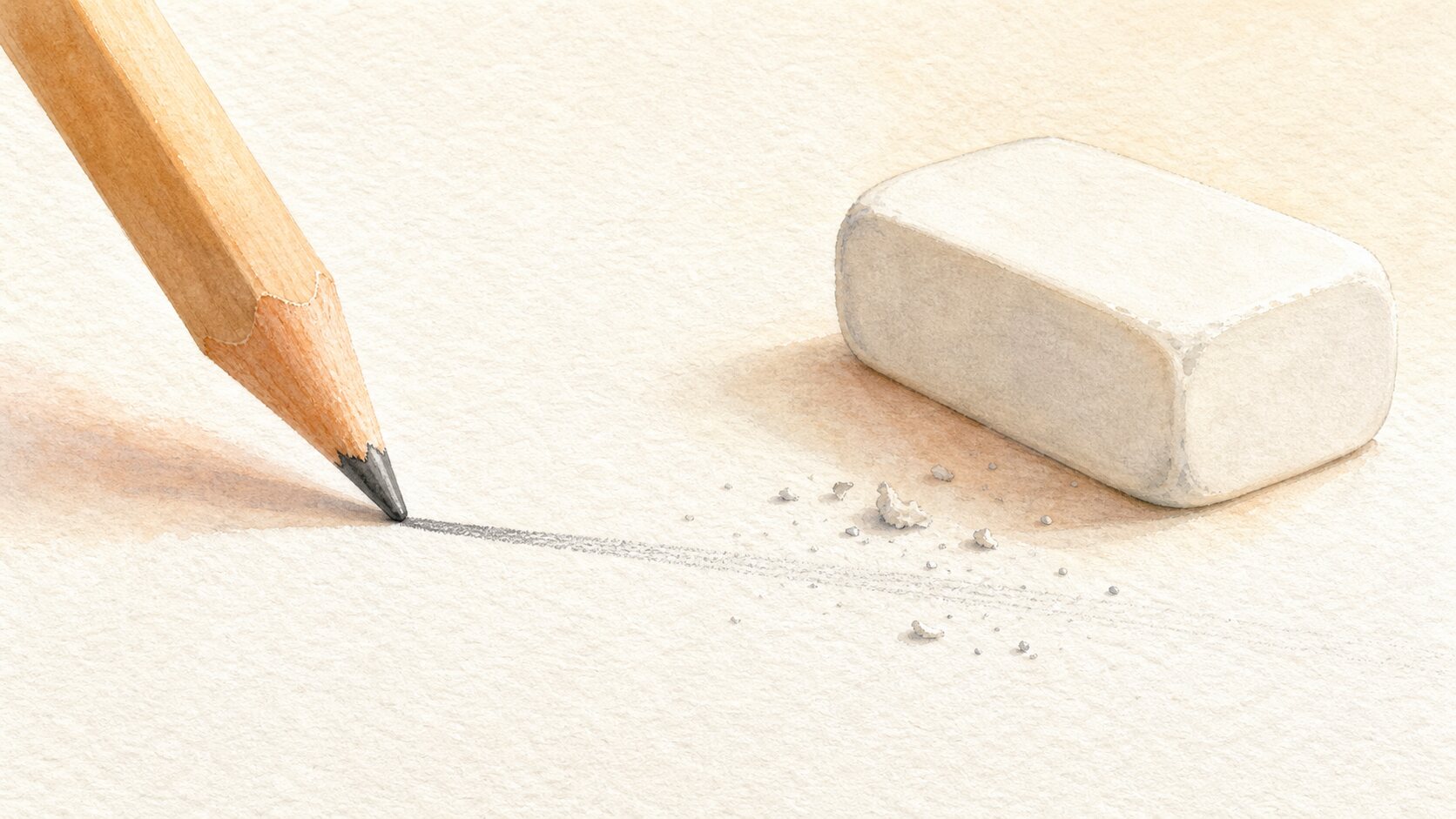
An eraser seems to make a pencil line disappear, but it does not erase writing by magic. Pencil cores are not lead; they are mainly graphite mixed with clay. When you write, tiny graphite particles transfer onto and between the fibers at the paper surface. Rubbing an eraser changes where those particles prefer to stay. Many attach to the eraser, then leave the page along with small pieces of the eraser itself.
Graphite is made of carbon atoms arranged in thin layers. Writing shears small particles from those layers and deposits them on paper. Paper looks smooth at a distance, but it is a textured network of cellulose fibers. Graphite catches on its surface and in shallow gaps. A pencil mark is therefore closer to a thin deposit near the surface than to a liquid dye that has deeply penetrated the sheet. That relatively accessible deposit is what makes ordinary erasing possible.
Erasers can be made from natural or synthetic rubber, vinyl-like polymers, and other formulations. They need a careful balance: too hard and they abrade paper aggressively; too soft or smooth and they do not pick up graphite effectively. Friction and adhesion work together as the eraser passes over the mark. The crumbs that appear are not merely waste. They include sacrificial eraser material carrying away graphite particles that were once on the page.
That is why eraser debris often turns gray or black. It contains both eraser material and the graphite that has been lifted. Pressing too hard removes more than graphite: it can tear or flatten the paper's upper fibers. Softer vinyl erasers and kneaded erasers are often preferred for delicate drawing paper because they can pick up marks with less force and less surface abrasion. Different erasers are compromises among cleaning power, precision, debris, and paper safety.
Pencil marks are not all equally erasable. A hard pencil can leave a lighter deposit, while a soft pencil may place more graphite on the page. Heavy pressure can push particles farther into the fibers and leave an indentation. An eraser may remove most of the dark material but cannot restore the compressed paper structure. Faint gray residue, shine, or a groove can remain even after a line seems mostly gone.
The contrast with ordinary pen ink is revealing. Many inks are liquids that penetrate the paper-fiber network or bind color within it. Lifting surface particles with an eraser is then not enough, and more aggressive rubbing usually damages the paper first. Erasable pens are separate products designed with special inks; they do not show that a normal pencil eraser can remove any kind of writing.
An eraser is a small materials-science tool. It makes attachment between graphite and eraser more useful than attachment between graphite and paper, while sacrificing a little of itself to carry the particles away. A good eraser is not simply the harshest one. It is one that removes graphite efficiently while disturbing as little of the paper as possible, even after repeated corrections on the same sheet.
EDITORIAL RESPONSIBILITY
FactosBrain Editorial Desk
The FactosBrain Editorial Desk researched and reviewed this article under our editorial policy. We assess error reports under our corrections policy.