Look a little closer
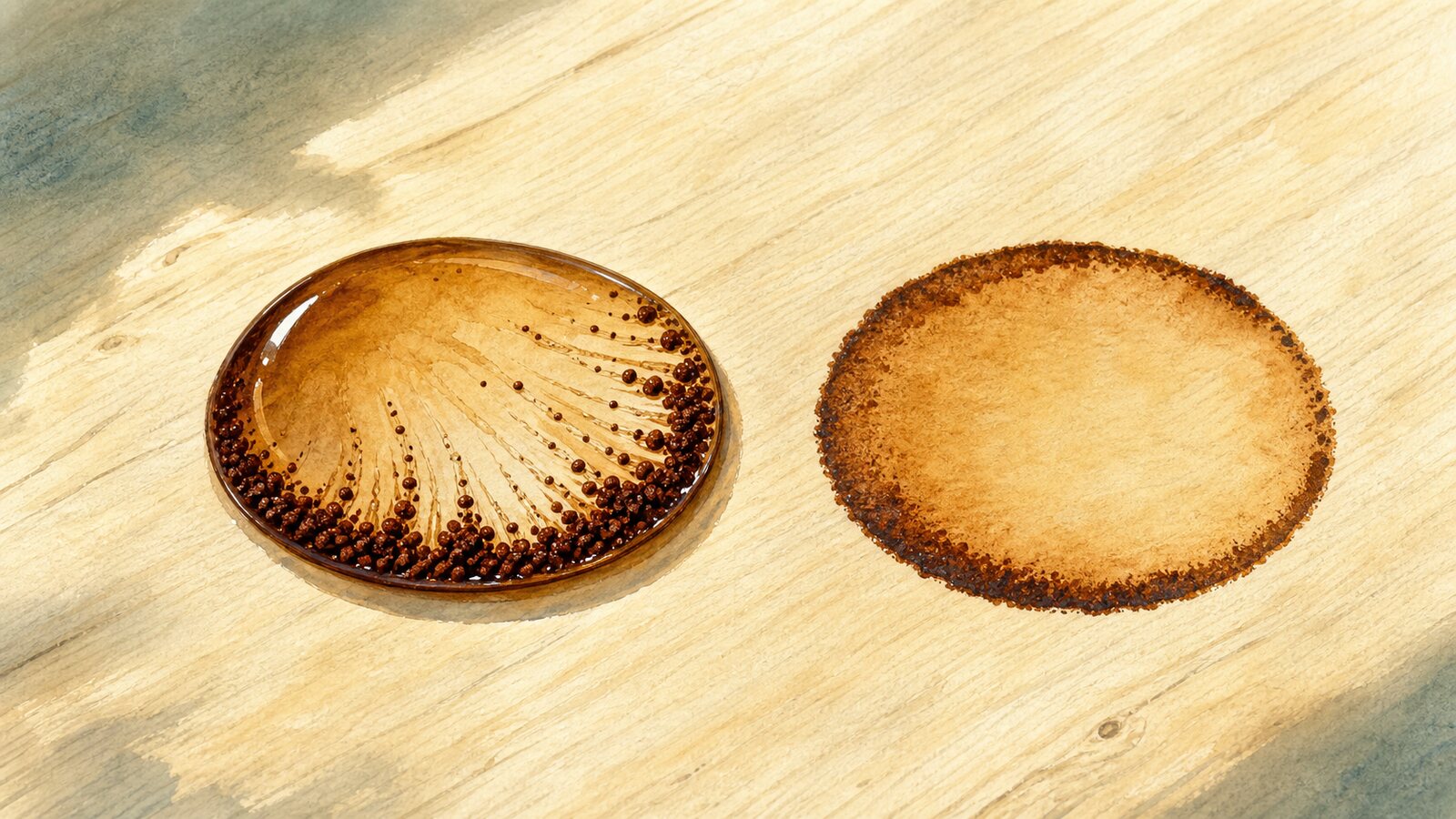
A dried coffee drop is usually darker at its edge because evaporation transports suspended material toward the perimeter before the water disappears. If the rim of the drop stays pinned to tiny irregularities on the surface, liquid must flow outward to replace water lost near that rim, carrying coffee particles with it. The concentrated deposit left behind is known as the coffee-ring effect.
Coffee is not simply a perfectly dissolved brown dye. It is a complicated mixture containing dissolved compounds, tiny oil droplets, and fine solid material. Water can enter the air as vapor, but most of those nonvolatile ingredients remain on the table. The final stain therefore records not just where water evaporated, but where the material left in the liquid traveled while the drop was drying.
The critical boundary is the contact line, the circular place where liquid, air, and tabletop meet. On an ideal surface, the edge of a shrinking drop could steadily retreat toward the center. Real surfaces have microscopic roughness and chemical variations, however, and particles can also catch at the edge. The contact line may remain in almost the same position while the drop loses volume, so the liquid cap becomes lower rather than simply smaller in diameter.
That pinned geometry creates a supply problem. Evaporation is especially intense near the thin outer region because vapor can diffuse away from the edge efficiently. The edge cannot retreat to make up for the lost liquid. Conservation of mass requires water from farther inside the drop to move outward and replenish it. This slow, evaporation-driven capillary flow runs along the drop toward the contact line and sweeps suspended particles in the same direction.
Robert Deegan and colleagues connected those steps experimentally in a landmark 1997 Nature paper. They showed a two-centimeter coffee drop containing one percent solids drying into a perimeter deposit and tracked microscopic spheres moving through model droplets. Their theory predicted a characteristic way for the ring's mass to grow with time, and microscopic observations of colloidal liquids supported it. The particles are not rolling sideways because gravity somehow pulls them toward a circle; they are passengers in a flow created by evaporation and a fixed boundary.
Deposition at the rim then reinforces the visible contrast. Particles arriving in the increasingly shallow liquid near the edge become crowded and can no longer travel far. More particles continue to arrive behind them, thickening a narrow deposit near the original contact line. When the last water leaves, relatively little material may remain across the center while a large share marks the old outline, producing the familiar dark brown ring.
A ring is common, but it is not the unavoidable fate of every drying drop. If the contact line depins and recedes early, the outward replenishing flow changes. Surface-tension gradients can also drive Marangoni circulation that competes with outward transport. Particle size and shape, concentration, solvent composition, surface wettability, temperature, and humidity all affect the deposit. Two circular stains can therefore conceal different flow histories, and some droplets dry into disks, central spots, or irregular patterns instead.
Experiments with particle shape make that limitation vivid. In 2011, Peter Yunker and colleagues found that spherical particles packed densely at a drying drop's contact line, whereas elongated ellipsoidal particles attached at the air-water interface and formed loose structures that resisted transport into a narrow ring. The resulting deposit was much more uniform. Adding surfactant altered the interfacial interactions and restored ring formation even for the ellipsoids. Outward flow is central to the classic explanation, but the way particles interact with one another and with the interface helps decide what the eye finally sees.
The same physics matters far beyond a forgotten splash on a desk. Inkjet printing, biological assays, paints, and thin electronic coatings often require material to dry into a uniform layer rather than a heavy rim. Engineers can change the surface, solvent, particles, or internal circulation to control that distribution. A coffee ring is thus a small, readable record of moving liquid: evaporation removes the water, while the pinned edge and compensating flow rearrange almost everything that cannot evaporate.
EDITORIAL RESPONSIBILITY
FactosBrain Editorial Desk
The FactosBrain Editorial Desk researched and reviewed this article under our editorial policy. We assess error reports under our corrections policy.