Look a little closer
A deer antler is not a permanent ornament that happens to break. It is a bony organ built, hardened, used during the breeding season, and then deliberately detached on an annual physiological schedule. After the rut, a decline in reproductive hormone signaling allows bone-resorbing cells to weaken the junction between antler and skull. A new antler later grows from tissues that remain on the head; the object shed into the forest does not come back to life.
Antlers also differ from the structures biologists call true horns. An antler is an extension of the skull made of bone and is usually cast as a whole. A horn has a permanent bony core covered by a keratin sheath and generally continues growing rather than being replaced each year. Most deer species put antlers on males, although female reindeer and caribou are a conspicuous exception. The annual cycle therefore belongs to a particular anatomical system, not to every animal with a pointed head weapon.
Seasonal daylight helps set the calendar. Information about changing day length passes through the brain and endocrine system, coordinating reproduction with antler development. In many temperate deer, testosterone falls after mating. At the boundary between the finished antler and the permanent bony pedestal, or pedicle, osteoclasts begin removing bone. This creates an abscission line that becomes progressively thinner. Eventually the antler's own weight, an ordinary jolt, or both can finish the separation.
Casting leaves the pedicle exposed, and skin soon closes over its surface. The capacity to regenerate resides in stem and progenitor cell populations associated with the pedicle and its periosteum. These cells proliferate and contribute to the cartilage and bone of a new antler bud. A discarded antler contains no equivalent growth base, which is why a shed does not sprout where it lands. The animal is rebuilding an organ from a persistent foundation rather than repairing last year's branches.
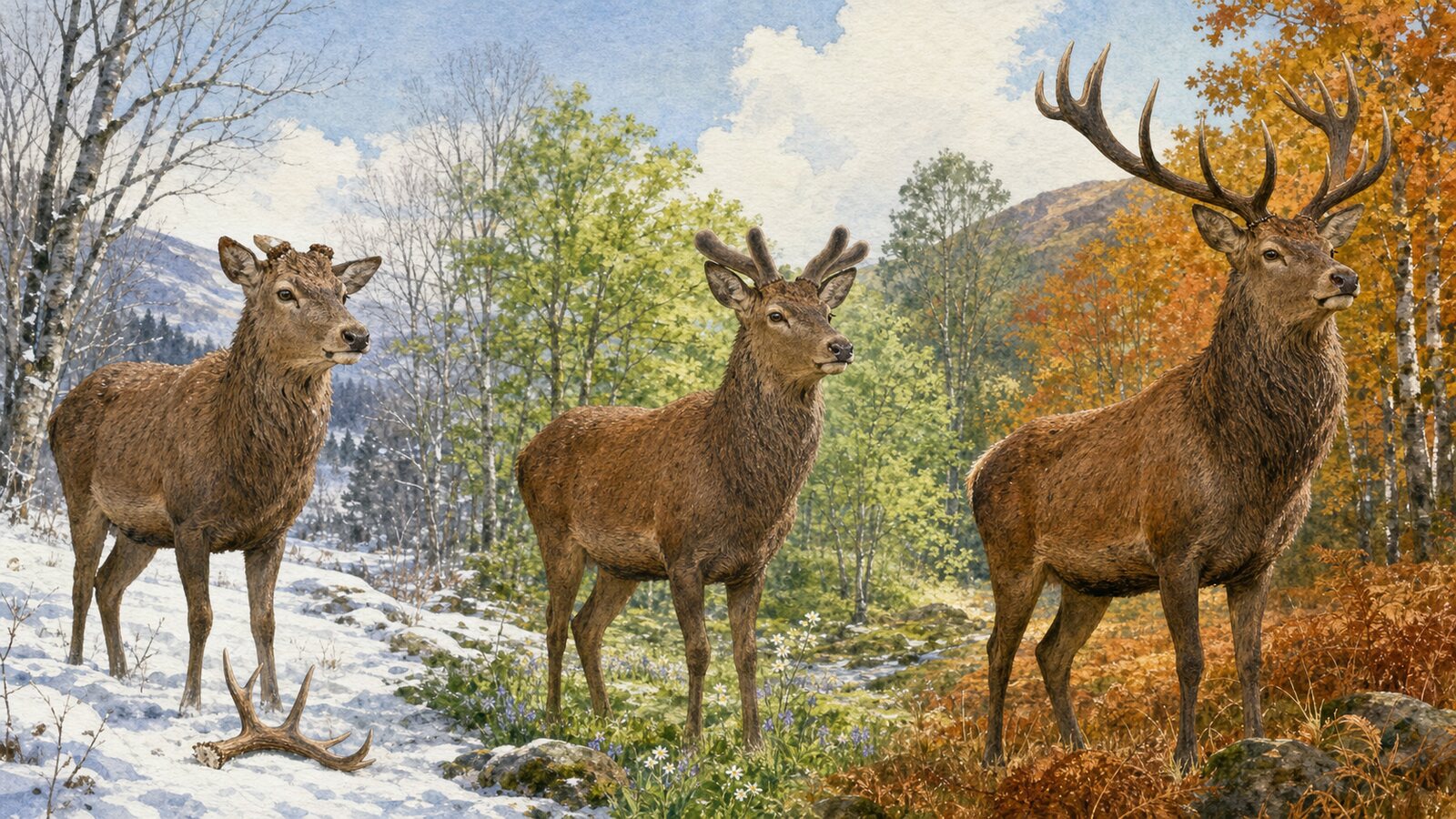
The young antler is covered by velvet, a soft skin rich in blood vessels and nerves. That circulation delivers oxygen, amino acids, minerals, and signaling molecules to rapidly expanding tissue. Cells near the growing tips multiply, a cartilaginous framework develops, and mineralized bone replaces it from within. At this stage the antler is metabolically active living tissue, unlike the dry hard structure seen during the rut. Producing a large set is expensive, so nutrition, age, injury, and general condition can leave visible effects on size and symmetry.
As the breeding season approaches and testosterone rises, elongation stops and mineralization is completed. The velvet loses its blood supply, dries, and is shed, revealing hard bone. A male can then use the antlers in visual assessment, pushing contests, or direct combat with rivals. Once hard, the antler has lost the living skin and vessels that supported growth, so its dimensions are largely fixed for that season. Endocrine timing has changed the same organ from a growing tissue into a breeding-season structure.
Testosterone is a principal timing signal, but it is not a lone master switch. Growth-hormone pathways, local growth factors, nerves, nutrition, and communication among several cell types all contribute to regeneration and ossification. The dates of casting and regrowth vary with species, latitude, age, and health. A sound explanation therefore begins with photoperiod entraining an endocrine cycle, then recognizes that many local signals execute bone resorption, wound healing, cell proliferation, and mineralization.
Discarding so much bone can look wasteful, yet the value and cost of antlers are strongly seasonal. A large branched structure advertises condition and provides leverage in competition, but it is also heavy, nutritionally demanding, liable to damage, and awkward in vegetation. Casting after reproduction concentrates those burdens around the period when the structure is useful. That logic does not prove one exclusive evolutionary advantage; annual replacement emerged under a mixture of sexual selection, survival costs, and the physiology of deer.
Antlers are scientifically striking because they are among the rare mammalian examples of repeated, near-complete regeneration of a large bony appendage. Their cycle links changing daylight to endocrine signals, osteoclast activity at a designed separation zone, wound closure over the pedicle, stem-cell-supported growth under velvet, and final mineralization. The shed antler on the ground is the dead product of the previous season. The regenerative machinery stays with the animal, making casting not a failed attachment but the controlled opening of the next cycle.
EDITORIAL RESPONSIBILITY
FactosBrain Editorial Desk
The FactosBrain Editorial Desk researched and reviewed this article under our editorial policy. We assess error reports under our corrections policy.