Look a little closer
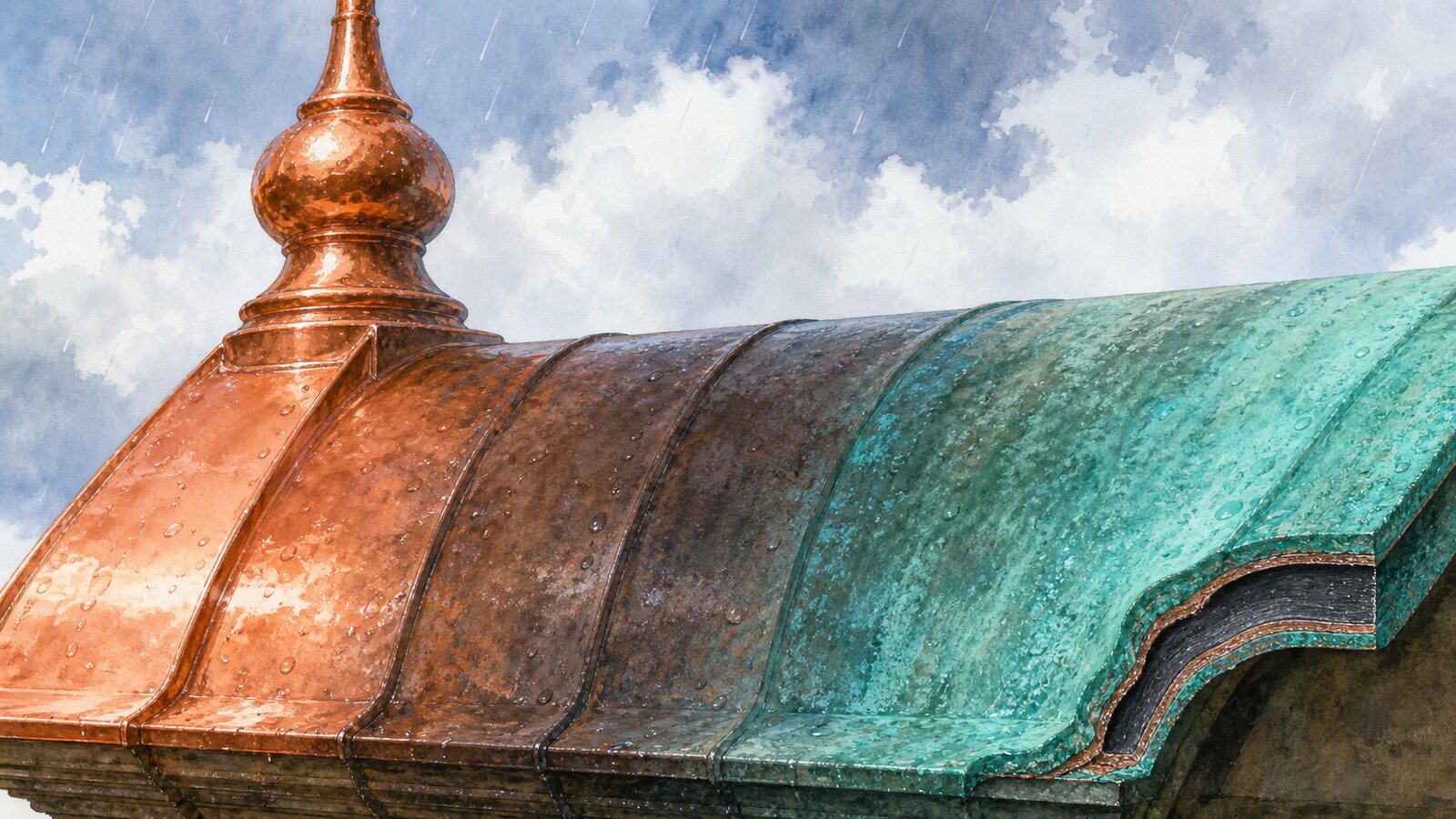
Copper roofs and statues turn green because copper slowly reacts with oxygen, moisture, airborne pollutants, and sea salt to build a layered corrosion surface. The color does not appear in one jump or come from a single universal compound. Fresh reddish copper usually passes through brown and nearly black stages before blue-green sulfates, chlorides, or other minerals grow on the outside, forming what is commonly called a patina.
Polished copper has its characteristic salmon-orange metallic sheen because of the way electrons in the metal interact with visible light. Outdoors, however, a bare copper surface is short-lived. Oxygen first helps form cuprite, copper(I) oxide, which looks red-brown when thin and can make the surface progressively darker. Studies of natural patinas consistently find this cuprite next to the underlying metal as an inner layer.
A film of water too thin to notice then becomes crucial. Rain, dew, or high humidity leaves an electrolyte on the surface, allowing copper ions and substances dissolved from the air to move and react. New crystals precipitate over the existing oxide as wet and dry periods repeat. That is why an exposed roof slope, a sheltered underside, and a groove that holds water may develop different colors and textures even when all three began as the same sheet of copper.
The chemistry of the green outer layer depends strongly on the atmosphere. A study using quantitative X-ray diffraction at 39 outdoor exposure sites found that the dominant sequence on rain-washed copper was cuprite followed by posnjakite and then brochantite. Brochantite is a basic copper sulfate and is common where sulfur-bearing atmospheric compounds contribute to the reaction. In chloride-dominated coastal air, another route involving nantokite and green atacamite, a basic copper chloride, can become important.
The familiar claim that green patina is simply copper carbonate is therefore too neat. Carbon dioxide and carbonate chemistry can participate, and carbonate minerals such as malachite may be present, but research on long-exposed architectural copper often finds sulfates dominant, with chlorides important near the sea. A real patina is also not a perfectly smooth film of one pure substance. It is a heterogeneous stack of crystals that can include particles from dust, neighboring materials, and local pollution.
There is no fixed timetable for the color change. The first brown oxide can become visible within days, weeks, or months, whereas a mature blue-green layer may require years or decades. Moisture, orientation to rain, temperature, salt, pollution, surface slope, and earlier cleaning or coating all alter the rate. Patchy brown, black, and green areas on one roof are often intermediate stages or records of uneven exposure rather than evidence that only part of the metal is genuine copper.
Patina also differs from the loose red rust commonly associated with iron. A compact copper corrosion layer, especially its cuprite base, can slow the movement of oxygen and reactive material and reduce the later corrosion rate. Field studies describe a relatively stable patina acting as a protective barrier under many outdoor conditions. Green is not an automatic certificate of safety, though. Trapped chlorides on copper alloys, acidic runoff, persistent crevices, or contact with a dissimilar metal can sustain localized attack beneath or around an attractive surface.
The word statue introduces another useful qualification. Many monuments casually called copper statues are bronze, an alloy of copper with tin or other elements, and their composition and casting structure can make patination uneven. Artists and conservators may also create a desired patina with heat and chemical solutions, then manage it with wax or coatings. An intentionally colored sculpture in a museum collection does not necessarily tell the same chemical story as a roof that weathered naturally for a century.
A green copper surface is therefore a thin mineral record of the air and water around the object. Cuprite usually establishes the dark inner foundation, and environment-specific sulfates, chlorides, and related compounds accumulate above it until blue-green tones dominate what we see. Reading the color carefully reveals more than the age of the metal: it can preserve clues about rain exposure, shelter, urban emissions, coastal salt, and the long sequence of conditions the object has endured.
EDITORIAL RESPONSIBILITY
FactosBrain Editorial Desk
The FactosBrain Editorial Desk researched and reviewed this article under our editorial policy. We assess error reports under our corrections policy.