Look a little closer
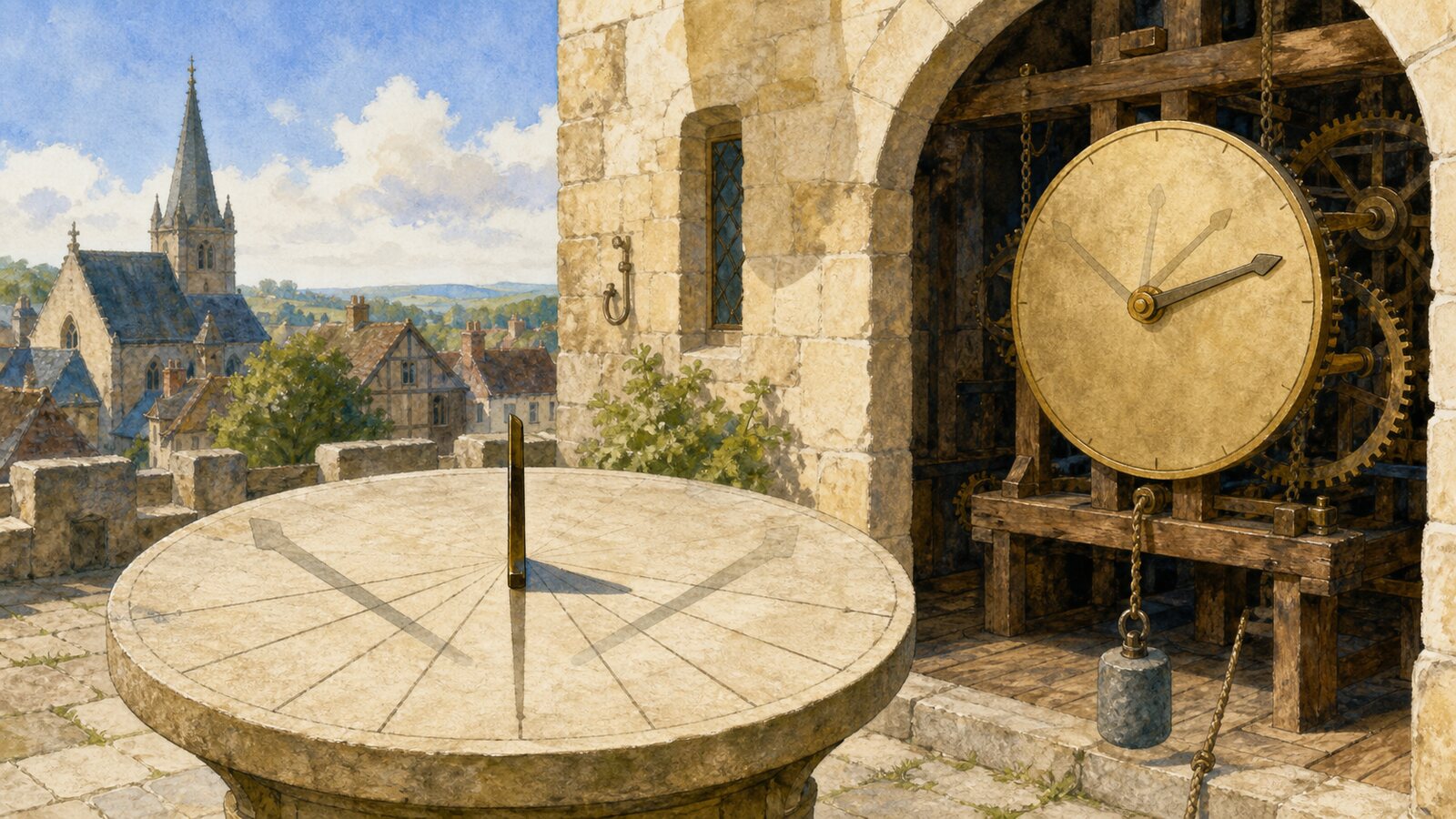
Clock hands turn in their familiar direction not because gears must rotate that way, but most plausibly because mechanical dials inherited a motion familiar from horizontal sundials in the northern mid-latitudes. As dial clocks developed in Europe, that choice became conventional and eventually standard. Only after clocks made the motion widely recognizable did the direction itself acquire the everyday name clockwise.
At northern mid-latitudes, the Sun rises in the east, crosses the southern part of the sky, and sets in the west. The shadow of a vertical stick points away from the Sun, so it lies generally westward in the morning, northward around local noon, and eastward in the afternoon. Viewed from above with north at the top of a dial, that path runs from the modern nine o'clock side through twelve toward three—the same sense as a clock hand.
The shadow-casting part of a sundial is called the gnomon. A vertical stick can reveal the passage of a day, but seasonal changes in the Sun's height complicate where its shadow falls. On a more accurate horizontal dial, the gnomon's working edge is aligned parallel to Earth's rotation axis, pointing toward the appropriate celestial pole. The shadow then represents the Sun's hour angle consistently, although the spacing of hour lines must be constructed for the dial's latitude.
Sundials long predate mechanical clocks. The Science Museum traces the oldest known example to Egypt around 1500 BCE and describes sundials scratched into medieval European church walls to schedule worship. When the first mechanical clocks appeared in Europe in the late thirteenth century, sundials did not vanish. Early mechanisms were inaccurate and prone to stopping, so solar observations continued to provide a reference for setting and correcting them.
Those first mechanical clocks did not necessarily resemble a modern wall clock. Weight-driven mechanisms and escapements created intervals and struck bells; broadcasting the hour by sound could matter more than displaying it. As visible dials and rotating hands were added, makers needed a direction in which the indication would advance. Matching a familiar northern horizontal sundial gave readers an intuitive visual sequence for a new machine.
There is no securely documented moment when one clockmaker officially decreed the direction for everyone. Medieval tower and astronomical clocks varied in layout and could contain indicators that moved in different ways. The sundial connection is therefore better stated as a strong historical explanation than as a single proven act of copying. Northern shadow practice, European mechanical clockmaking, and later standardization fit together, but the convention emerged across workshops and places rather than from one surviving order.
Nor does every sundial everywhere turn in the modern clock direction. On a correctly oriented horizontal dial in much of the Southern Hemisphere, the Sun crosses the northern sky and the shadow's progression is reversed. Near the equator, the noon Sun can lie to the north or south depending on season. Vertical, declining, and other specialized dials project motion onto different planes, so their shadows need not mimic a familiar clock face. The convention came from a common regional form, not a universal law of shadows.
A mechanical clock could easily be designed to run the other way. Adding a gear stage or rearranging a train reverses an output shaft, and an electric clock can likewise be built for either rotation. Popular explanations based on right-handedness or the direction of reading miss the central timekeeping connection. Once many public dials shared one orientation, consistency made clocks easier to read, teach, repair, and compare, giving later makers little reason to reverse it.
Pendulum clocks in the seventeenth century greatly improved timekeeping, and nineteenth-century railways later helped replace local solar time with shared standards. Yet those changes altered accuracy and coordination, not the visual direction readers already knew. A clock hand's sweep is therefore not a fundamental arrow built into time. It is a durable historical trace of northern sunlight, the geometry of a horizontal dial, and European mechanical practice becoming a global visual convention.
EDITORIAL RESPONSIBILITY
FactosBrain Editorial Desk
The FactosBrain Editorial Desk researched and reviewed this article under our editorial policy. We assess error reports under our corrections policy.