Look a little closer
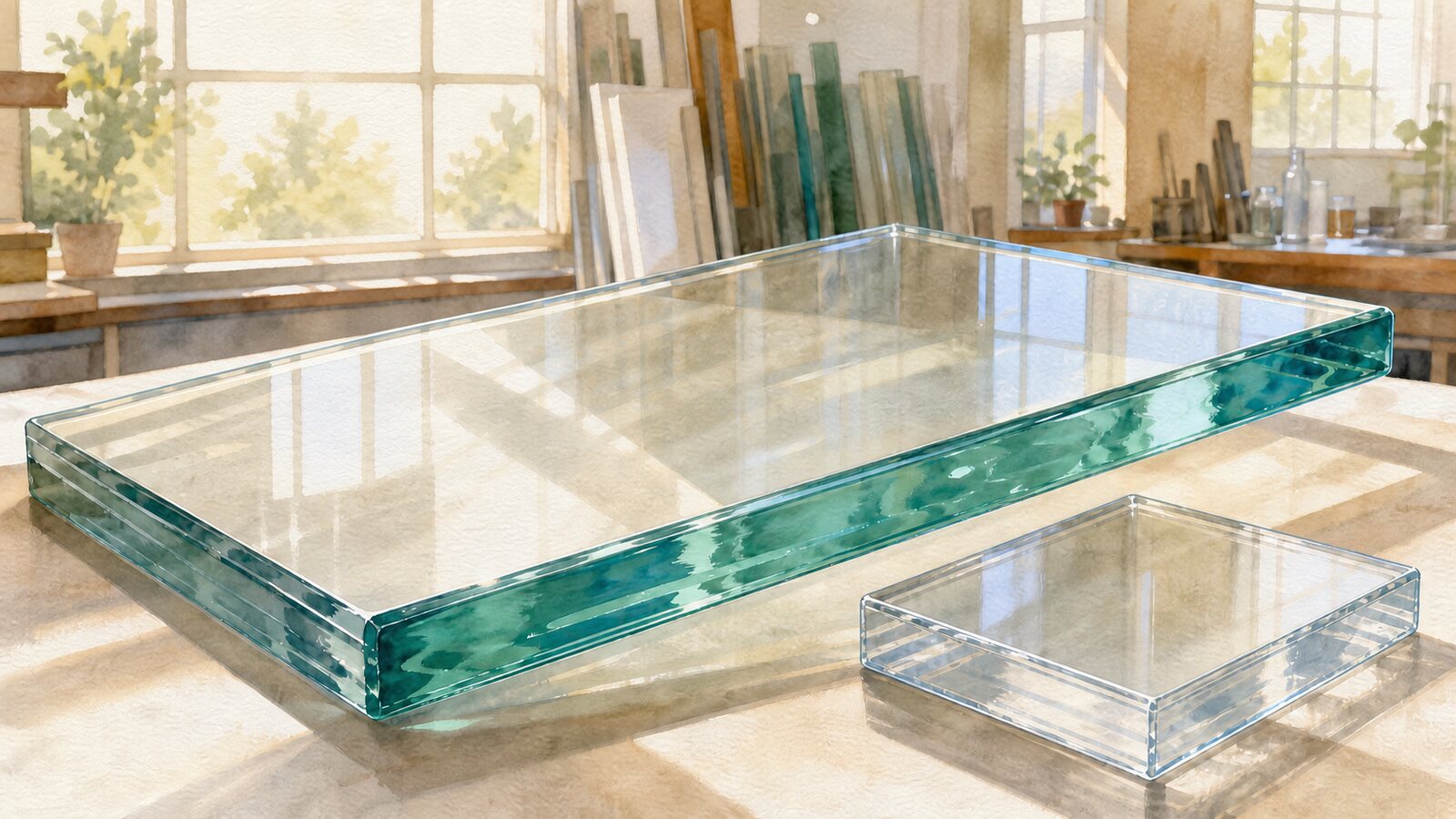
The edge of an ordinary clear window or glass tabletop looks green because trace iron in the glass absorbs some wavelengths more strongly than others. Face-on, light may cross only a few millimeters, so the color shift is faint. Along a polished edge, light can travel through many centimeters of the same material, allowing a tiny selective absorption to accumulate into a conspicuous blue-green tint.
Most flat glass used in buildings and furniture is soda-lime-silica glass, made chiefly from silica sand, soda ash, and limestone. Even after processing, sand can retain small amounts of iron compounds; recycled cullet and other raw materials can contribute more. In this context, clear means that the pane transmits a high proportion of visible light. It does not mean every visible wavelength passes in exactly the same proportion or that the material is chemically free of color-producing ions.
Iron does not occupy only one chemical state in the glass. Ferrous and ferric ions interact with different parts of the spectrum, and their proportions depend on composition and furnace conditions. Ferrous iron is an important contributor to absorption toward the red and near-infrared, leaving transmitted light biased toward blue-green, while ferric iron adds different absorption toward ultraviolet and shorter visible wavelengths. Total iron, oxidation state, and other trace ingredients together determine the observed shade. The explanation is not that rust-colored particles simply paint the pane green.
The edge effect is about optical path length, not iron collecting at the perimeter. At a fixed concentration, more absorbing material lies in the path when light travels farther, so transmission falls progressively. Viewed through the broad face, the path is approximately the pane's thickness. Viewed into a polished edge, a ray may cross a substantial fraction of the pane's width or length, and internal reflections can extend the journey. A slight wavelength imbalance that is almost invisible after several millimeters becomes obvious after many centimeters.
Thickness and stacking produce the same trend. Thin picture glass against white paper may seem essentially colorless, whereas a heavy tabletop, aquarium wall, laminated rail, or pile of sheets can show a green cast even through the face. The edge offers the easiest visual test because it presents a long route through the body of the pane. No special green layer has formed there, and polishing compound is not normally responsible. The edge reveals a weak color already distributed through the glass.
Low-iron glass reduces the effect at its source. Manufacturers select purer, iron-poor silica and control raw materials so that visible transmission is higher and more color-neutral. Its thick edge can appear pale blue or nearly colorless beside the saturated edge of standard float glass. Museums, display cases, storefronts, thick architectural panels, and solar applications may use it when faithful color or high transmission matters. Low-iron does not necessarily mean zero iron, so a residual tint can remain depending on thickness and illumination.
Deliberately tinted glass is a related but different product. Manufacturers can add metal oxides or change oxidation conditions to make deeper green, blue, gray, or bronze material. Because these colorants are mixed into the melt, the body color extends throughout the thickness. Surface coatings can instead alter reflection, glare, ultraviolet transmission, or solar heat without being the same as body tint. The faint green edge of standard clear glass should not be confused with a dark pane engineered for solar control.
Appearance also depends on coatings, laminating interlayers, reflections, lighting, and the color of the surroundings. Tempering does not by itself turn an otherwise identical pane into a different body color, although processing and surface effects may change its visual impression. An interlayer can add its own cast. A green edge alone cannot establish strength, safety class, age, or ultraviolet performance; those properties require markings, standards, and product documentation.
Clear is therefore a practical description of high transmission over a short path, not proof of perfect colorlessness. Trace iron makes wavelength transmission slightly unequal, and the long journey seen through an edge magnifies that difference until green becomes visible. The composition of the pane has not changed at the perimeter. What changes is how much glass the light crosses before reaching the eye, turning a nearly invisible absorption into the familiar emerald line around a transparent sheet.
EDITORIAL RESPONSIBILITY
FactosBrain Editorial Desk
The FactosBrain Editorial Desk researched and reviewed this article under our editorial policy. We assess error reports under our corrections policy.