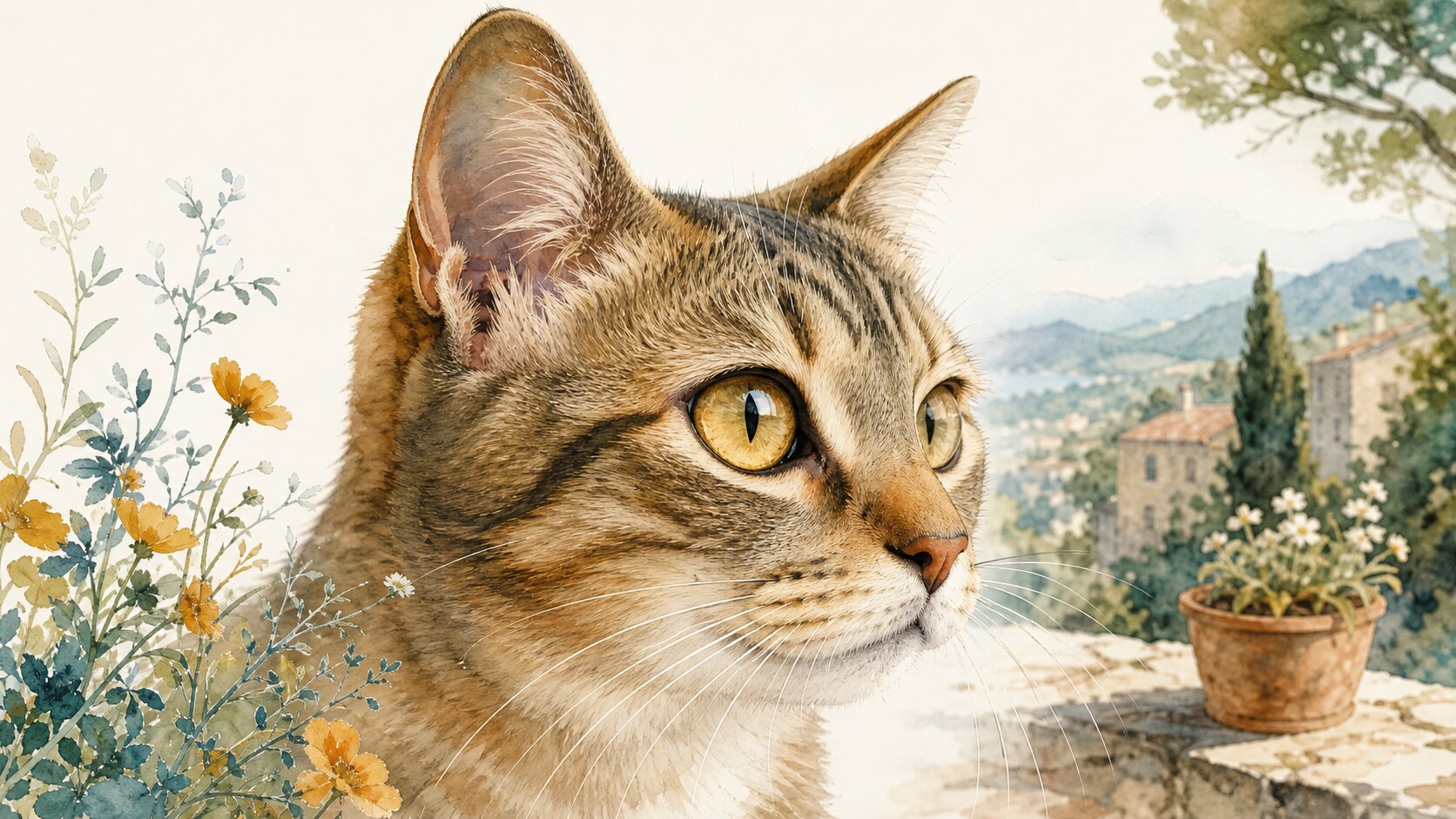
In bright light, a domestic cat's pupil narrows to a black vertical line. The shape is not decoration. A pupil is the opening that regulates how much light enters the eye, and a vertical slit is closely associated with the life of a small ambush predator that operates near the ground in both bright and dim conditions.
One advantage is an unusually large range of light control. In the comparative research described by UC Berkeley, the area of a domestic cat's pupil changed about 135-fold between its most constricted and most dilated states. The comparable change in a human's round pupil was about 15-fold. A cat can therefore admit much more light in darkness while sharply limiting glare during the day.
Light control alone does not explain why the slit is vertical rather than horizontal. The researchers focused on two cues used to judge distance: binocular disparity, the difference between the two eyes' views, and defocus blur, the way contours soften when they fall outside the plane of focus. Front-facing eyes combined with vertical pupils may make both cues useful at close range.
That combination matters most to a short hunter crouching before a precise pounce. In a comparison of 214 terrestrial species, vertical pupils were strongly associated with ambush predators active during both day and night. Of 65 front-eyed ambush predators in the sample, 44 had vertical pupils, and 36 of those stood less than 42 centimeters high at the shoulder. Domestic cats fit this pattern well.
Not every feline has the same pupil. Taller cats such as lions and tigers have round pupils, while many grazing prey animals have horizontal pupils that support a broad view along the ground. Pupil shape is therefore not a simple label for predator or prey. Eye height, activity schedule, habitat and hunting method all help determine which optical tradeoffs matter.
The study identifies cross-species associations and tests an optical explanation; it did not experimentally swap pupil shapes in cats and measure hunting success. Animals that live in water, air or trees may also face different visual demands. Even with those limits, the evidence supports a careful conclusion: a cat's vertical pupil is part of a visual system tuned to handle changing light and estimate the distance of prey during a ground-level ambush.
EDITORIAL RESPONSIBILITY
FactosBrain Editorial Desk
The FactosBrain Editorial Desk researched and reviewed this article under our editorial policy. We assess error reports under our corrections policy.