Look a little closer
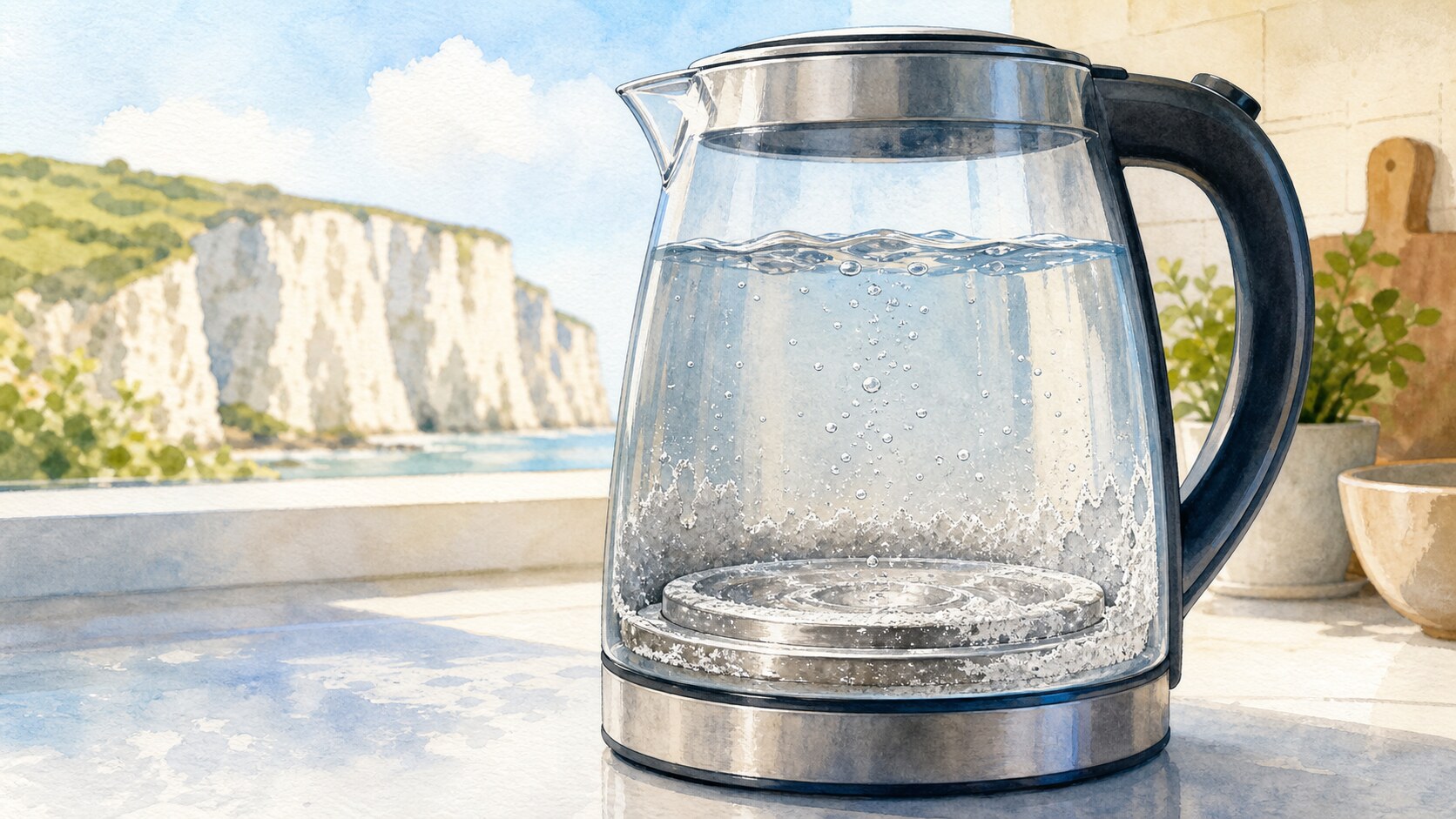
The white rim and brittle flakes inside a kettle are usually limescale: mineral matter that was dissolved in the water and later precipitated as a solid, chiefly calcium carbonate. Hard water supplies calcium, magnesium, and bicarbonate ions. Heating drives dissolved carbon dioxide out of the water and shifts the carbonate balance, so some calcium can no longer remain dissolved. Boiling does not add a mysterious white substance; it makes previously invisible dissolved material separate into visible crystals.
Those minerals began their journey before the water reached a pipe. Rainwater absorbs a little carbon dioxide from air and much more from soil, becoming mildly acidic. As it moves through limestone, chalk, or dolomite, it dissolves calcium and magnesium compounds and carries their ions into groundwater. The U.S. Geological Survey defines water hardness mainly by the concentration of dissolved calcium and magnesium. Supplies drawn from carbonate-rich aquifers are therefore often harder than water that has had little contact with those rocks. A clear glass of tap water can be carrying a small, unseen record of the ground beneath a region.
Heat disturbs the chemical system that keeps that record in solution. In cooler water, dissolved carbon dioxide and bicarbonate help calcium remain mobile. As temperature rises, carbon dioxide becomes easier to release into the air. Losing that gas changes the acid–carbonate equilibrium, increasing the conditions under which carbonate combines with calcium and forms poorly soluble calcium carbonate. A Royal Society of Chemistry demonstration makes temporary hard water, boils it, and obtains a cloudy white calcium-carbonate precipitate. The familiar bubbles and the developing scale are thus linked to the same change in the water rather than being unrelated effects of boiling.
Deposits favor the heating plate, the hottest sections of metal, and the wet-and-dry line. Close to a hot surface, carbon dioxide escapes readily and the solution can become supersaturated with calcium carbonate. Microscopic scratches and older crystals provide nucleation sites on which new mineral can grow. Repeated boiling adds another effect: water vapor leaves, but nonvolatile ions remain. Topping the kettle up supplies a fresh mineral load, while evaporation concentrates what is already there. A dusting can consequently become a coherent crust and then break away as pale flakes.
Boiling does not remove every kind of hardness. Hardness associated with calcium or magnesium bicarbonate is traditionally called carbonate or temporary hardness because heating can precipitate part of it. Non-carbonate hardness, involving ions such as sulfate or chloride, does not disappear through the same simple boiling process and is often called permanent hardness. Real deposits are not guaranteed to be pure calcium carbonate either. Magnesium compounds, silica, iron, and other material can join the scale and alter its color or texture. A gray or tan deposit cannot be identified precisely from appearance alone.
A thick mineral layer is more than a cosmetic annoyance. Calcium-carbonate scale conducts heat much less effectively than exposed metal, placing an insulating barrier between a heater and the water. That can lengthen heating time and increase energy use. In water heaters, boilers, narrow pipes, valves, and sensors, accumulation can also restrict flow or interfere with operation. Yet a few white flakes in a kettle do not by themselves show that the water is microbiologically unsafe. Hardness and microbial contamination are different water-quality properties, and evidence of one cannot diagnose the other.
Hard water is also not automatically a health hazard. World Health Organization material describes calcium and magnesium as the principal contributors to hardness and does not establish a health-based guideline value for hardness itself. Both elements are essential nutrients, and drinking water can make a contribution to intake. That statement should not be stretched into reassurance about every unusual residue. A sudden change in color or odor, metallic debris, or a local water-quality notice calls for information from the supplier or public-health authority rather than an assumption that ordinary limescale explains it.
Weak acids can remove carbonate scale because they reverse part of the chemistry. When acid reacts with carbonate, calcium returns to a more soluble ionic form and carbon dioxide bubbles may be released. This is why vinegar- or citric-acid-based descalers can work. Kettle materials, coatings, seals, and sensors differ, however, so concentration and contact time should follow the manufacturer's instructions, and cleaning products should not be mixed. Ion-exchange softeners or processes that remove dissolved minerals can reduce the raw ingredients of scale. A simple particle filter, by contrast, does not necessarily capture calcium that is still present as dissolved ions.
The pale ring in a kettle is a miniature geological cycle joining rock, air, water, and heat. Carbon-dioxide-rich water dissolves mineral from the ground and transports it invisibly; heating releases gas and lets some of that mineral become stone-like solid again. The amount of scale therefore reflects source-water chemistry, boiling frequency, evaporation, and the condition of the surface—not housekeeping alone. What looks like residue left behind by vanished water is better understood as dissolved geology becoming solid enough to see.
EDITORIAL RESPONSIBILITY
FactosBrain Editorial Desk
The FactosBrain Editorial Desk researched and reviewed this article under our editorial policy. We assess error reports under our corrections policy.