Look a little closer
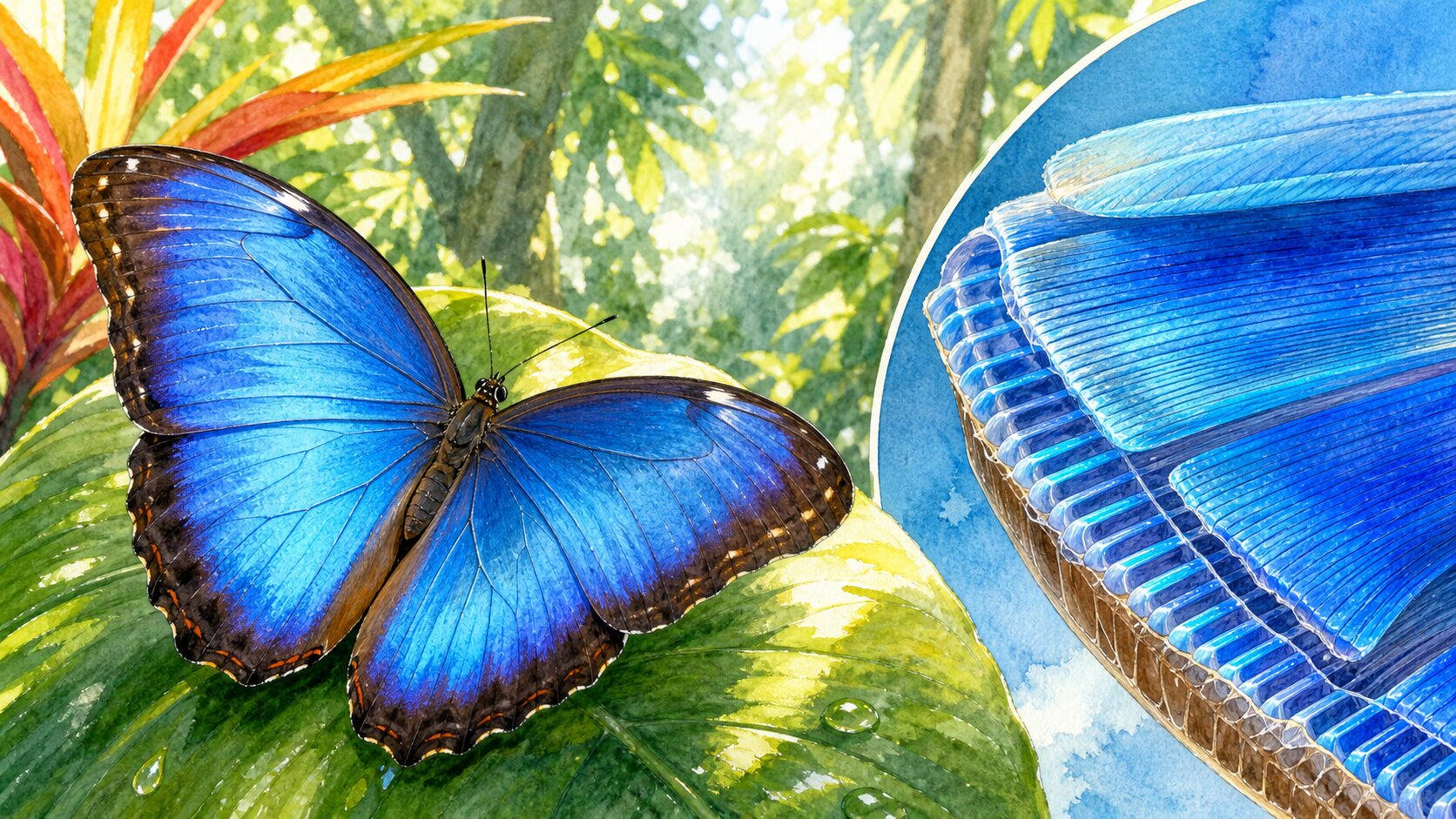
The brilliant blue of a Blue Morpho butterfly does not come from blue paint in its wings. It is largely structural color: tiny features in the wing scales return selected wavelengths of white light to an observer, making the wing look intensely blue. The same broad principle helps explain the shifting colors of soap bubbles and peacock feathers. In structural color, the route light takes through a material can matter as much as the material's chemical pigments.
Butterfly wings are covered by countless overlapping scales. In Morpho butterflies, some scales carry ridges with thin, shelf-like layers extending from them. Chitin and air are arranged at dimensions comparable to visible wavelengths. Light reflects from many of those boundaries. When reflected waves of a particular wavelength arrive in step, they reinforce one another; when other waves arrive out of step, they are weakened. The geometry can therefore favor strong blue reflection under white illumination.
This is more subtle than a tiny blue mirror. The reflected color and brightness depend on layer number, thickness, spacing, refractive-index contrast, illumination angle, and viewing angle. A fluttering Morpho can seem to flash blue and then disappear because the direction of strongest reflection changes as its wing turns. From another angle, the same surface may look darker or brownish. That angle dependence is called iridescence in many structural-color systems, though the exact effect differs among species and structures.
Structural color does not mean pigment is absent everywhere. Many butterflies use dark or brown pigments to absorb unwanted light and increase contrast around a structural reflection. In Blue Morphos, the scale architecture is central to the famous blue, but darker layers and neighboring scales help determine how saturated it appears. The useful question is not simply pigment versus structure; it is how pigments, layers, air spaces, and geometry work together to control light.
Butterflies build structural color in several ways. Some tune a thin film, while others use multilayer ridges, perforated layers, or three-dimensional photonic crystals. Comparative research has catalogued hundreds of optical nanostructures in butterfly scales. Blue-producing structures appear in many lineages, whereas vivid long-wavelength structural reds are much rarer. Wing color is therefore a record of both evolution and physical constraints on what microscopic architecture can make light do.
Perfect repetition is not always the best biological design. A completely regular optical lattice can confine a reflection to an extremely narrow angle. Morpho-scale ridges include small variations that spread strong blue reflection across a useful range of directions, helping produce a visible flash during flight. The result is a balance between optical order and controlled irregularity rather than a simple perfect mirror.
The biological function also depends on the viewer. A bright reflection may help signal to a mate, yet it can also be noticed by a predator. Birds and butterflies do not necessarily see the same wavelengths or contrasts that people do. Differences between a vivid upper wing and a patterned, brownish lower wing can therefore support different needs in flight and at rest.
The scales interest engineers because they suggest color without conventional dyes, angle-dependent security features, chemical sensors, and low-energy display surfaces. Copying a wing is not automatically a product, however. A butterfly grows a very light structure over a small area; manufacturing must reproduce accurate dimensions across a durable, large surface. Angular color can be an advantage for a signal but a drawback for a uniform coating or screen.
A Morpho's blue is best understood as a structure that makes blue light conspicuous, not as blue substance alone. Its chitin-air boundaries arrange reflected light so some blue wavelengths are amplified. Damage or a change in the material filling the air spaces can change the optical result. The wing is a remarkably thin biological optical device, built on a scale too small for the unaided eye to see, yet precisely organized enough to direct light under changing natural conditions in sustained active flight.
EDITORIAL RESPONSIBILITY
FactosBrain Editorial Desk
The FactosBrain Editorial Desk researched and reviewed this article under our editorial policy. We assess error reports under our corrections policy.