Look a little closer
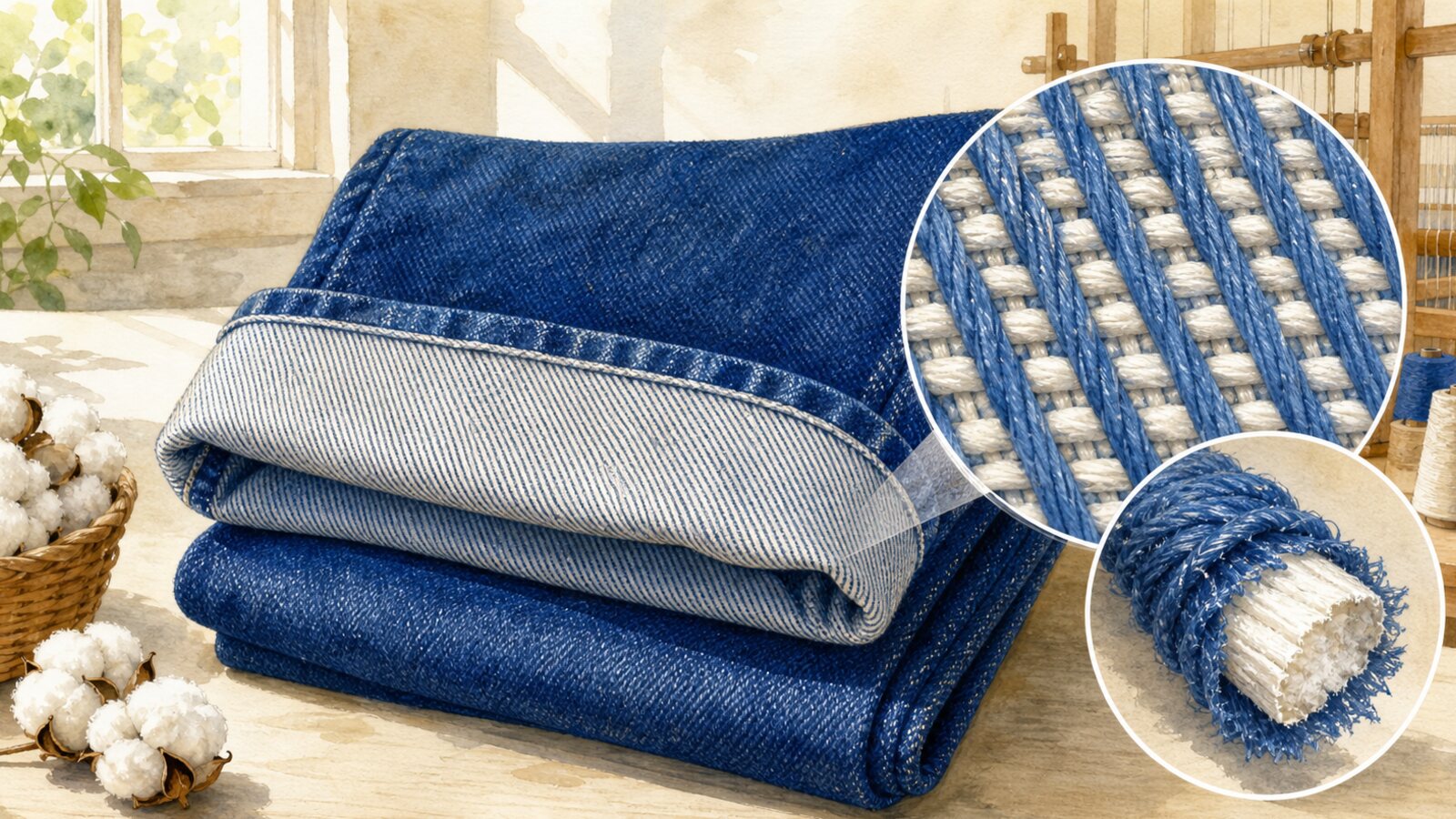
Classic blue jeans look dark on the outside and pale on the inside because the fabric is usually woven with indigo-dyed lengthwise yarns and undyed crosswise yarns. The weave exposes more of the blue yarn on the face and more of the white yarn on the reverse. Indigo also tends to concentrate near the outside of each dyed yarn instead of coloring its center uniformly, so a second pale layer is hidden inside the blue threads themselves.
The lengthwise yarns held under tension on a loom are the warp; the yarn that travels across them is the weft, also called the filling. Traditional blue denim combines a blue warp with a white or natural-colored weft in a twill weave. Twill sends yarns over and under one another in an offset sequence, producing the familiar diagonal ribs. Common jean denim is warp-faced, meaning that the warp covers a larger share of the fabric's face. Turn the cloth over and the crossing weft becomes much more conspicuous, which is why a rolled cuff appears pale and striped rather than solid blue.
Indigo has to undergo a chemical change before it can color cotton. The familiar blue form is nearly insoluble in water, so dyers reduce it to a pale, soluble form that can enter and coat the yarn. When the wet yarn leaves the bath and meets oxygen, the dye oxidizes back to insoluble blue indigo and remains on the fibers. Repeated dips and periods of oxidation build a deeper shade. The visible blue is therefore produced during exposure to air, not simply absorbed as a ready-made blue liquid.
Denim dye ranges are commonly adjusted to keep much of that color near the yarn surface. Short cycles of dipping and oxidation create what textile specialists call ring dyeing: a cross-section can show a strongly colored outer ring around a white or lightly dyed core. Bath chemistry, pretreatment, yarn twist, immersion time, and the desired finish all affect the depth of penetration, so the boundary is not identical in every yarn. Still, surface-heavy indigo is a defining tool for making traditional denim age with contrast.
Wear reveals this construction in stages. Knees, thighs, pocket edges, hems, and creases repeatedly bend and rub against skin, other cloth, seats, and the washing machine. As outer cotton fibers and their indigo are abraded or washed away, less-dyed fibers within the warp yarn become visible. Continued wear can expose more of the pale weft underneath as well. Pressure is uneven across a moving garment, so the change does not occur as a flat, uniform loss of color. Folds and high-contact zones develop bright lines while sheltered areas remain dark.
The pale reverse is therefore not merely evidence that blue dye accidentally failed to soak through a finished sheet of cloth. Three design choices work together: only one yarn system is normally dyed, the twill puts different proportions of those yarns on the two faces, and the dye is concentrated toward the outside of the blue yarn. The fine blue diagonal marks that remain visible inside a cuff are the dyed warp crossing the reverse. The light field around them comes mainly from undyed weft.
Not every fabric sold as denim follows this recipe. Black, gray, or colored denim may use other dyes. Some materials are garment-dyed after sewing, overdyed, coated, or made with both warp and weft colored, reducing the face-to-back contrast. Blends containing polyester or stretch fibers can wear differently from all-cotton cloth. A dark reverse does not prove that jeans are inauthentic, and a white yarn core does not prove that natural plant indigo was used. Most modern blue denim is colored with synthetic indigo that has the same key molecular behavior.
The year 1873 is important to jeans history, but it is not the birthday of denim or indigo dyeing. Levi Strauss and Jacob Davis received a United States patent for reinforcing work trousers with metal rivets at stress points. Cotton twills and indigo textiles were older. Riveted construction, durable denim, and the distinctive way indigo wears later converged in the garment now recognized around the world. Rivets explain why early work trousers resisted tearing at pockets; the yarn and weave explain why their two sides looked different.
A pair of jeans is thus a fabric designed to reveal its structure gradually. Blue warp on the face, pale weft on the reverse, and a lighter core within the warp emerge at different rates as the garment is used. Deep indigo becomes blue-gray and then nearly white where abrasion is greatest. The resulting fades are not only a symptom of weak colorfastness. They are a record of motion written into a textile whose outside and inside were never colored alike in the first place.
EDITORIAL RESPONSIBILITY
FactosBrain Editorial Desk
The FactosBrain Editorial Desk researched and reviewed this article under our editorial policy. We assess error reports under our corrections policy.