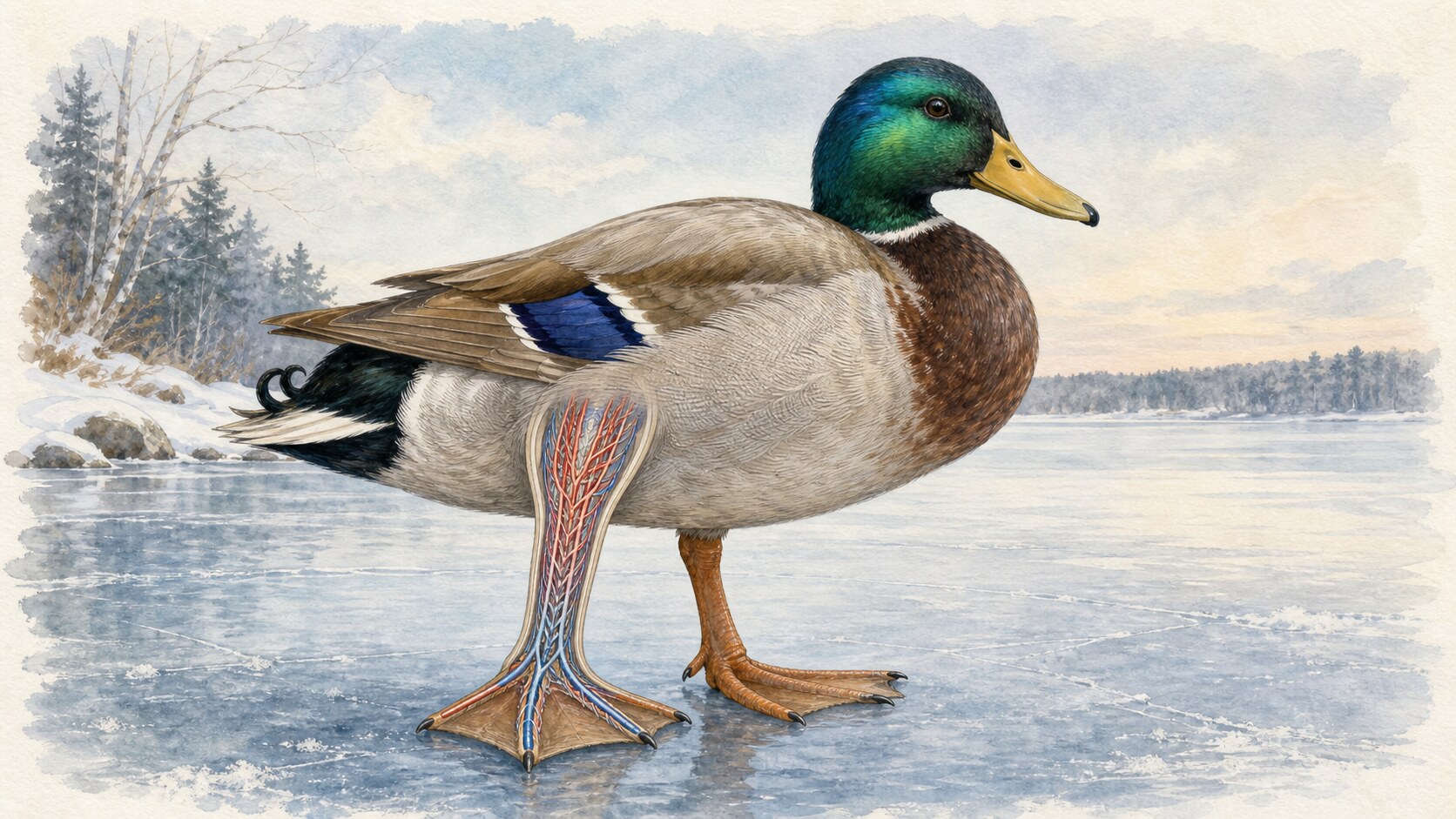
When a duck or gull stands on ice, its feet are not warm like its torso. The bird instead uses regional heterothermy: it maintains a high core temperature while allowing its feet to approach freezing. A smaller temperature difference between foot and ice means less heat escapes to the surroundings.
Inside the leg, arteries carrying blood away from the core run close to veins returning from the foot. As the streams travel in opposite directions, heat passes from the warmer arterial blood to the cooler venous blood in a countercurrent exchanger. Blood returning to the body is warmed while blood entering the foot is precooled.
This transfer prevents the bird from delivering core-temperature blood all the way to the sole and immediately losing that heat. Circulation is not shut off, however. Living tissue still needs oxygen and nutrients. A limited supply continues, and periodic increases in flow can help keep tissue from falling to a damaging freezing temperature.
Control of the blood vessels matters too. In cold conditions, constriction and vascular shunts restrict warm flow near the leg surface; in heat, increased flow can turn an unfeathered leg into a radiator. An infrared study of 14 wild bird species found that leg surfaces became cooler than plumage surfaces in cold air, evidence of active heat conservation.
Bird feet also contain relatively little bulky muscle and nerve tissue and are composed largely of bone and tendon. There is therefore less metabolically active tissue that must be maintained at a high temperature than in a human foot or a bird's core. This anatomy works alongside circulation rather than replacing it.
Behavior provides another layer of protection. A bird can alternate tucking one foot into its feathers, crouch so belly plumage covers both feet, or choose a site sheltered from wind. Species differ in leg length, feather coverage and habitat, so they do not all rely on these responses to the same degree.
These adaptations are not an absolute shield against frostbite. Severe cold, wind, wetness, prolonged exposure, poor nutrition or illness can push heat balance beyond its limits. The successful strategy is not to make a foot hot; it is to regulate blood flow and heat transfer so the foot remains cold but viable while the whole bird conserves energy.
EDITORIAL RESPONSIBILITY
FactosBrain Editorial Desk
The FactosBrain Editorial Desk researched and reviewed this article under our editorial policy. We assess error reports under our corrections policy.