Look a little closer
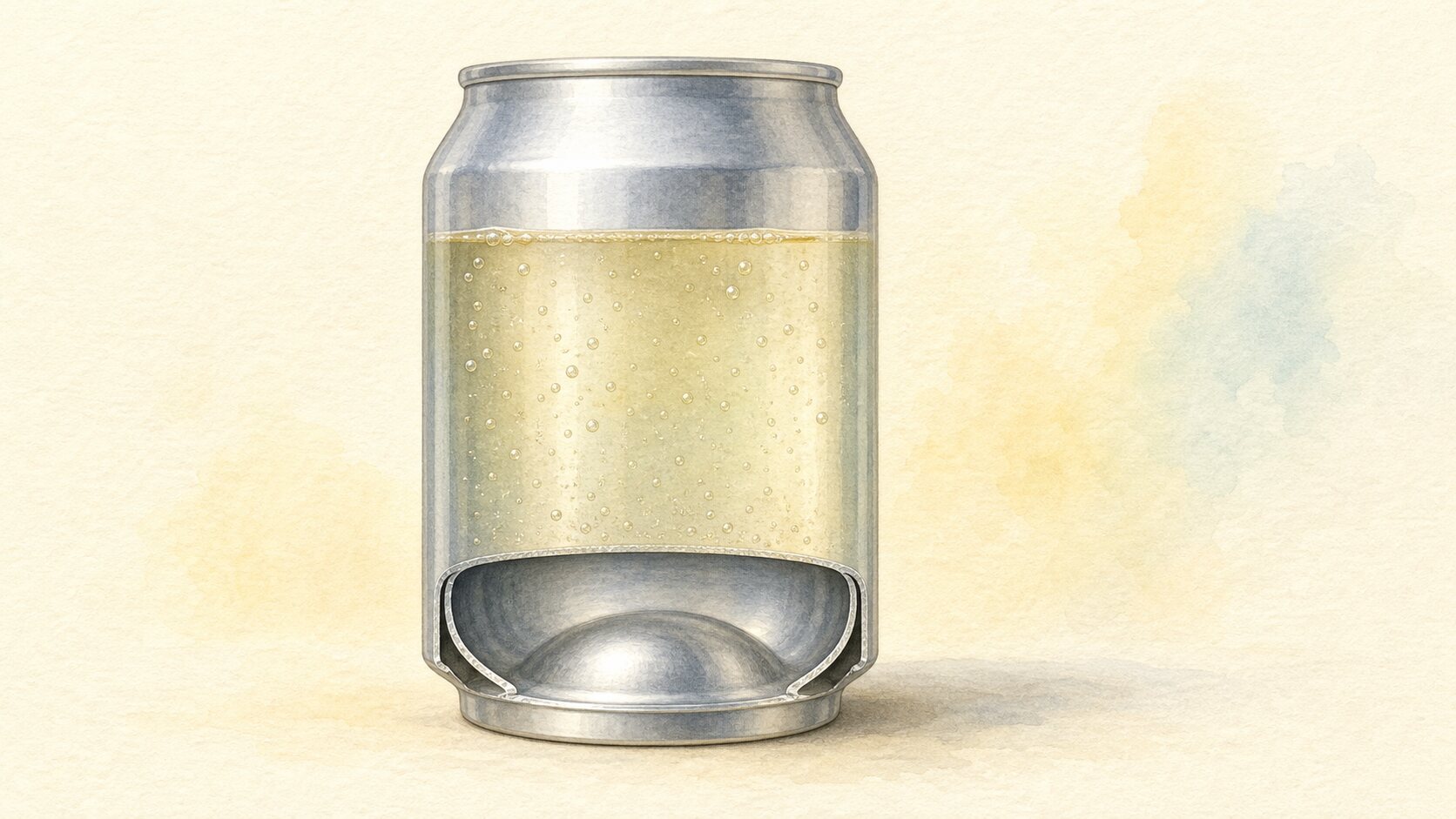
Turn a beverage can upside down and its center is not flat. It is recessed, while a firm circular ring around the edge is the part that actually meets the table. That inward dish is not a dent left by a factory accident. Engineers call the formed base a dome. It helps a very thin aluminum container resist pressure and handling forces while still standing steadily on a shelf, a table, or a conveyor.
The need is especially easy to see with a carbonated drink. Dissolved carbon dioxide and the gas above the liquid create pressure inside the sealed can. Pressure pushes on the sidewall and the base in every direction. A thin, perfectly flat base would tend to flex outward at its center. If it bulged enough, the can could wobble and the shape might not return when the pressure changes. Forming the base into a recessed dome gives the force a curved path through the metal rather than asking a flat sheet to carry the load by bending alone.
The comparison with an arch or a curved roof is useful, provided it is not taken too literally. A curved shell can distribute load around its surface and into the surrounding ring more efficiently than a flat panel of the same thin material. The dome does not make pressure disappear. Can designers choose its depth, curvature, support-ring profile, and local metal thickness together, then test the result. One critical failure mode is dome reversal: internal pressure drives the normally recessed base outward, changing its shape and undermining stable standing.
The outer ring at the bottom has a second job. It creates a stable contact circle, so the can can sit upright even though the center is raised inside the container and recessed from the outside. It also reinforces the transition from the cylindrical wall to the base and helps carry vertical loads when filled cans are stacked. A manufacturer could make a broad, flat, thick bottom instead, but that would require more metal. A dome-and-ring design can reach the required strength and stability with less aluminum, an important result when billions of containers are made.
An empty can reveals how much geometry matters. Its wall is thin enough that it can be dented easily by hand. A sealed pressurized can is stiffer because internal pressure puts the cylindrical shell under tension, a little like air making a balloon firm. Yet pressure is not the can's only defense. Filling, sealing, shipping, and stacking also create vertical loads, so the base is engineered for both internal pressure and axial loading. Small changes in the formed dome are therefore meaningful quality-control details, not merely cosmetic variation.
Not every drink is strongly carbonated, and not every can base has the same dimensions. Still, many mass-produced beverage cans use related formed-base designs because manufacturing compatibility, transport impacts, stacking, and material efficiency matter across products. A recessed base by itself is normal and does not mean a can is defective or dangerously overpressurized. By contrast, a base that has visibly popped far outward, a leaking can, or a severely distorted seam is no longer behaving as designed and is best set aside rather than opened or consumed.
The hollow-looking center is therefore not space sacrificed to make the can hold less drink. It is structural room: a carefully shaped part of a lightweight pressure container. Along with the support ring, it keeps the can stable, helps it resist the forces created by its contents, and reduces the amount of metal needed to do that work. The feature also illustrates a broader engineering lesson: when a thin sheet must carry a load, changing its shape can be more effective than merely making it thicker. It belongs to the same family of decisions as the can's cylindrical sidewall. Once you notice it, the bottom of a can becomes a compact example of engineering by shape rather than simply adding more material.
EDITORIAL RESPONSIBILITY
FactosBrain Editorial Desk
The FactosBrain Editorial Desk researched and reviewed this article under our editorial policy. We assess error reports under our corrections policy.